
Tesla's Structural Fortitude: Why Declining Deliveries Mask Long-Term Dominance
The first quarter of 2025 brought unwelcome news for TeslaTSLA-- investors: a 13% year-over-year drop in deliveries to 336,681 vehicles, followed by a further 14% decline in Q2. These numbers, while concerning, tell only part of the story. Beneath the headline struggles, Tesla's structural advantages in the EV market—its unrivaled brand equity, cost leadership through vertical integration, and underappreciated innovation pipelines—position it as a compelling long-term investment. Even as quarterly hiccups persist, the company's trajectory remains anchored by forces that will define the EV revolution.
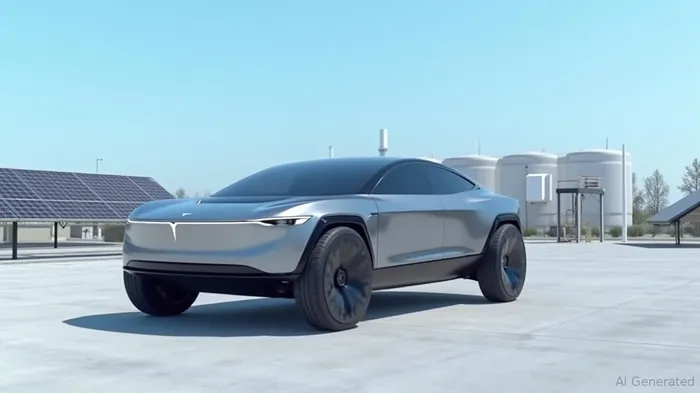
Brand Equity: The Unshaken EV Leader
Tesla's brand remains the most powerful in electric vehicles, despite recent political missteps by Elon Musk. While his alignment with far-right movements and clashes with President Trump have sparked backlash, the company's market leadership persists. In Q2 2025, Tesla retained its title as the U.S. EV sales leader, even as overall U.S. EV demand dropped 10.7% year-over-year. This resilience stems from Tesla's unmatched customer loyalty and its role as the standard-bearer for innovation. Competitors like BYD and Ford are closing gaps in specific markets, but Tesla's first-mover advantage in software, charging infrastructure, and autonomous driving (FSD) continues to deter direct replication.
Analysts note that 90% of Tesla's future valuation hinges on its autonomous and robotics capabilities—assets competitors cannot match. “Tesla's brand is not just a car company; it's a tech platform,” said Benchmark analyst David Kostin, who recently raised Tesla's price target to $475, citing its vision-only autonomy and Optimus robot progress.
Cost Leadership: Vertical Integration as a Moat
Tesla's vertically integrated supply chain—a result of its battery factories, in-house chip design, and proprietary software—provides an unmatched cost advantage. While competitors scramble to source batteries and semiconductors, Tesla's Gigafactories and $5 billion investment in Nevada's battery production ensure it can weather supply chain shocks.
Consider the Model Y redesign: though the Q1 production pause hurt deliveries, the new model's $39,900 starting price (down from $43,000) positions it to reclaim lost market share. Analysts at Wedbush estimate Tesla's Model 3/Y production costs are 20% lower than rivals', enabling aggressive pricing to stave off BYD and Ford.
Even during recent declines, Tesla's stock has outperformed niche EV peers, reflecting investor faith in its structural moat.
Product Pipeline: The Cybertruck Pivot and Affordable Model
The Cybertruck's underperformance in early 2025 (with production throttled to 1,000 units/month) masks its long-term potential. Once Tesla resolves its rear-door recall and ramps production to 50,000 units/year, the Cybertruck's bold design and $50,000+ price tag could carve a niche in the pickup market. Meanwhile, the affordable Tesla model—rumored to cost $25,000—is Tesla's sleeper weapon. If launched in 2026, it could dominate emerging markets and undercut Chinese EVs like the BYD Dolphin.
The Model Y's redesign also signals strategic foresight. Its reduced weight, improved range, and interior upgrades aim to reignite demand in Europe, where Tesla's sales fell 45% year-over-year through May 2025. By mid-2026, analysts predict the Model Y will be the world's top-selling EV, leveraging Tesla's global factory network.
Innovation Pipeline: Robotics and FSD as Future Drivers
Tesla's Optimus robot and Full Self-Driving (FSD) software represent its most underappreciated assets. Optimus, designed for manufacturing and logistics, could generate $10 billion+ in revenue by 2030, according to ARK Invest. Meanwhile, FSD's vision-only approach (no lidar) gives Tesla a cost and scalability edge over competitors like Waymo.
The upcoming Robotaxi rollout in Texas—set for 2026—will test this tech in real-world conditions. If successful, it could unlock a $200 billion autonomous ride-hailing market. These projects, while risky, align with Tesla's “software as a service” model, where recurring FSD subscription revenue ($10,000 per car over time) could offset EV hardware margins.
Addressing the Near-Term Challenges
Tesla's Q2 inventory buildup (25,000 unsold vehicles) and political distractions are valid concerns. Musk's feud with Trump over subsidies threatens short-term volatility, but analysts expect a resolution as both sides prioritize economic growth. The departure of senior executives like Milan Kovac (Optimus lead) is worrisome, but Tesla's bench strength in robotics and AI remains deeper than rivals'.
Investment Thesis: Buy the Dip, Trust the Long Game
Tesla's Q2 2025 results were lackluster, but they reflect temporary headwinds, not terminal decline. The company's strategic advantages—brand equity, cost leadership, and tech dominance—remain intact. While competitors focus on incremental gains, Tesla is building a vertically integrated energy empire spanning EVs, solar, and robotics.
Investors should view current dips (post-Q2, shares fell 5%) as buying opportunities. The $1.85 million 2025 delivery target is conservative, and 2026's affordable model launch could ignite a rebound. For long-term holders, Tesla's stock—trading at 20x 2026 EBIT estimates—offers a discount to its innovation potential.
Final Take:
Tesla's delivery dips are a speed bump, not a roadblock. Its structural strengths in cost, brand, and innovation will continue to define the EV era. For investors with a 3–5 year horizon, Tesla remains a core holding in any growth portfolio—provided they ignore the noise and focus on the roadmap.
Tesla's relentless investment in innovation ensures its edge—no competitor matches its R&D intensity or vision.
Avi Salzman is a pseudonymous analyst specializing in technology and EV markets. This article reflects independent research and does not constitute financial advice.

Stay ahead of the market.
Get curated U.S. market news, insights and key dates delivered to your inbox.




Comments
No comments yet