
Tesla's Strategic Rebranding: From EV Manufacturer to AI-Driven Tech Titan


 Aime Summary
The $1 Trillion Pay Package: A High-Stakes Bet on Musk's Vision
Tesla shareholders overwhelmingly approved Musk's compensation package, with over 75% support, despite a 2025 vehicle sales decline and ongoing brand challenges tied to Musk's political affiliations and trade policies, according to a KVOA report. The package is structured around ambitious performance milestones: achieving an $8.5 trillion market cap, delivering 20 million vehicles, and deploying 1 million robotaxis for commercial use, as detailed in a Los Angeles Times report. If met, Musk could own 25% of TeslaTSLA--, up from his current 13% stake.
Board chair Robyn Denholm defended the package as critical to retaining Musk during Tesla's transition to AI-driven products, including autonomous driving and humanoid robots, according to the Los Angeles Times report. However, the approval has sparked investor skepticism. A 7% stock drop in early November 2025 followed concerns over governance optics and the feasibility of targets like an $8.5 trillion valuation-a figure that would dwarf Apple's current market cap, as noted in a TS2 Tech analysis.
AI and Robotics: The New Core of Tesla's Value Proposition
Tesla's AI ambitions are no longer confined to electric vehicles. The company is investing heavily in semiconductor design, robotics, and autonomous systems to position itself as a tech titan. Key initiatives include:
AI Chip Development: Tesla is designing its fifth-generation AI chip (AI5), with a roadmap extending to AI7, to power Full Self-Driving (FSD) systems and robotics. Partnerships with TSMC and Samsung are critical, with Samsung's Texas fab dedicated to AI6 production and TSMC handling AI5 in Arizona, as reported by a WebPronews report. Musk has also hinted at a potential Intel collaboration to diversify supply chains, according to the WebPronews report.
TeraFab Ambitions: Musk's proposed "TeraFab" chip fabrication plant aims to produce trillions of chips annually, addressing Tesla's growing AI demands. However, Nvidia CEO Jensen Huang has warned that building such a facility from scratch is "extremely hard," citing technical and financial hurdles, as reported by a Tom's Hardware article.
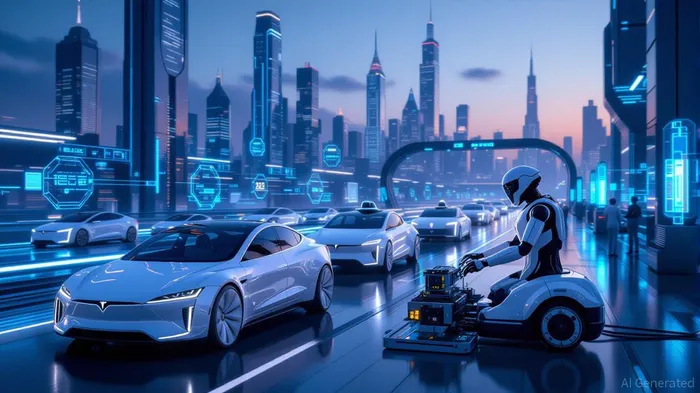
Robotaxi and Optimus: Tesla's FSD v14 and robotaxi pilots are central to its AI narrative. With 1 million FSD subscribers generating $300 million in quarterly revenue, the company projects unsupervised FSD by late 2024, unlocking a $1 trillion robotaxi market, according to a Blockchain News earnings call. Meanwhile, the Optimus humanoid robot is advancing from factory automation to general-purpose tasks, with AI-powered object manipulation showcased in recent demos, as noted in the Blockchain News earnings call.
Market Reactions: Optimism vs. Skepticism
Tesla's stock has traded near record highs in 2025, driven by AI hype and product launches. However, recent volatility-such as a 3.68% drop on November 7, 2025-reflects investor caution. Analysts are divided: Wedbush's Dan Ives upgraded Tesla to $600, citing robotaxi potential, while skeptics warn of a valuation disconnect from fundamentals, as noted in a TS2 Tech analysis.
Financial metrics underscore the stakes. Tesla's Q3 2025 earnings highlighted a 17% year-over-year increase in vehicle deliveries, partly attributed to AI-enhanced features, according to the Blockchain News earnings call. Yet, operating margins are deteriorating, and competition in China and Europe has intensified, with BYD and Xiaomi eroding Tesla's market share, as noted in the TS2 Tech analysis.
Investment Implications: Balancing Rewards and Risks
Tesla's rebranding presents a high-risk, high-reward scenario for investors. On one hand, its AI and robotics initiatives could unlock new revenue streams, including a $10 trillion autonomous vehicle market by 2030, as reported in the Blockchain News earnings call. On the other, execution risks loom large:
- Technical Challenges: Developing advanced AI chips and achieving unsupervised FSD require breakthroughs in hardware and software.
- Regulatory Hurdles: Investigations into FSD safety practices and data privacy concerns could delay deployments.
- Financial Strain: A $10 billion annual investment in AI and robotics strains Tesla's balance sheet, particularly if vehicle sales growth slows.
For investors, the key question is whether Tesla can maintain its technological edge while navigating these challenges. The pay package's performance milestones-while audacious-align with Musk's long-term vision, but their achievability remains unproven.
Conclusion: A Pivotal Moment for Tesla
Tesla's strategic rebranding reflects a bold bet on AI and robotics as the next frontier of innovation. While the $1 trillion pay package and TeraFab ambitions signal confidence in Musk's leadership, they also expose the company to execution risks and governance scrutiny. Investors must weigh Tesla's potential to dominate AI-driven mobility against its current financial and operational challenges. For those with a long-term horizon, the rewards could be transformative-but patience and risk tolerance will be essential.

Delivering real-time insights and analysis on emerging financial trends and market movements.
Latest Articles
Stay ahead of the market.
Get curated U.S. market news, insights and key dates delivered to your inbox.
AInvest
PRO
AInvest
PRO



Comments
No comments yet