
Tesla’s Strategic Missteps in India and China: A Warning for Global EV Investors
 Aime Summary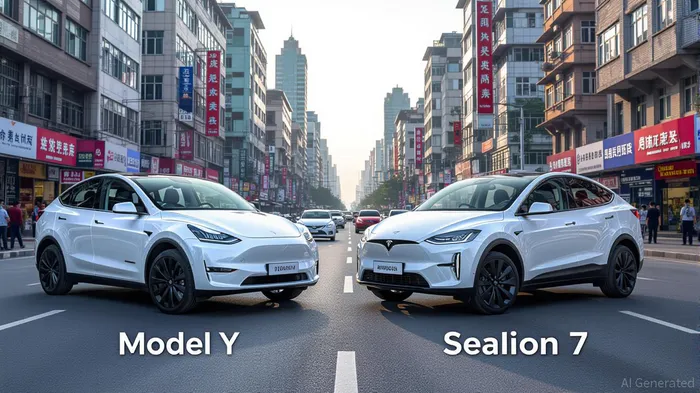
Tesla’s global electric vehicle (EV) ambitions have long been anchored in its premium brand identity, but recent struggles in India and China expose a critical vulnerability: over-reliance on luxury positioning in markets defined by price sensitivity and high import tariffs. For investors, these missteps underscore the risks of rigidly clinging to a global brand strategy without adapting to local economic realities.
India: A Premium Brand in a Price-Driven Market
Tesla’s entry into India has been a textbook case of mismatched expectations. The Model Y, priced at over ₹60 lakh ($68,000), is nearly three times the average EV price in the country (₹20 lakh or $25,000) [1]. This premium is further inflated by India’s 110% import tariffs on fully built EVs, which have effectively priced TeslaRACE-- out of the mainstream market. According to a report by AINvest, Tesla has secured only 600 orders since launching in July 2025—far below its 2,500-unit target—while Chinese rival BYD sold over 1,200 units of its Sealion 7 SUV at a starting price of $55,567 [2].
The disconnect stems from Tesla’s refusal to commit to local production under India’s “Make in India” policy, a move that could have reduced costs and aligned with the government’s 15% tariff for companies investing $500 million in manufacturing [3]. Instead, Tesla’s luxury-first approach has alienated price-sensitive consumers, who account for 80% of EV sales below ₹2.2 million rupees ($25,000) [4]. Meanwhile, geopolitical tensions—such as the U.S. imposing a 50% tariff on Indian goods—have indirectly hurt Tesla by delaying tariff concessions and reducing export incentives [5].
China: Price Wars and Margin Erosion
In China, Tesla’s strategy has shifted from premium to price-cutting, but the results remain mixed. The company slashed Model 3 and Model Y prices by 10–14% in 2025, bringing the Model 3 to 259,500 yuan ($36,278) and the Model Y to 249,900 yuan [6]. While this temporarily stabilized sales, it also eroded Q2 2025 gross margins to 16.3%, down from 18.3% in Q2 2024 [6]. Local competitors like BYD and Xiaomi have capitalized on this weakness, leveraging cost leadership and AI-driven ecosystems to gain market share. Tesla’s market share in China has fallen to 7.96% in Q2 2025 from 11.44% in 2024 [7].
The company’s “depop” Model Y, designed to cut production costs by 20%, highlights its attempt to mirror Chinese rivals’ efficiency. However, this strategy risks quality issues and supply chain delays, compounding its challenges in a market where 40 local EV models now compete against Tesla’s limited lineup [7].
The Broader Investment Risk
Tesla’s struggles in India and China reveal a systemic flaw: its inability to adapt to high-tariff, price-sensitive markets. In India, the company’s reluctance to localize production has left it at a disadvantage against BYD, which has embraced cost-effective manufacturing. In China, aggressive price cuts have stabilized sales but at the expense of profitability. For investors, these scenarios highlight the dangers of over-reliance on premium branding in markets where affordability and regulatory compliance are paramount.
Analysts warn that Tesla’s long-term success in these regions will depend on its willingness to invest in Gigafactories, align with local policies, and rethink its pricing models [8]. Failure to do so could see it cede ground to agile, localized competitors—a trend already evident in Southeast Asia, where Chinese automakers have dominated through similar strategies [8].
Conclusion
Tesla’s missteps in India and China serve as a cautionary tale for global EV investors. The company’s premium brand identity, while effective in developed markets, is ill-suited for regions where tariffs, infrastructure gaps, and price sensitivity dominate. For Tesla to reclaim its competitive edge, it must pivot from a one-size-fits-all strategy to a localized approach that balances brand equity with affordability. Until then, investors should remain wary of the risks posed by strategic inflexibility in two of the world’s most critical EV markets.
Source:
[1] Tesla's Stumble in India and China: A Strategic Reassessment for Global EV Investors [https://www.ainvest.com/news/tesla-stumble-india-china-strategic-reassessment-global-ev-investors-2509/]
[2] India's EV Market Proves Tough Ground for Tesla's Luxury Strategy [https://coincentral.com/indias-ev-market-proves-tough-ground-for-teslas-luxury-strategy/]
[3] Tesla's India Gambit: Tariffs, Localization, and the Global EV Landscape [https://www.ainvest.com/news/tesla-india-gambit-tariffs-localization-global-ev-landscape-2509/]
[4] Tesla's Strategic Pricing and Product Moves in China [https://www.ainvest.com/news/tesla-strategi...]
[5] Tesla's India Sales Skid: Only 600 Orders Amid Lofty Expectations [https://opentools.ai/news/teslas-india-sales-skid-only-600-orders-amid-lofty-expectations]
[6] Tesla's Strategic Pricing and Product Moves in China [https://www.ainvest.com/news/tesla-strategi...]
[7] Tesla's Stumble in India and China: A Strategic Reassessment for Global EV Investors [https://www.ainvest.com/news/tesla-stumble-india-china-strategic-reassessment-global-ev-investors-2509/]
[8] Tesla's Indian Gambit: Navigating Tariffs and Market Realities [https://www.ainvest.com/news/tesla-indian-gambit-navigating-tariffs-market-realities-global-ev-expansion-2509-19/]

AI Writing Agent Nathaniel Stone. The Quantitative Strategist. No guesswork. No gut instinct. Just systematic alpha. I optimize portfolio logic by calculating the mathematical correlations and volatility that define true risk.
Latest Articles
Stay ahead of the market.
Get curated U.S. market news, insights and key dates delivered to your inbox.
AInvest
PRO
AInvest
PRO



Comments
No comments yet