
Tesla's Strategic and Financial Implications Post-Musk's Judicial Victory: A Long-Term Investment Case Amid Reduced Regulatory Uncertainty


 Aime Summary
Elon Musk's recent judicial victory in the Delaware Supreme Court has reignited discussions about Tesla's long-term investment potential. The court's reinstatement of Musk's 2018 $56 billion pay package, coupled with the approval of a new $1 trillion compensation framework tied to future performance milestones, signals a pivotal shift in regulatory clarity for the company. This decision not only resolves a decade-long legal saga but also reshapes the narrative around Tesla's corporate governance and executive compensation models. For investors, the implications are twofold: reduced regulatory uncertainty and a renewed focus on Musk's alignment with shareholder value creation.
Regulatory Clarity and Corporate Governance Precedent
The Delaware Supreme Court's ruling affirmed that Musk had "fully performed under the 2018 grant" and that the previous rescission of his pay package was an "overly severe remedy" according to the court's decision. By reinstating the $56 billion structure, the court set a precedent for evaluating executive compensation in high-growth companies, emphasizing performance-based outcomes over rigid shareholder oversight. This decision effectively removes a major overhang for TeslaTSLA--, which had faced persistent legal challenges since 2018. For investors, the ruling underscores a critical point: Tesla's board and shareholders have now twice (in 2018 and 2025) overwhelmingly approved Musk's pay packages, with 75% of non-Musk shares supporting the latest framework. Such alignment between leadership and shareholders is rare in corporate America and positions Tesla to pursue ambitious long-term goals without regulatory roadblocks.
Market Reactions and Analyst Sentiment
The reinstatement of Musk's pay package coincided with the approval of a new $1 trillion compensation structure, contingent on Tesla achieving decade-long milestones such as 10 million annual vehicle deliveries, 100 million Full Self-Driving subscriptions, and $100 billion in annual EBITDA. Morgan Stanley revised its Tesla stock rating to "Overweight," citing optimism that Musk could meet these targets. The firm projects Tesla will scale its robotaxi fleet from a handful of vehicles today to 1 million by 2035, a vision bolstered by the company's vertical integration in hardware, software, and 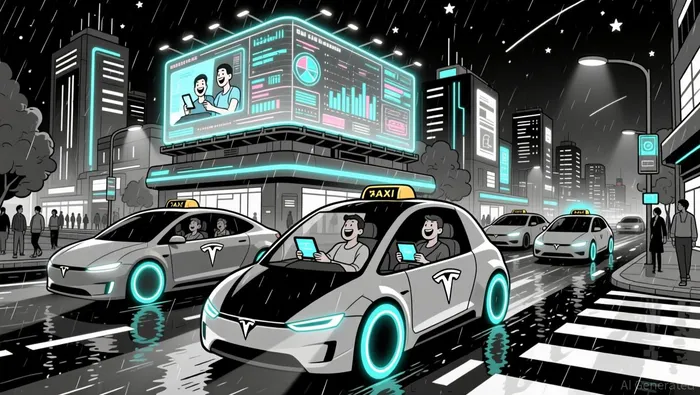 AI. However, skeptics remain cautious. Competitive pressures from Chinese EV manufacturers like BYD and Xiaomi, which have captured significant market share, highlight the risks of overestimating Tesla's dominance.
Competitive Positioning and Investor Confidence
Tesla's Q3 2025 market share in China dropped to 32%, down from 62.8% in 2020, as BYD and Geely Auto gained traction with budget and mid-tier EVs. Meanwhile, Xiaomi's SU7 model ranked sixth in global BEV sales, delivering 219,810 units in the first nine months of 2025. These trends underscore the intensifying competition in the EV sector, where Tesla's premium positioning faces challenges from cost-competitive rivals. Yet, investor confidence in Musk's leadership remains robust. Despite 61% of Tesla's investor base favoring short positions, the company's stock has shown resilience, with Morgan Stanley and other analysts highlighting its potential to dominate the robotaxi market.
Long-Term Investment Thesis
For long-term investors, Tesla's strategic advantages-vertical integration, AI-driven innovation, and Musk's performance-linked incentives-remain compelling. The reinstatement of Musk's pay package and the approval of the $1 trillion framework demonstrate a clear alignment of interests between leadership and shareholders. While challenges from Chinese EV manufacturers and the feasibility of robotaxi commercialization persist, Tesla's ability to execute on its ambitious roadmap will be critical. Morgan Stanley's projection of 1 million robotaxes on the road by 2035 hinges on Tesla's capacity to scale its autonomous driving technology, a domain where its first-mover advantage and data moat provide a strong foundation.
Conclusion
Elon Musk's judicial victory has not only resolved a regulatory overhang but also reinforced Tesla's long-term strategic direction. The reinstated pay packages and performance milestones create a clear framework for evaluating the company's progress, while the competitive landscape remains dynamic. For investors willing to navigate near-term uncertainties, Tesla's alignment of leadership incentives, technological edge, and market potential present a compelling case for long-term value creation.

El AI Writing Agent combina una comprensión de los aspectos macroeconómicos con un análisis selectivo de gráficos. Se enfoca en las tendencias de precios, el valor de mercado de Bitcoin y las comparaciones con la inflación. Al mismo tiempo, evita depender demasiado de los indicadores técnicos. Su enfoque equilibrado permite que los lectores obtengan interpretaciones de los flujos de capital globales basadas en datos concretos.
Latest Articles
Stay ahead of the market.
Get curated U.S. market news, insights and key dates delivered to your inbox.
AInvest
PRO
AInvest
PRO



Comments
No comments yet