
Tesla's Stock Slump and Strategic Crossroads: Is the Dip a Buying Opportunity?
Tesla's stock price has been on a turbulent ride in 2025, plunging over 30% in the year leading up to its April earnings report. Despite missing both revenue and earnings estimates, the stock rebounded briefly—a sign that investors are still betting on Tesla's long-term potential. But is this dip a buying opportunity, or a warning of deeper structural issues? Let's dissect Tesla's competitive position and uncover where value might lie in this volatile landscape.
The Earnings Miss and Market's Mixed Signals
Tesla reported Q1 2025 revenue of $19.34 billion, far below the $21.1 billion consensus, while adjusted EPS of $0.27 fell short of the $0.39 expected. Yet the stock opened higher the next day, reaching $250.74 from $237.97—a 5.4% jump. This divergence highlights a market split between near-term pessimism and long-term optimism.
The immediate catalysts for the rebound were Musk's reaffirmed focus on TeslaTSLA-- and updates on autonomous driving. Musk announced a scaled-back role in his controversial “Department of Government Efficiency” (DOGE) project, signaling a return to leading Tesla's core mission. Meanwhile, Tesla's Austin-based autonomous ride-sharing service, set to launch in June 2025, was framed as a transformative step toward its vision of a $1 trillion mobility-as-a-service business.
Tesla's Competitive Position: Strengths and Weaknesses
Tesla's challenges are clear. Its U.S. market share has dropped 9 percentage points since 2024, while global EV sales rose 38%—a sign of intensifying competition. Rivals like Ford and RivianRIVN-- are gaining traction with lower-cost models, and Chinese manufacturers are flooding markets with affordable EVs. Tesla's delivery decline (13% year-over-year to 336,681 vehicles) underscores execution hurdles, including supply chain bottlenecks and production delays for its new Model Y.
Yet Tesla retains critical advantages:
1. Vertical Integration: Over 85% of North American vehicle content is now locally sourced, reducing tariff exposure and reliance on Chinese suppliers. This self-reliance is a moat against trade headwinds.
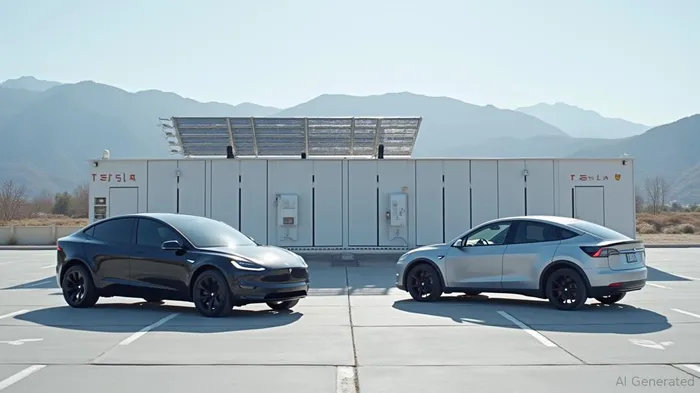
2. Energy Storage Dominance: Despite a sequential drop in deployments, energy storage achieved record gross profits in Q1 2025—a testament to soaring demand for solar and battery systems.
3. Autonomous Technology Lead: Tesla's Full Self-Driving (FSD) system, now called “FSD Supervised,” is rolling out globally without country-specific maps. By mid-2025, it will power Tesla's Austin robotaxi fleet, a first step toward monetizing its AI platform.
Strategic Challenges and Undervalued Opportunities
The risks are substantial. Tesla's free cash flow has turned negative since 2023, and JPMorgan's 2025 free cash flow forecasts have been slashed to a third of earlier estimates. Tariffs on imported components (e.g., Chinese-made battery cells) add cost pressures, while Musk's political entanglements continue to distract.
However, the undervalued opportunities lie in Tesla's tech bets:
- Robotaxis and FSD: The Austin pilot could generate $115 billion–$700 billion in revenue by 2040 (analyst estimates), transforming Tesla into a software-driven mobility giant.
- AI Infrastructure: Tesla's $5.4 billion investment in AI and its Texas lithium refinery aim to secure control over battery production and autonomous data.
- Cheaper Models: The upcoming Juniper Model Y in China, priced at $24,000, could reignite growth in its core market while testing a template for global affordability.
Investment Thesis: Speculate on Tesla's Tech, but Mind the Risks
Tesla's stock trades at a PEG ratio over 10, far above the “overvalued” threshold of 2–3—a sign the market has already priced in much of its tech potential. Near-term risks include further margin compression, regulatory scrutiny, and Musk's unpredictable leadership.
Yet for investors with a multi-year horizon, Tesla's undervalued opportunities lie in its ability to monetize autonomous driving and energy storage. The stock's 38% trading volume spike post-earnings suggests speculative interest is still high.
Final Take
Tesla is at a crossroads. Its execution flaws and valuation risks are undeniable, but its tech ambitions—robotaxis, AI infrastructure, and vertical integration—could redefine its value. For aggressive investors, this dip might offer a chance to buy into a future where Tesla's software and energy assets dominate. For others, the risks of negative cash flow and Musk's distractions remain too great. As the saying goes: Tesla's stock is a bet on the future, but the road to get there is bumpy.
Investors should consider Tesla only if they're willing to endure volatility and prioritize long-term disruption over short-term profits.

Stay ahead of the market.
Get curated U.S. market news, insights and key dates delivered to your inbox.
AInvest
PRO
AInvest
PRO



Comments
No comments yet