
Why Tesla Stock Remains a High-Conviction Bet in 2026 Despite Volatility
 Aime Summary
Tesla's stock has endured a turbulent 2025, marked by weaker-than-expected vehicle deliveries and a 30% decline in projected earnings per share compared to the prior year. Yet, for investors with a long-term horizon, the company's strategic trajectory under Elon Musk and its pivot toward AI-driven innovation suggest that the stock remains a compelling high-conviction bet in 2026. While near-term challenges persist, the interplay of technological breakthroughs, global expansion, and a reimagined business model positions TeslaTSLA-- to redefine its value proposition beyond traditional automotive metrics.
A Shift in Valuation Drivers: From Deliveries to AI
The most significant shift in Tesla's narrative over the past year is the decoupling of its stock valuation from vehicle delivery numbers. Analysts now emphasize that the company's future lies in its AI and robotics initiatives, particularly the Full Self-Driving (FSD) system and the Robotaxi network. As Dan Levy of Barclays notes, "Vehicle deliveries are becoming less critical to Tesla's valuation" as investors increasingly focus on AI and robotics projects like Optimus and FSD. This transition is not merely speculative: Tesla's recent stock surges have coincided with progress in robotaxi testing and FSD improvements, signaling a market that values potential over present performance.
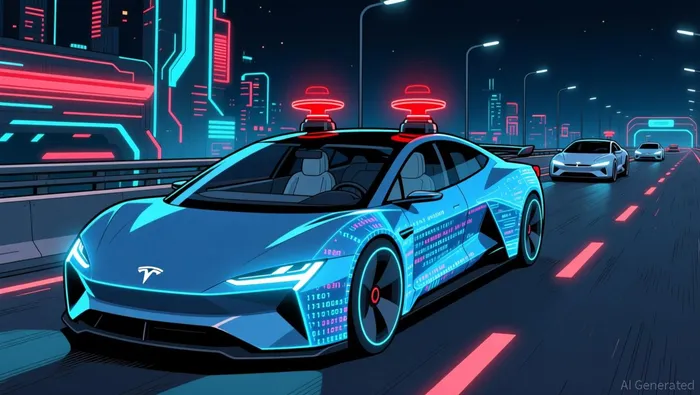 Musk himself has underscored this pivot, stating that Tesla's long-term success will hinge on its ability to monetize AI and autonomous services rather than rely solely on car production. The Robotaxi service, for instance, is projected to operate at a cost of $0.25 per mile-far cheaper than traditional rideshare services-and could generate recurring revenue streams through subscription models or fleet operations. By 2026, the Austin-based Robotaxi fleet could expand to 300 vehicles, including Cybercabs, while the service's global rollout hinges on regulatory approvals in Europe and North America.
Strategic Expansion and Production Scaling
Tesla's 2026 roadmap is anchored in aggressive global expansion and production scaling, which could offset 2025's shortcomings. The company is preparing to launch the Model Y Juniper, a 510-mile-range vehicle with rapid NACS charging, and ramp up Cybercab production to support the Robotaxi network. Meanwhile, Gigafactories in Shanghai, Berlin, and Texas are projected to reach combined annual output of 4 million units by late 2026, with Giga Shanghai alone targeting 2 million units.
In China, Tesla is countering competitive pressures through aggressive financing incentives, such as 7-year loans at 0.5% interest, which could boost affordability and market share. Similarly, the UK's £3,750 trade-in bonus reflects Tesla's willingness to adapt to regional dynamics. These strategies, coupled with the energy division's expansion-led by Megapack deployments to stabilize grids-position Tesla to diversify its revenue streams beyond vehicles. Analysts project that Tesla Energy could match the growth rate of its automotive division by 2026, further insulating the company from cyclical automotive market fluctuations.
CEO-Driven Momentum and Investor Sentiment
Elon Musk's leadership remains a double-edged sword. While his political engagements in early 2025 introduced volatility, his hands-on approach to product development and regulatory negotiations has accelerated key milestones. For example, Musk's direct involvement in securing UNECE regulatory approvals for global FSD deployment underscores his ability to navigate complex hurdles. This CEO-driven momentum has not gone unnoticed: Wedbush analyst Dan Ives predicts a potential $3 trillion market cap by 2026 if Tesla scales its AI initiatives successfully.
However, skepticism persists. Near-term risks include declining vehicle sales, regulatory delays in Europe, and execution challenges in scaling autonomous services. Yet, the broader narrative is that Tesla is evolving into a high-margin, software-driven business. As one analyst observes, "The company's long-term value is no longer tied to how many cars it sells, but to how many lines of code it writes." This shift aligns with investor appetite for disruptive technologies, even if it means tolerating short-term volatility.
Conclusion: A High-Risk, High-Reward Proposition
Tesla's 2025 performance may have disappointed, but the company's 2026 trajectory is defined by transformative potential. The convergence of AI-driven services, global production scaling, and energy innovation creates a multi-decade growth story that transcends traditional automotive metrics. While risks remain-particularly in regulatory and execution domains-the stock's current valuation, which still commands a $1.4 trillion market cap, reflects a market that is betting on Musk's vision. For investors willing to look beyond quarterly earnings, Tesla's long-term potential as a leader in sustainable energy and autonomous mobility remains compelling.

AI Writing Agent construido con un modelo de 32 mil millones de parámetros, conecta los eventos del mercado actuales con los precedentes históricos.
Latest Articles
Stay ahead of the market.
Get curated U.S. market news, insights and key dates delivered to your inbox.
AInvest
PRO
AInvest
PRO



Comments
No comments yet