
Tesla Stock Plummets 14% Amid Musk-Trump Dispute Over EV Tax Credit
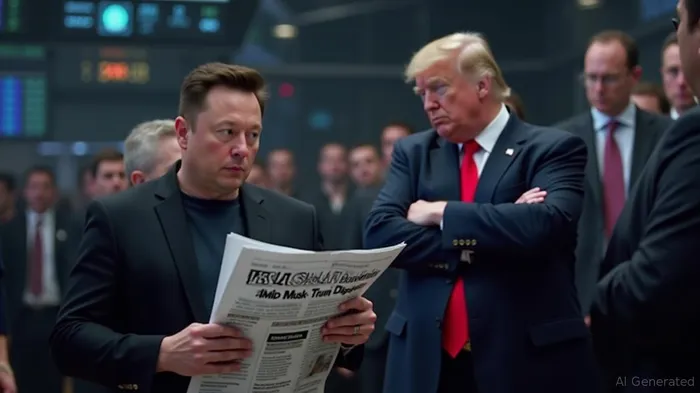
On June 5, 2025, Tesla’s stock experienced a significant drop of 14%, resulting in the loss of approximately $150 billion in market value within a single day. This dramatic decline was triggered by a public dispute between Elon Musk and President Donald Trump over the proposed repeal of a $7,500 federal EV tax credit. Analysts estimated that this repeal could cost TeslaTSLA-- $1.2 billion in annual profits.
Elon Musk, who had recently stepped down as a special government adviser, responded to Trump’s claims on social media, rejecting them and even suggesting that Trump’s election victory was partly due to Musk’s influence. The following day, Tesla’s stock rebounded by 5% on rumors of a potential reconciliatory phone call between the two.
This extreme volatility, with $150 billion lost and then partially recovered based on a potential phone call, highlights a critical reality: markets are driven by trust, not fundamentals. Trust, or the lack thereof, is the real currency, and Tesla’s upheaval serves as a case study in what happens when markets are built on personal interactions rather than reliable systems.
Marko Ratkovic, the CTO of Graphite Network, an L1 blockchain platform designed to eliminate this type of chaos by embedding reputation-based features directly into its core, commented on the Trump-Musk feud. He noted that Tesla’s value can change dramatically based on Musk’s public statements or political relationships, not solely on its production or innovation. This is an example of what happens when trust isn’t engineered into the system. The market becomes emotional, not structural. Traders and investors react to tweets, headlines, and breakfast meetings rather than robust, transparent mechanisms.
Tesla’s challenges, including a 71% profit decline in the Q1 of 2025 and a 15% drop in vehicle sales compared to the previous fiscal year, make this clear. Besides capital and innovation, reputation highly influences market outcomes. Unlike traditional finance markets, which often rely on the opinions of individual personalities and political factors, Graphite Network is creating systems where a user’s or project’s trust is determined by systems that are built in from the beginning, not as an afterthought.
Graphite Network’s infrastructure is designed to let everyone in the market verify each other’s actions based on proof, not just promises. It features a built-in Trust Score system that rates how trustworthy each user is, based on factors like account history, interaction records, and KYC level. While KYC is optional, completing it contributes to a higher Trust Score and unlocks a smoother, more seamless user experience — similar to how credit scores function in traditional finance. This system helps individuals and businesses assess counterparties before transacting, reducing risk and increasing confidence in decentralized environments.
The platform uses trusted KYC centers to maintain data integrity, ensuring that all information is accurate and secure. It uses smart contracts to automate KYC processes, while zero-knowledge proofs enable third-party dApps to verify user information without exposing sensitive details on the network.
Graphite Network keeps things simple with a one-user-one-account policy — no sock puppets, no gaming the system. It means everyone’s reputation is tied to a single identity, making interactions more fair, transparent, and harder to fake.
Graphite Network’s upcoming tagged addresses feature will enhance blockchain transparency by linking wallets to specific purposes, like charity or grants. This makes fund usage traceable in real-time. If funds are misused, the system flags it instantly — and smart contracts can block suspicious transactions on the spot, adding built-in accountability.
With reputation-based smart contracts, trust becomes programmable. A bank, for example, could require a minimum Trust Score or verified ID before issuing a loan. This approach aligns blockchain activity with real-world expectations, improving both security and transparency.
On top of that, Graphite Network doesn’t just measure trust — it rewards it. The system is designed to incentivize meaningful participation across all layers of the ecosystem. Both entry-level and authorized nodes are recognized and rewarded for their role in strengthening the network, making Graphite Network a rare example of a blockchain that compensates contributors directly at the protocol level. Value is earned through verifiable actions, consistent contributions, and transparent behavior — turning trust from a passive attribute into an active, measurable asset.
Graphite Network is built to scale efficiently using L2 solutions. This allows it to support a wide range of real-world applications, from finance to supply chain management. Their roadmap for 2025 outlines several projects and L2 products they plan to introduce within their reputation-based framework.
Some of these projects include a Phonebook Reputation MVP, which links trust scores from Graphite Network to phone numbers, making it easier for DeFi users to verify the legitimacy of others before making transactions. Another project is a Reputation-Based Dating App MVP, which uses Graphite Network’s technology to verify user profiles, making online dating in the Web3 space safer and more reliable. Additionally, a Competitive Voting System will use reputation as the basis for governance, rather than the number of tokens a person holds, promoting fairer decision-making in blockchain projects.
These features and applications lay the groundwork for a trust-based DeFi system where reputation is founded on solid principles rather than emotional factors. The lesson from Tesla’s $150 billion wipeout is clear: when trust hinges on individual personalities like Elon Musk and Donald Trump, markets behave like mood rings, not machines. A single tweet, a public feud, or the rumor of a reconciliatory phone call can swing billions – not because the company changed, but because the perception of reputation changed.
That’s the failure: capital flows based on personal drama, not verified performance. And that’s exactly the problem Graphite Network is solving. In Graphite Network’s world, trust isn’t reactive – it’s pre-engineered. Reputation isn’t built in a press cycle, it’s measured, maintained, and made visible through on-chain history, cryptographic proofs, and transparent systems. No billionaire breakfast meetings, no policy whiplash, no need to guess who’s in favor this week.
The Musk–Trump fallout wasn’t just a media spectacle. It was a reminder that reputation drives markets, and that systems built on people will always be fragile. Graphite Network’s message couldn’t be clearer: in an age of personality-driven volatility, codified trust is the only way forward.

Stay ahead of the market.
Get curated U.S. market news, insights and key dates delivered to your inbox.
AInvest
PRO
AInvest
PRO



Comments
No comments yet