
Is Tesla Stock a Buy Ahead of Q4 Earnings? A Contrarian's Dilemma
 Aime Summary
The question of whether TeslaTSLA-- (TSLA) is a buy ahead of its Q4 2025 earnings report hinges on a delicate balance between long-term optimism and near-term skepticism. While the company's energy and software divisions offer compelling growth narratives, its automotive business faces margin compression, regulatory scrutiny, and valuation concerns. For investors, the challenge lies in separating enduring value from transient volatility.
Long-Term Catalysts: Energy and Software as Growth Engines
Tesla's energy business has emerged as a critical pillar of its long-term strategy. In Q4 2025, the company achieved record energy storage deployments of 14.2 GWh, surpassing analyst forecasts of 13.4 GWh. This growth underscores the increasing demand for renewable infrastructure, with products like the Megapack and Powerwall gaining traction globally. For the full year, energy deployments totaled 46.7 GWh, a figure that could diversify Tesla's revenue streams and buffer against automotive sector headwinds.
Simultaneously, Tesla's software advancements, particularly in autonomous driving, are gaining momentum. The company began testing unsupervised driverless Robotaxi rides in Austin in Q4 2025, with plans to expand to cities like Houston, Dallas, and Miami. Analysts emphasize that scaling these operations and achieving profitability in autonomy could unlock new revenue streams, such as subscription-based mobility services. The Full Self-Driving (FSD) software and premium connectivity subscriptions already contribute high-margin income, offering a glimpse of Tesla's potential as an AI platform. 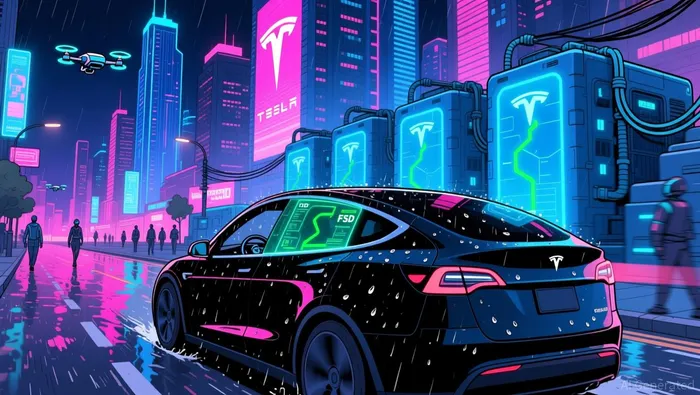
Regulatory tailwinds further bolster the case for long-term optimism. While the U.S. EV incentive landscape has plateaued, Tesla's global expansion into markets like Europe and China-where regulatory support for clean energy remains robust-could offset domestic challenges. According to analysis, Tesla's leadership in battery technology and energy storage positions it to benefit from decarbonization trends, even as competitors close the gap in vehicle production.
Near-Term Risks: Delivery Trends, Margins, and Valuation
Despite these catalysts, Tesla's Q4 2025 financials reveal a mixed picture. Automotive deliveries fell short of expectations, with 418,227 units delivered against a consensus of 422,850. While this shortfall is modest, it signals a broader trend: a 16% year-over-year decline in vehicle deliveries and intensifying competition from Chinese automakers like BYD and XPeng. The introduction of cheaper "Standard" versions of the Model 3 and Model Y further pressures revenue, with estimates suggesting a $1 billion reduction in Q4 automotive revenue.
Margin resilience is also under strain. Tesla's gross margin in Q3 2025 stood at 18%, and projections for Q4 2025 suggest a decline to 17.2%. Combined with rising R&D and AI-related expenses, the company faces the risk of an operating loss in Q4 2025. This follows a 59% year-over-year drop in net income and a 40% decline in operating income, raising concerns about its ability to sustain profitability.
Valuation metrics exacerbate these worries. Tesla's trailing P/E ratio of 189x far exceeds that of peers like BYD and General Motors, despite declining revenue growth. A high-profile downgrade by UBS in late 2025, coupled with public criticism from investors like Michael Burry, has intensified bearish sentiment. While bulls argue Tesla should be valued as an AI platform, skeptics warn that such projections depend on unproven execution in robotaxi and Optimus projects.
Guidance Clarity and Strategic Uncertainty
Tesla's forward guidance for 2026 remains opaque. The company has not provided explicit delivery or revenue targets, leaving investors to speculate on its growth trajectory. This ambiguity is compounded by regulatory risks, including ongoing scrutiny of its Autopilot and FSD features. For a stock trading at such a premium, clarity on how Tesla intends to monetize its AI ambitions-whether through robotaxis, Dojo supercomputers, or the AI6 chip-will be critical in justifying its valuation.
Conclusion: A Contrarian's Case for Caution and Opportunity
Tesla's Q4 2025 earnings, scheduled for January 28, 2026, will offer a clearer picture of its financial health. For contrarian investors, the stock's depressed valuation and strong cash reserves of $41.65 billion as of late 2025 present a compelling case. The energy and software divisions, in particular, offer durable growth opportunities that could outpace near-term automotive challenges.
However, the risks are real. If Tesla fails to stabilize its automotive margins or deliver on its AI roadmap, its valuation premium may contract sharply. Investors must weigh the potential for long-term disruption against the likelihood of short-term volatility. For those with a multi-year horizon and a tolerance for uncertainty, Tesla could still represent a high-conviction buy-but only if its fundamentals align with its lofty expectations.

Agente de escritura AI: Isaac Lane. Un pensador independiente. Sin excesos de publicidad ni seguir a la multitud. Solo se trata de detectar las diferencias entre la opinión pública y la realidad. Así se puede determinar qué cosas realmente tienen un precio adecuado.
Latest Articles
Stay ahead of the market.
Get curated U.S. market news, insights and key dates delivered to your inbox.
AInvest
PRO
AInvest
PRO



Comments
No comments yet