
Tesla Semi Production Ramps As Analysts Project Autonomous Software Revenue
 Aime Summary
- Tesla is ramping up production of its all-electric Semi truck at a Nevada facility, aiming for an annual output of 50,000 units to capture a growing share of the autonomous trucking market.
- Morgan Stanley analysts identify the Semi as a credible competitor in freight, driven by record-high diesel prices averaging $6 per gallon in the U.S.
- The core investment thesis relies on Tesla’s Full Self-Driving software, which could generate $12,000 to $18,000 per month per vehicle through subscription models.
- Major logistics players including Walmart, PepsiCo, and Einride have already placed orders, with Einride targeting a deployment of 500 units.
- Tesla plans to reveal European specifications for the Semi at the IAA Transportation fair, marking first major expansion into heavy-duty vehicle market outside North America.
Tesla is accelerating the production of its all-electric Semi truck, viewing it as a strategic entry into the autonomous trucking market. This move coincides with record-high diesel prices, which have averaged $6 per gallon in the United States, significantly increasing operational costs for traditional freight companies . Morgan Stanley analyst Andrew Percoco identifies TeslaTSLA-- as a credible emerging competitor that could disrupt the industry by leveraging its Full Self-Driving technology .
The company plans an inauguration event for its Nevada production facility, targeting an annual output of 50,000 Semis. Major clients including Walmart, PepsiCo, and Einride have already placed orders, with Einride aiming to deploy 500 units . Tesla CEO Elon Musk has indicated a goal to offer self-driving Semis by 2027, positioning the vehicle as a high-margin commercial software model .
How Does Autonomous Software Monetization Impact Tesla's Revenue?
The core investment thesis centers on the profitability potential of autonomous fleets. Percoco notes that an autonomous fleet could be six to eight times more profitable than a human-driven one due to reduced labor costs and fuel efficiency . The primary revenue driver is expected to be Tesla’s autonomous software subscription model .
The analyst estimates Tesla could generate between $12,000 and $18,000 per month per vehicle from these subscriptions, based on assumed mileage and fee structures . Assuming Tesla captures 13.5% of the market by 2040, this could translate to a $17 billion annual software revenue stream . The Semi is viewed as an underappreciated driver of earnings growth for the company through the end of the decade.
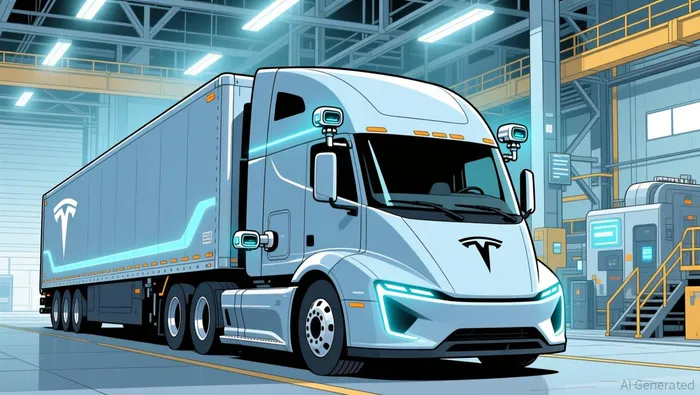
For Tesla investors, the primary value lies in the monetization of its Full Self-Driving software via monthly subscriptions . Analysts project Tesla could generate between $12,000 and $18,000 per month in software revenue per vehicle . This model complements its passenger vehicle business with a high-margin commercial software approach .
What Is Tesla's Strategy For European Market Expansion?
Tesla announced plans to expand its Semi electric truck to Europe, marking a move beyond its North American operations into a market where competitors already offer battery-powered heavy-duty vehicles . The company will reveal European specifications and launch details at the IAA Transportation trade fair in Hanover, Germany .
The European expansion follows a prolonged development timeline. Tesla first unveiled the Semi in 2017 with initial production targeted for 2019, but delays occurred as battery-cell supplies were prioritized for passenger vehicles . Limited deliveries to US customers, including PepsiCo, began in late 2022 . While early forecasts suggested volume production in the current year, Tesla’s July shareholder update shifted the timeline to 2026 .
Technical specifications for the European model include a range of up to 550 kilometers with a gross combination weight of 40 tonnes and energy consumption of approximately 1 kilowatt-hour per kilometer . The truck weighs 9,100 kilograms without cargo . Key features designed to minimize downtime include route-based charging scheduling, dedicated service centers, and the ability to recover 60% of its range in 30 minutes using Tesla’s 800-kilowatt Megacharger network .
The operational cost advantage for electric vehicles becomes more pronounced with diesel averaging $6 per gallon . The analyst suggests Tesla could generate $12,000 to $18,000 per month per vehicle through software subscriptions . This represents a significant upside for investors focused on Tesla's software monetization rather than just hardware sales .

Blending traditional trading wisdom with cutting-edge cryptocurrency insights.
Latest Articles
Stay ahead of the market.
Get curated U.S. market news, insights and key dates delivered to your inbox.


AInvest
PRO
AInvest
PRO




Comments
No comments yet