
Tesla's Robotaxi Service: Exclusive Access Sparks Frenzy Among Fans and Investors
ByAinvest
Sunday, Jul 27, 2025 6:25 am ET1min read
RACE--
The launch comes approximately a month after Tesla's robotaxis began testing in Austin, with the vehicles still under human co-pilot supervision to navigate challenging traffic conditions and ensure safety. The service has been receiving mixed reviews, with some users praising the vehicles' cautious and human-like behavior, while others have reported incidents that have raised concerns about the technology's reliability [1].
Tesla's decision to launch the Robotaxi service in Austin follows a series of setbacks for the company, including a 16% year-over-year decline in automotive sales during the second quarter of 2025. The company's stock has also taken a hit due to these setbacks, with shares dipping as investor confidence wanes [1].
Despite the challenges, investors see the Robotaxi service as a pivotal moment for Tesla, as it could potentially transform the company's business model and pave the way for future growth. The service is expected to generate significant revenue through a network of autonomous vehicles that can operate without human drivers, a concept that has the potential to revolutionize the transportation industry [1].
Tesla has been facing competition in the robotaxi space from companies like Waymo, which has already completed millions of driverless rides in various cities across the United States. Waymo's vehicles are currently operating without backup human co-pilots, giving it an edge over Tesla's Robotaxi service [1].
As Tesla continues to refine its autonomous technology, it remains to be seen how the company will adapt to the competitive landscape and address the challenges that have arisen during the early stages of its Robotaxi service. The success of the service could have a significant impact on Tesla's future prospects, as it aims to expand its autonomous ride-hailing offerings to other cities and eventually to half of the U.S. population by the end of 2025 [1].
References:
[1] https://www.latimes.com/business/story/2025-07-25/robotaxi-testing-bay-area-report
[2] https://www.teslarati.com/tesla-robotaxi-service-customer-pickups-upgrade/
TSLA--
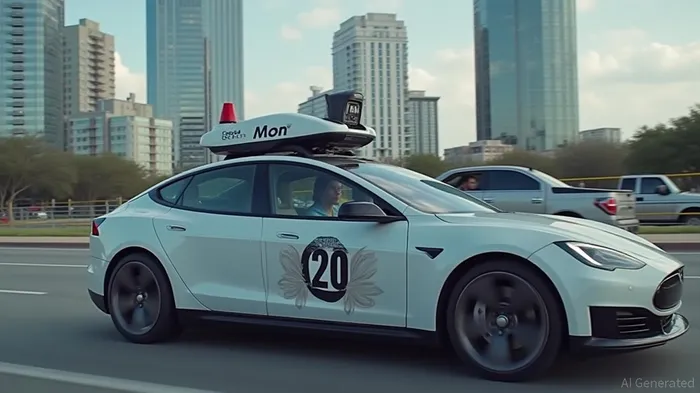
Tesla has launched its robotaxi service, Robotaxi, in Austin, Texas, with access limited to invite-only. Some invites have gone to Tesla influencers with large online followings. Investors see Robotaxi as a pivotal moment for the company. Tesla owners and fans have traveled to Austin to experience the service, with some even flying in from the San Francisco Bay Area. The service allows for autonomous ride-hailing, with a safety monitor in the front passenger seat and a geofence covering about 30 square miles of the city.
Tesla has rolled out its Robotaxi service in Austin, Texas, with an invite-only access program that has drawn significant attention from investors and enthusiasts alike. The service, which allows for autonomous ride-hailing, is currently operating within a 30-square-mile geofence in the city, with a safety monitor seated in the front passenger seat to oversee the vehicle's operations [1].The launch comes approximately a month after Tesla's robotaxis began testing in Austin, with the vehicles still under human co-pilot supervision to navigate challenging traffic conditions and ensure safety. The service has been receiving mixed reviews, with some users praising the vehicles' cautious and human-like behavior, while others have reported incidents that have raised concerns about the technology's reliability [1].
Tesla's decision to launch the Robotaxi service in Austin follows a series of setbacks for the company, including a 16% year-over-year decline in automotive sales during the second quarter of 2025. The company's stock has also taken a hit due to these setbacks, with shares dipping as investor confidence wanes [1].
Despite the challenges, investors see the Robotaxi service as a pivotal moment for Tesla, as it could potentially transform the company's business model and pave the way for future growth. The service is expected to generate significant revenue through a network of autonomous vehicles that can operate without human drivers, a concept that has the potential to revolutionize the transportation industry [1].
Tesla has been facing competition in the robotaxi space from companies like Waymo, which has already completed millions of driverless rides in various cities across the United States. Waymo's vehicles are currently operating without backup human co-pilots, giving it an edge over Tesla's Robotaxi service [1].
As Tesla continues to refine its autonomous technology, it remains to be seen how the company will adapt to the competitive landscape and address the challenges that have arisen during the early stages of its Robotaxi service. The success of the service could have a significant impact on Tesla's future prospects, as it aims to expand its autonomous ride-hailing offerings to other cities and eventually to half of the U.S. population by the end of 2025 [1].
References:
[1] https://www.latimes.com/business/story/2025-07-25/robotaxi-testing-bay-area-report
[2] https://www.teslarati.com/tesla-robotaxi-service-customer-pickups-upgrade/
Stay ahead of the market.
Get curated U.S. market news, insights and key dates delivered to your inbox.
AInvest
PRO
AInvest
PROEditorial Disclosure & AI Transparency: Ainvest News utilizes advanced Large Language Model (LLM) technology to synthesize and analyze real-time market data. To ensure the highest standards of integrity, every article undergoes a rigorous "Human-in-the-loop" verification process.
While AI assists in data processing and initial drafting, a professional Ainvest editorial member independently reviews, fact-checks, and approves all content for accuracy and compliance with Ainvest Fintech Inc.’s editorial standards. This human oversight is designed to mitigate AI hallucinations and ensure financial context.
Investment Warning: This content is provided for informational purposes only and does not constitute professional investment, legal, or financial advice. Markets involve inherent risks. Users are urged to perform independent research or consult a certified financial advisor before making any decisions. Ainvest Fintech Inc. disclaims all liability for actions taken based on this information. Found an error?Report an Issue


ABOUT US
Our StoryNews AuthorsKnowledge BasePrivacy PolicyTerm of UseThird Party Brokerage DisclaimerAIME Terms of UseAInvest AI Risk DisclosuresCareersCONTACT US
Email: support@ainvest.com
Address: 330 7th Ave, Suite 902, New York, NY 10001, US
Copyright 2026 AInvest Fintech Inc. All rights reserved.


Comments
No comments yet