
Tesla's Robotaxi Rollout in Austin: A Crossroads for Autonomous Mobility and Market Dominance
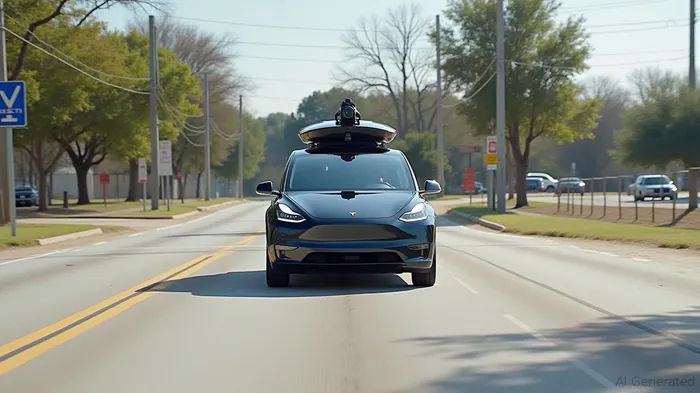
The long-awaited TeslaTSLA-- robotaxi rollout in Austin, Texas, set to begin on June 22, 2025, marks a pivotal moment for the company's ambition to redefine autonomous mobility. This limited pilot—featuring a fleet of 10–25 Model Y vehicles operating within a geofenced area—could either propel Tesla toward a $2 trillion valuation by 2026 or expose vulnerabilities in its autonomous driving technology. The stakes are high, with regulatory scrutiny, safety concerns, and competition all hanging in the balance.
The Rollout: A Fragile Start
Tesla's launch is a cautious first step. The service is invitation-only for investors and enthusiasts, with rides limited to a predefined zone and restricted to 6 a.m. to midnight. A “Tesla Safety Monitor” sits in the front passenger seat during initial rides, and remote human oversight is in place—a nod to the unresolved safety risks of its Full Self-Driving (FSD) software. Despite these safeguards, Texas lawmakers had urged a delay until September 1 to align with new state regulations requiring commercial autonomous vehicles to obtain DMV authorization. Tesla's decision to proceed underscores its confidence in compliance with existing rules, but the tension between innovation and oversight remains unresolved.
The Technology at the Heart of the Bet
Tesla's success hinges on its FSD software, now in version 14, and its AI4 hardware. The system's ability to handle edge cases—like stationary school buses or unpredictable pedestrians—will determine its viability. Recent tests by safety advocates, however, revealed glaring flaws, with FSD failing to stop for child-sized mannequins in some scenarios. Musk has acknowledged these risks, calling the team “super paranoid” about safety, but the NHTSA's ongoing investigations into FSD-related crashes add pressure to prove reliability.
The company's data advantage is its strongest asset. With 1.5 million vehicles on the road, Tesla's neural networks are trained on vast real-world driving data, a “moat” competitors like Waymo and Cruise cannot easily replicate. Yet, scaling this data into actionable improvements requires flawless execution—a hurdle even Musk admits is daunting.
Market Potential and Valuation Upside
Analysts like Wedbush's Dan Ives see the robotaxi rollout as a catalyst for Tesla's $2 trillion valuation target by 2026. Success in Austin could enable Tesla to expand to 25 U.S. cities within a year and deploy a million autonomous vehicles by 2030. The revenue streams are compelling: ridesharing fees, AI software licensing, and data monetization could generate $100 billion annually. Competitors like Waymo, which already logs 250,000 weekly paid trips, pose a challenge, but Tesla's cost advantages—built on vertical integration and economies of scale—give it an edge.
Tesla's stock has already reacted to autonomous driving milestones, rising nearly 30% in 2024 amid FSD v14's release. A successful pilot could amplify this trend, but failure might trigger a sell-off, particularly amid concerns over declining sales in key markets and Musk's political distractions.
Risks and Roadblocks
The path to $2 trillion is fraught with obstacles. Regulatory delays could stifle expansion, as Texas's September deadline looms. Technical setbacks—such as software errors or public backlash over safety lapses—might erode trust. Competitors, too, are advancing: Waymo's partnerships with automakers and its mature software base could limit Tesla's market share. Meanwhile, Musk's controversial public persona risks diverting attention from the company's core mission.
Investment Considerations
Investors must weigh Tesla's transformative potential against its execution risks. The Austin rollout is a binary event: a smooth launch could validate Musk's vision, driving the stock toward $2 trillion. A stumble, however, might reignite skepticism about Tesla's ability to commercialize autonomy.
For aggressive investors, Tesla's current valuation—around $800 billion—offers a compelling risk/reward tradeoff, especially if the robotaxi service proves scalable. Conservative investors may prefer to wait for quarterly updates on safety metrics and regulatory approvals before committing. Either way, Tesla's autonomous push is a litmus test for its future as a tech-driven mobility giant.
Conclusion
Tesla's robotaxi rollout is more than a product launch—it's a high-stakes experiment in redefining transportation. Success in Austin could cement Tesla's dominance in autonomous mobility, unlocking new revenue streams and investor confidence. Failure, however, risks relegating the company to a niche player in a market it once sought to own. The world will be watching closely; the next few months could determine whether Tesla's $2 trillion vision becomes reality or fantasy.
For investors, the verdict is clear: Tesla's autonomous future is its most valuable asset—but only if it can deliver.

Stay ahead of the market.
Get curated U.S. market news, insights and key dates delivered to your inbox.
AInvest
PRO
AInvest
PRO



Comments
No comments yet