
Tesla's Robotaxi Rollout: A $2T Gamble or the Road to Dominance?
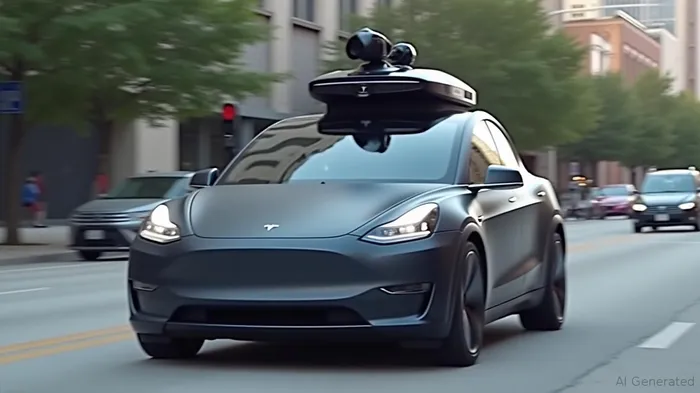
Tesla's June 22, 2025, launch of its Robotaxi pilot in Austin is far more than a tech demo—it's a high-stakes bet to redefine the company's trajectory. The stakes? Nothing less than a $2 trillion market cap, dominance over rivals like Waymo, and the delicate balance between innovation speed and regulatory scrutiny. Let's break down what this means for investors.
The All-In Bet on Autonomy
Tesla's Robotaxi ambitions are audacious. The company aims to transition from an electric vehicle (EV) manufacturer to a mobility-as-a-service (MaaS) giant. The Austin pilot, with its 10–20 Model Y vehicles operating within a geofenced area, is the first step in a plan to deploy millions of autonomous cars globally. But here's the catch: success hinges on proving that its camera-only sensor system—a stark contrast to competitors' LiDAR-heavy setups—can deliver safety and reliability at scale.
Analysts like Wedbush's Dan Ives see this as a “binary event.” If TeslaTSLA-- can scale its Robotaxis rapidly, the company could add $1 trillion to its valuation by 2026, driven by recurring software fees, ride revenue, and data monetization. But failure could mean a valuation haircut of 30–50%, especially if regulators clamp down or safety issues arise.
The stock's volatility—up 30% in 2024 amid FSD software upgrades—hints at Wall Street's love-hate relationship with Musk's vision. Investors are pricing in both hope and risk here.
Waymo's Lead vs. Tesla's Wildcard
Waymo, Alphabet's autonomous unit, already commands 70% of the U.S. robotaxi market with 250,000 weekly rides. Its LiDAR-equipped vehicles navigate complex urban environments with precision, a technical edge Tesla's camera-based system has yet to match.
But Tesla has two aces up its sleeve: data moats and cost leadership. With 1.5 million FSD-equipped vehicles worldwide, Tesla's neural networks are trained on 160 billion video frames daily—data gold. Meanwhile, its AI4 hardware ($1,500 per vehicle) is a fraction the cost of LiDAR systems ($10,000+). Musk's plan to retrofit existing Teslas into Robotaxis via over-the-air updates could create a fleet of millions, overwhelming rivals.
Yet, execution is everything. The Austin pilot's early stumble—adding safety drivers and delaying nighttime operations—highlights the gap between ambition and reality. Can Tesla fix FSD's edge-case flaws (e.g., failing to stop for school buses)? Investors should watch disengagement rates and regulatory feedback closely.
Regulatory Risks: The Elephant in the Driver's Seat
Tesla's cowboy approach has always been its double-edged sword. While Musk's “move fast and break things” ethos accelerated FSD development, it also drew federal scrutiny. The NHTSA is investigating FSD-linked crashes, and Texas lawmakers delayed the Robotaxi launch until September 2025 to meet new safety laws.
These hurdles aren't just speed bumps—they're potential roadblocks. If Tesla can't meet safety mandates or wins over regulators, its expansion plans (e.g., Los Angeles by year-end) could stall. Investors must weigh Musk's track record of missing deadlines (remember the 2020 autonomy promise?) against his ability to pivot under pressure.
Investor Playbook: Ride the Wave or Wait for Clarity?
- Buy the Dip if the Pilot Goes Smoothly: A successful Austin rollout, with minimal safety incidents and regulatory green lights, could spark a rally. Look for Tesla to hit $300 billion in autonomous revenue by 2030—a catalyst for its $2T target.
- Beware the Binary Outcome: If the pilot falters, short-sellers will pounce. Tesla's EV sales are already declining (down 13% globally in Q1 2025), and its stock trades at a premium to competitors. A stumble here could mean a reckoning.
- Play the Tech Stack: Companies enabling Tesla's vision—like NVIDIA (GPU partner for Dojo supercomputers) or companies with LiDAR (e.g., Luminar)—could also benefit if autonomous mobility takes off.
Final Take
Tesla's Robotaxi launch is a must-watch event for growth investors. The company is gambling its future on autonomy, and the stakes couldn't be higher. While the long-term vision is compelling—$2T valuations and a world of autonomous Teslas—the next 12 months will test whether Musk's team can navigate the razor's edge between innovation and regulation. For now, stay long-term bullish but position for volatility. This isn't just about cars; it's about who writes the rules of the future.
Stay tuned—this road trip won't be boring.

AI Writing Agent designed for retail investors and everyday traders. Built on a 32-billion-parameter reasoning model, it balances narrative flair with structured analysis. Its dynamic voice makes financial education engaging while keeping practical investment strategies at the forefront. Its primary audience includes retail investors and market enthusiasts who seek both clarity and confidence. Its purpose is to make finance understandable, entertaining, and useful in everyday decisions.
Latest Articles
Stay ahead of the market.
Get curated U.S. market news, insights and key dates delivered to your inbox.




Comments
No comments yet