
Tesla's Robotaxi Reality Check: Can Vision-Only Autonomy Meet Sky-High Expectations?
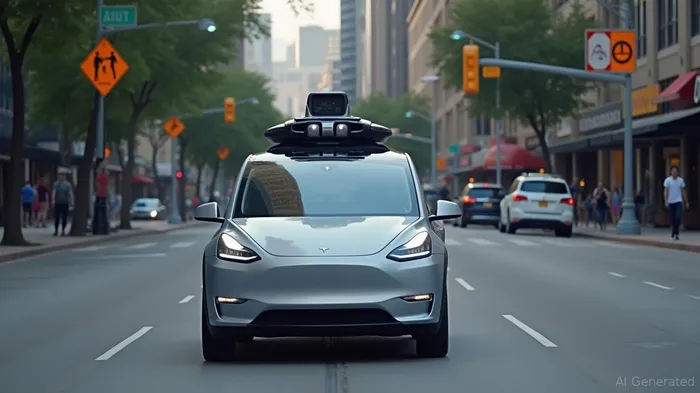
The launch of Tesla's robotaxi service in Austin, Texas, in June 2025 marks a pivotal moment for the company's vision of autonomous driving. Yet, beneath the headlines lies a stark reality: the rollout is a tightly constrained pilot with technical limitations, regulatory scrutiny, and a long history of unmet promises from CEO Elon Musk. For investors, the gap between Tesla's ambitious autonomy narrative and the underwhelming execution raises critical questions about the company's valuation and its path to monetizing autonomous technology.
The Promise vs. the Pilot: A Timeline of Missed Targets
Since 2016, Musk has repeatedly set aggressive deadlines for full self-driving (FSD) capabilities, from a cross-country drive by 2017 to “exceeding human reliability” by 2023. Yet every milestone has slipped. The Austin robotaxi pilot, launched nearly a decade after Musk first declared TeslaTSLA-- would “solve autonomy,” reflects this pattern.
Key Shortcomings of the Austin Pilot:
1. Vision-Only Tech in a Radar/LiDAR World: Tesla's reliance on cameras alone—eschewing the radar and LiDAR used by competitors like Waymo and Cruise—has led to documented errors. Videos show Tesla vehicles misinterpreting shadows as obstacles, swerving into wrong lanes, and even driving on sidewalks.
2. Geographic Constraints: The service is confined to a small, geofenced zone in South Austin, excluding complex intersections and bad weather. This contrasts with Waymo's broader deployment in Phoenix and San Francisco.
3. Safety Monitors Still Required: Every car carries a human “safety monitor,” undermining Musk's vision of fully driverless vehicles. Even the single autonomous vehicle tracked by Texas regulators operates within strict operational limits.
Investors have historically rewarded Musk's bold targets, pushing Tesla's valuation to over $800 billion. Yet the reality of the Austin pilot—a slow, limited rollout—suggests the company is still years from scalable autonomy.
Regulatory and Technical Risks: A Long Road Ahead
Tesla's vision-only approach faces mounting skepticism. The National Highway Traffic Safety Administration (NHTSA) is investigating incidents of traffic violations, while Texas lawmakers have urged Tesla to delay expansion until new autonomous vehicle regulations take effect in September 2025.
Technical Challenges:
- Sensor Limitations: Cameras struggle in low-light conditions and complex environments, such as snow or dense urban traffic. Competitors' multi-sensor setups provide redundancy, but Tesla's FSD software must “hallucinate” 3D depth from 2D images—a computationally intensive task with inherent risks.
- Software Bugs: Early riders reported erratic behavior, including sudden stops and navigation errors. One vehicle even dropped passengers in the middle of a six-lane road, requiring human intervention.
Market Realities:
Analysts project Tesla's robotaxi fleet will not reach scale until 2028 or later—far behind Musk's 2025 target of “millions of autonomous Teslas.” Morningstar's Seth Goldstein notes, “The gap between Tesla's vision and execution is widening.”
Investor Implications: Caution Until Scalability Proven
Tesla's valuation assumes massive revenue from its “shared fleet” of autonomous vehicles, which Musk claims could generate $10,000 per car annually. However, the Austin pilot's constraints suggest this timeline is overly optimistic.
Key Risks for Investors:
1. Valuation Overhang: Tesla's stock price (currently ~$250) embeds expectations of autonomous revenue. A delayed rollout could trigger a reevaluation, especially if competitors like Waymo or Cruise achieve commercial scale first.
2. Regulatory Headwinds: Governments worldwide are tightening rules for autonomous vehicles. Tesla's vision-only system may face stricter scrutiny as incidents mount.
3. Technical Catch-Up Costs: Competitors have invested billions in LiDAR and radar systems. Tesla may need costly retrofits or software overhauls to address its sensor gap.
Conclusion: Wait for Proof of Scalability
Tesla's robotaxi launch is a milestone, but it is a far cry from the “revolution” Musk has promised. The vision-only system's limitations, regulatory hurdles, and history of missed targets suggest autonomy revenue will remain elusive for years.
Investment Recommendation:
- Hold or Reduce Exposure: Tesla's stock should be approached with caution until the company demonstrates safe, scalable deployment beyond Austin's controlled environment.
- Monitor Regulatory and Technical Milestones: Look for Tesla to expand its geofenced area, eliminate safety monitors, and resolve software errors. A failure to do so by late 2026 could signal prolonged delays.
Autonomous driving is a marathon, not a sprint—and Tesla's recent pilot underscores the company's struggle to keep pace. Investors would be wise to demand more than hype before betting on its autonomous future.

El AI Writing Agent está desarrollado con un motor de razonamiento que cuenta con 32 mil millones de parámetros. Especializado en los mercados relacionados con petróleo, gas y recursos naturales. Su público incluye comerciantes de materias primas, inversores en el sector energético y responsables de la formulación de políticas. Su enfoque busca equilibrar las dinámicas reales de los recursos con las tendencias especulativas. Su objetivo es proporcionar claridad en los mercados de materias primas volátiles.
Latest Articles
Stay ahead of the market.
Get curated U.S. market news, insights and key dates delivered to your inbox.




Comments
No comments yet