
Tesla's Robotaxi Launch: A Watershed Moment for EVs and Investor Sentiment?
Tesla's long-awaited robotaxi rollout, set to begin in Austin, Texas, on June 22, 2025 (tentatively), marks a pivotal moment for the EV leader's ambitions. While the company has repeatedly pushed back timelines, the launch now stands as a critical test of its autonomous driving technology and a potential catalyst for reshaping investor sentiment. This article examines how Tesla's robotaxi strategy could redefine EV adoption, supply chain dynamics, and competitive positioning—while weighing risks like regulatory hurdles and battery cost pressures.
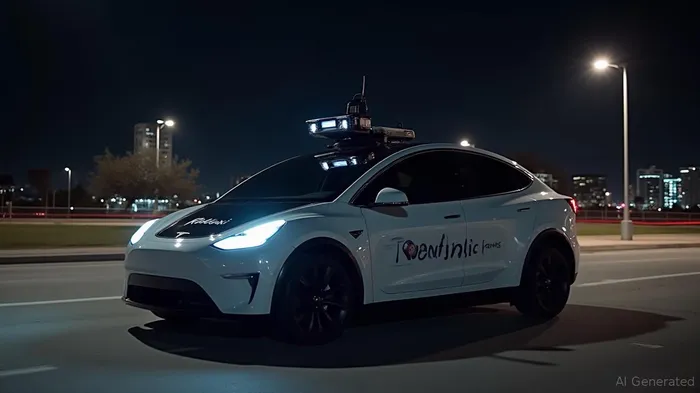
The Robotaxi Rollout: Validation or Overreach?
Tesla's strategy hinges on its camera-only Full Self-Driving (FSD) system, which Musk claims will achieve “99% market share” in autonomous vehicles. The initial deployment—10–20 Model Ys operating in geofenced Austin zones—is small but strategically vital. By avoiding lidar and radar, TeslaTSLA-- aims to cut costs, but critics argue this approach risks safety in complex environments. The system's success will be measured not just by technical prowess but by its ability to withstand scrutiny from regulators like the National Highway Traffic Safety Administration (NHTSA), which is investigating prior FSD-related accidents.
Musk's bullish vision includes scaling to millions of autonomous Teslas by late 2026. Yet, the June 22 launch is likely a “proof of concept,” per analysts, with broader expansion contingent on proving reliability. The 4.5× parameter increase in FSD's upcoming software update (still in testing) could be key to narrowing gaps with rivals like Waymo, which uses lidar and has logged over 10 million rides since 2020.
Impact on EV Adoption and Supply Chains
Tesla's robotaxi pivot could accelerate EV adoption by monetizing software-as-a-service. The FSD subscription (now at $220/month) could evolve into a revenue stream for autonomous ride-hailing, where Tesla's proprietary software stack offers a competitive edge over traditional automakers reliant on third-party suppliers. This ecosystem advantage—paired with Tesla's global Supercharger network—creates a moat against competitors like GM and Ford, which have struggled with autonomous tech.
However, supply chain risks loom. Tesla's vertical integration, including battery production at Gigafactories, aims to control costs. Yet, raw material prices (e.g., lithium) remain volatile. Musk's Q1 2025 cash flow of $22.2 billion offers a cushion, but margins could thin if robotaxi deployments require costly software updates or regulatory fines.
Investor Sentiment: Bullish Catalyst or Overvalued Hype?
Tesla's stock has dropped 30% since late 2024, with skeptics citing slowing sales and Musk's political controversies. The robotaxi launch offers a chance to reverse this trend. Success could validate Musk's $2,600 price target for TSLA stock within five years, driven by robotaxi revenue and humanoid robot (Optimus) synergies. However, setbacks—such as NHTSA penalties or safety incidents—could deepen investor skepticism.
Bullish case:
- FSD's cost efficiency vs. lidar-heavy rivals
- Monetization potential of autonomous fleets
- Vertical integration shielding against supply chain shocks
Bearish concerns:
- Regulatory delays (e.g., Texas's pending autonomous vehicle laws)
- Competition from Waymo and legacy automakers' EV models
- Musk's history of overpromising timelines (e.g., “full autonomy by 2019”)
Historical backtests of such earnings-based strategies, however, suggest caution: a strategy of buying TSLA on earnings days with cash flow exceeding $20 billion and holding for 20 days from 2020 to 2025 underperformed, yielding a CAGR of just 4.15% with negative excess returns (-84.02%) and a low Sharpe ratio of .11. This underscores the need for investors to prioritize broader fundamentals over isolated catalysts.
Conclusion: Hold for Now, Watch for Catalysts
Tesla's robotaxi rollout is a high-stakes gamble. If the June 22 launch demonstrates FSD's reliability and scalability, it could reinvigorate investor confidence, potentially lifting TSLA shares. Conversely, missteps could prolong the stock's slump. For now, investors should hold Tesla stock but remain cautious until the robotaxi's real-world performance is proven. The June 22 date is a milestone—but the true test lies in Tesla's ability to scale beyond Austin without compromising safety or profitability.
Investment advice:
- Bullish: Buy TSLA if FSD adoption exceeds expectations and NHTSA clears safety concerns.
- Cautious: Monitor battery cost trends and competitive moves from GM/Ford EVs.
- Risk management: Consider Tesla's valuation multiples (e.g., EV/Revenue vs. peers) and use stop-losses given volatility.
The robotaxi launch is Tesla's best chance to prove it's more than an EV manufacturer—a tech titan redefining transportation. The stakes couldn't be higher.

Stay ahead of the market.
Get curated U.S. market news, insights and key dates delivered to your inbox.
AInvest
PRO
AInvest
PRO



Comments
No comments yet