
Tesla's Robotaxi Launch: A Pivotal Moment for Autonomous Dominance and Valuation
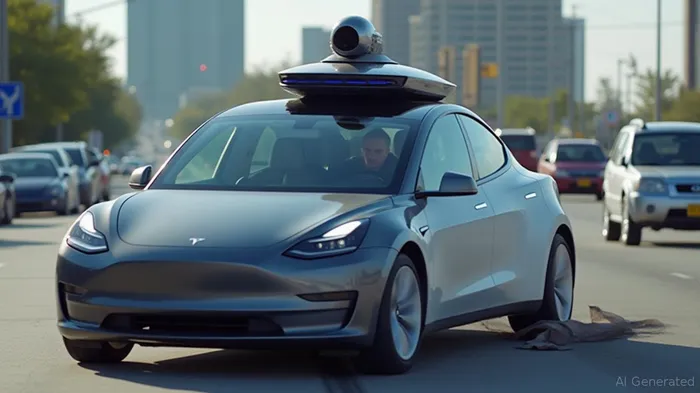
Tesla's long-awaited self-driving taxi service, dubbed the “robotaxi,” is poised to redefine the automotive and mobility sectors. Set to launch in Austin on June 22, 2024, with a scaled rollout anticipated in 2025, the service could transform TeslaTSLA-- from a premium electric vehicle (EV) manufacturer into a leader in autonomous mobility. However, its success hinges on overcoming regulatory, technical, and competitive challenges—factors that will determine whether Tesla's valuation soars or stumbles.
The Transformative Potential: Beyond Vehicle Sales
Tesla's robotaxi service represents a strategic pivot toward recurring revenue streams. By leveraging its installed base of FSD-equipped vehicles—now over 1.5 million—the company aims to monetize its software prowess through a subscription-based mobility service. Initial tests in Austin will use Model Ys, but the eventual deployment of the Cybercab—a purpose-built autonomous vehicle without steering wheels—could lower costs and expand capacity.
Crucially, the robotaxi network could disrupt traditional automakers' business models. Analysts estimate Tesla could generate $2,000–$5,000 annually per vehicle in ride-hailing revenue, potentially doubling its current average profit margins. This shift aligns with Musk's vision of Tesla as a “software-first” company, where cars become rolling data centers and mobility platforms.
Tesla's stock has fallen 30% since late 2023 amid declining EV sales and profit warnings, but investors are betting the robotaxi will reverse this trend. A successful launch could validate Musk's claim that autonomous driving will drive a “500% increase in shareholder value” over the next decade.
Risks and Hurdles: Can Tesla Deliver?
Despite the promise, execution risks loom large. Tesla's FSD system, which relies solely on cameras (unlike lidar-equipped rivals like Waymo), faces scrutiny after a fatal pedestrian accident and an ongoing National Highway Traffic Safety Administration (NHTSA) investigation. Technical limitations—such as the FSD v13.2.9 update's 493-mile average between critical disengagements—highlight the gap between Tesla's ambitions and current capabilities.
Regulatory hurdles are equally daunting. While Texas permits autonomous testing without special licenses, broader U.S. deployment requires federal exemptions for Cybercab's lack of steering wheels. Internationally, Tesla must navigate stricter regulations, such as California's requirement for teleoperators—a system Tesla has yet to fully disclose.
Competitive pressures also loom. Waymo, already operating 250,000 weekly rides in select cities, enjoys a safety record 3.5x better than human drivers. Meanwhile, Tesla's historical timeline misses—such as its 2019 pledge of 1 million robotaxis by 2020—undermine credibility. Analyst Gordon Johnson of GLJ Research warns the 2024 launch may be a “proof of concept,” not a scalable service.
Risks to Traditional Automakers: A New Era of Disruption
Tesla's entry into autonomous mobility could accelerate the decline of legacy automakers. General Motors and Ford abandoned their autonomous projects due to costs, ceding ground to tech firms like Waymo. Tesla's vertically integrated model—combining software, hardware, and charging infrastructure—threatens to undercut competitors' margins and market share.
For investors, the stakes are existential. If Tesla's robotaxi succeeds, it could capture a $1.5 trillion global mobility market, justifying its $600 billion valuation. But failure risks further declines, as Tesla's stock trades at 185x forward P/E—far above peers.
Investment Implications: A High-Reward, High-Risk Bet
The robotaxi launch is Tesla's make-or-break moment. Here's how to position:
- Optimistic Long-Term Play: Buy Tesla stock (TSLA) for its autonomous software potential. A successful 2025 rollout could catalyze a re-rating, especially if FSD achieves Musk's 670,000-mile unsupervised benchmark.
- Wait-and-See Approach: Hold off until post-launch data confirms scalability and safety. Monitor NHTSA's findings and Cybercab production timelines.
- Competitor Exposure: Short legacy automakers (GM, F) if Tesla's service gains traction, as their EV margins could compress further.
Conclusion
Tesla's robotaxi is more than a product launch—it's a bet on Musk's vision of a software-driven automotive future. While risks abound, the potential rewards for Tesla's valuation and market dominance are immense. Investors must weigh the company's execution history against its transformative ambition. For those willing to bet on Tesla's long game, the next 12 months could determine whether it becomes the Amazon of autonomous mobility—or a cautionary tale of overhyped innovation.
As of June 2025, Tesla's stock has underperformed GM and Ford, reflecting skepticism. A successful robotaxi rollout could reverse this trend, but the road ahead remains fraught with potholes.

Stay ahead of the market.
Get curated U.S. market news, insights and key dates delivered to your inbox.
AInvest
PRO
AInvest
PRO



Comments
No comments yet