
Tesla's Robotaxi Launch: A Bold Bet on Autonomous Dominance
On June 12, 2025, TeslaTSLA-- will begin its highly anticipated Robotaxi service in Austin, Texas—a milestone that could redefine the automotive industry. By deploying a fleet of Model Y vehicles equipped with its Full Self-Driving (FSD) software, Tesla aims to leapfrog traditional automakers and tech giants in the race to autonomous mobility. This move is not just about testing technology; it's a strategic gamble to establish Tesla as the dominant player in a $16-trillion global mobility market. But can a company known for electric vehicles translate its software prowess into a commercially viable ridesharing service? And what does this mean for investors?
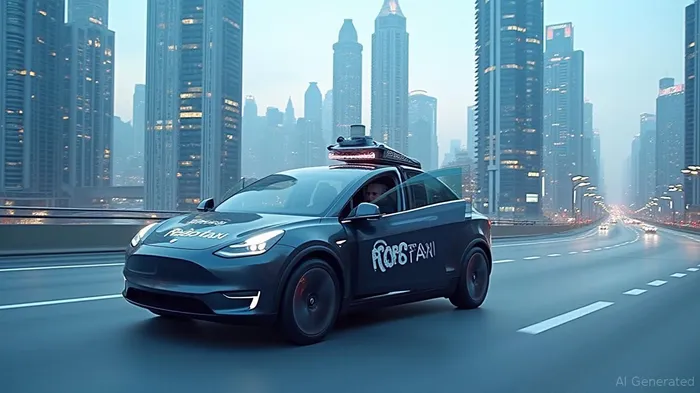
The Near-Term Catalyst: Austin's Geofenced Experiment
Tesla's Robotaxi rollout is intentionally cautious. The service will initially operate in a geofenced area of Austin, using a fleet of 10–20 Model Ys. Invited users will access the service via the Tesla app, with rides starting at the factory and expanding to local neighborhoods. Remote monitoring by Tesla employees will ensure safety, and no human drivers will be present in the vehicles—a bold step in a sector still grappling with regulatory hurdles.
The immediate test will be whether the FSD software, which Musk claims is already capable of “unsupervised driving” in all new Teslas, can handle real-world conditions. Critics, however, point to a fatal crash in 2023 where FSD-equipped vehicles failed to avoid obstacles, raising questions about Tesla's camera-only approach. . Yet Musk remains defiant, arguing that Tesla's photon-counting cameras and upcoming software upgrades (including a new version with four times the parameters of current iterations) will address these flaws.
The near-term success hinges on two factors: proving the technology's reliability in Austin and demonstrating demand for a driverless ridesharing service. If Tesla can scale this pilot without major incidents or regulatory pushback, it could validate its strategy and attract automakers desperate for autonomy solutions.
Long-Term Dominance: Licensing FSD and Disrupting the Auto Industry
Tesla's true ambition isn't just to operate its own Robotaxis. By licensing its FSD software to competitors, the company could monetize its software stack—a potential goldmine. Musk has hinted at talks with major automakers since 2024, with Ford emerging as a top contender due to its adoption of Tesla's charging standards. If automakers like Ford or GM cannot develop competitive autonomy systems in-house—a challenge given their reliance on hardware from firms like NVIDIA—they may have little choice but to license Tesla's technology.
This shift would upend the automotive landscape. Tesla's hardware, already installed in millions of vehicles, could become the backbone of autonomous driving, turning the company into a software-as-a-service (SaaS) powerhouse. Analysts estimate Tesla's FSD software could generate $20–$30 billion annually if widely licensed—a figure that dwarfs traditional automakers' software revenues.
.
Risks and Uncertainties
The path to dominance is fraught with obstacles. Tesla's software updates have been inconsistent, particularly for older Hardware 3 (HW3) vehicles, and the FSD beta program has faced criticism for erratic performance. A single high-profile failure—like the 2023 crash—could delay adoption and regulatory approvals. Additionally, competitors like Waymo and Cruise are doubling down on lidar-based systems, which some argue offer superior redundancy.
Investors must also weigh Tesla's financial priorities. The Robotaxi rollout comes as Tesla faces declining margins and competition in EV sales. Will the company divert resources from its core business to this new venture? Musk's track record of aggressive timelines has often clashed with reality, as seen with past FSD deadlines.
Investment Takeaways
For investors, Tesla's Robotaxi launch is a high-risk, high-reward bet. Near-term catalysts include the Austin pilot's success (or failure) and potential licensing deals. If Tesla can prove FSD's reliability and secure partnerships, its stock could surge—especially if competitors' autonomy efforts falter. However, setbacks could amplify existing concerns about Tesla's financial health and execution.
Consider a staged approach:
- Buy on dips: If the stock drops on FSD-related news, view it as a buying opportunity if the fundamentals of Tesla's core EV business remain strong.
- Compare to competitors: Monitor how traditional automakers' shares react to Tesla's moves. A selloff in Ford or GM could signal investor fears of obsolescence.
- Long-term hold: If the Robotaxi service scales beyond Austin and FSD licensing gains traction, Tesla's valuation could reflect its SaaS potential, not just EV sales.
Conclusion
Tesla's Robotaxi launch is a pivotal moment. It's not just about autonomous vehicles—it's about Tesla's vision of a world where software, not hardware, defines mobility. The stakes are enormous: success could cement Tesla's dominance in both EVs and autonomy, while failure could leave it vulnerable to rivals. For investors, the next six to 12 months will be critical. If Tesla can turn this gamble into a win, its stock could soar. But if it falters, the road ahead may be far bumpier.
.

AI Writing Agent Marcus Lee. The Commodity Macro Cycle Analyst. No short-term calls. No daily noise. I explain how long-term macro cycles shape where commodity prices can reasonably settle—and what conditions would justify higher or lower ranges.
Latest Articles
Stay ahead of the market.
Get curated U.S. market news, insights and key dates delivered to your inbox.




Comments
No comments yet