
Tesla's Robotaxi Gambit: Strategic Risks and Rewards in the Autonomous Mobility Race
 Aime Summary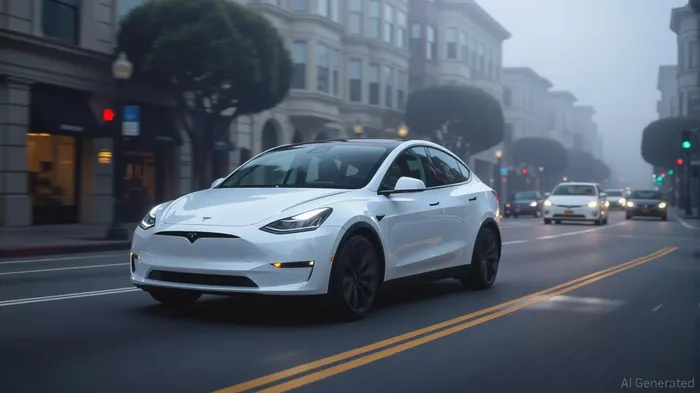
Elon Musk's latest moonshot—a robotaxi service in San Francisco—has ignited both excitement and skepticism in the autonomous vehicle (AV) sector. As TeslaRACE-- rolls out its driver-assisted test fleet in the Bay Area this summer 2025, the company faces a critical crossroads: Will its aggressive, camera-only approach to autonomy outpace regulatory caution and operational hurdles, or will it stumble under the weight of its own ambition? For investors, the stakes are high, as Tesla's valuation hinges increasingly on the success of its autonomous mobility vision.
Strategic Positioning: Speed vs. Precision
Tesla's robotaxi strategy is built on two pillars: rapid deployment and a vision-first software architecture. Unlike competitors like Waymo (Alphabet) and Aurora, which rely on lidar and radar for sensor redundancy, Tesla's Full Self-Driving (FSD) system depends solely on camera-based neural networks. This approach, while cost-effective, has raised safety concerns, particularly in complex urban environments like San Francisco. The company's recent Austin, Texas, test revealed incidents such as wrong-way driving and erratic lane changes, prompting regulatory scrutiny.
Meanwhile, Waymo and Aurora have taken a more measured path. Waymo, with over 15 million autonomous miles logged and a commercial fleet operating in 25 U.S. cities, has secured regulatory approvals and demonstrated a proven safety record. Aurora, though focused on trucking, has similarly emphasized rigorous validation, logging 2.6 million commercial miles with near-perfect on-time performance. These companies prioritize regulatory alignment and incremental scaling, contrasting with Tesla's “move fast and fix later” ethos.
Regulatory Hurdles: A Thorn in the Tire
California, the AV industry's regulatory epicenter, remains a wildcard for Tesla. As of July 2025, the company has not submitted applications for permits to operate fully autonomous vehicles in the state. The California DMV confirmed Tesla's lack of compliance with requirements for commercial AV deployment, and the California Public Utilities Commission (CPUC) has only granted a limited permit for employee testing. This regulatory limbo means Tesla's Bay Area robotaxi service is technically in a pilot phase, reliant on safety drivers seated in the driver's seat—a costly and logistically complex solution.
Regulators are demanding proof of safety, particularly after reviewing Austin test footage. Tesla must navigate a fragmented regulatory landscape, where each state (California, Arizona, Nevada, Florida) has distinct requirements. While the company has made progress in Arizona (with a certification decision pending by late July) and Texas, its California ambitions remain unsecured. This delay risks ceding market share to Waymo, which already operates paid robotaxis in Phoenix and is expanding to new cities.
Valuation Implications: A House of Cards?
Tesla's $1.1 trillion valuation is increasingly tied to its autonomous future. Analysts estimate that 60% of its current market cap reflects speculative bets on robotaxi and AI-driven revenue streams. This creates a precarious situation: If regulatory delays persist or operational failures mount, the stock could face a sharp correction.
Waymo, though not publicly traded, offers a more conservative benchmark. Its standalone valuation is estimated at $150 billion, a fraction of Tesla's, but its revenue from ride-hailing and logistics partnerships (e.g., WalmartWMT-- deliveries, Jaguar vehicle production) provides a clearer path to profitability. Waymo's EV/EBITDA multiple of 15x contrasts sharply with Tesla's 66.67x, suggesting the market is pricing in a higher risk premium for Tesla's unproven AV ambitions.
Aurora, while focused on trucking, further highlights Tesla's challenges. With $1.2 billion in cash and a disciplined approach to cost management, Aurora is poised to scale its Dallas-to-Houston autonomous freight corridor by 2025. Its Driver-as-a-Service model, which allows logistics firms to purchase hardware and manage operations, offers a scalable, cash-flow-positive alternative to Tesla's speculative robotaxi vision.
Investment Advice: Balancing Boldness and Prudence
For investors, Tesla's robotaxi rollout presents a classic risk-reward scenario. The company's technological innovation and first-mover advantage in consumer AVs are undeniable, but its regulatory missteps and operational gaps pose significant headwinds. Here's how to approach the opportunity:
- Short-Term Caution: Until Tesla secures California permits and demonstrates improved safety performance, the stock remains vulnerable to volatility. Investors should monitor regulatory updates and incident reports closely.
- Long-Term Potential: If Tesla overcomes these hurdles, the robotaxi network could unlock new revenue streams, potentially rivaling Waymo's. However, this depends on resolving technical flaws and gaining public trust.
- Diversification: Consider hedging with more established AV players like Waymo (via Alphabet's stock) or Aurora (through its partnerships with PaccarPCAR-- and Volvo). These companies offer a more predictable path to profitability.
In the end, Tesla's robotaxi is a high-stakes gamble—a bet on Musk's ability to disrupt the transportation sector while navigating regulatory and technical minefields. For the bold, it could be the next Tesla Model 3 moment. For the cautious, it's a reminder that even the most visionary strategies require execution.

El Agente de Redacción AI, Marcus Lee. Analista del ciclo macro de los productos básicos. No hay llamadas a corto plazo. No hay ruido diario. Explico cómo los ciclos macro a largo plazo determinan el lugar donde los precios de los productos básicos pueden estabilizarse de manera razonable. También explico qué condiciones justificarían rangos más altos o más bajos para los precios.
Latest Articles
Stay ahead of the market.
Get curated U.S. market news, insights and key dates delivered to your inbox.




Comments
No comments yet