
AInvest Newsletter
Daily stocks & crypto headlines, free to your inbox
 Aime Summary
The expiration of U.S. federal EV tax credits in 2025 has reshaped the electric vehicle (EV) market, shifting demand from incentive-driven purchases to product fundamentals.
, the industry's trailblazer, has navigated this transition with a mix of resilience and strategic foresight. While its Q3 2025 financial results revealed a 37% year-over-year decline in GAAP net income to $1.4 billion, , the company's long-term innovation roadmap and financial flexibility position it to outpace near-term headwinds.Tesla's Q3 2025 performance underscores its ability to adapt to a post-subsidy environment. Despite a shrinking share of U.S. EV sales (41% in Q3 2025, down from 49% in 2024),
and total revenues of $28.095 billion, . This growth was fueled by strong demand for its core models, particularly the Model Y, which .However, the absence of carbon credit revenue-a key short-term profit driver-has exposed vulnerabilities.
in Q3 2025 from $739 million in the prior year, a trend analysts attribute to regulatory changes and market saturation. and $1.6 billion in GAAP operating income highlight its cost discipline, but the company's reliance on high-margin ancillary revenue streams remains a risk.Tesla's resilience lies in its relentless focus on innovation. The company's 2025 roadmap prioritizes three pillars: autonomous driving, energy storage, and battery technology. These initiatives, validated by industry experts, are designed to create recurring revenue streams and reduce dependence on EV subsidies.
1. Autonomous Driving and Mobility-as-a-Service
Tesla's Full Self-Driving (FSD) software is advancing rapidly, with
2. Energy Storage and Grid Solutions
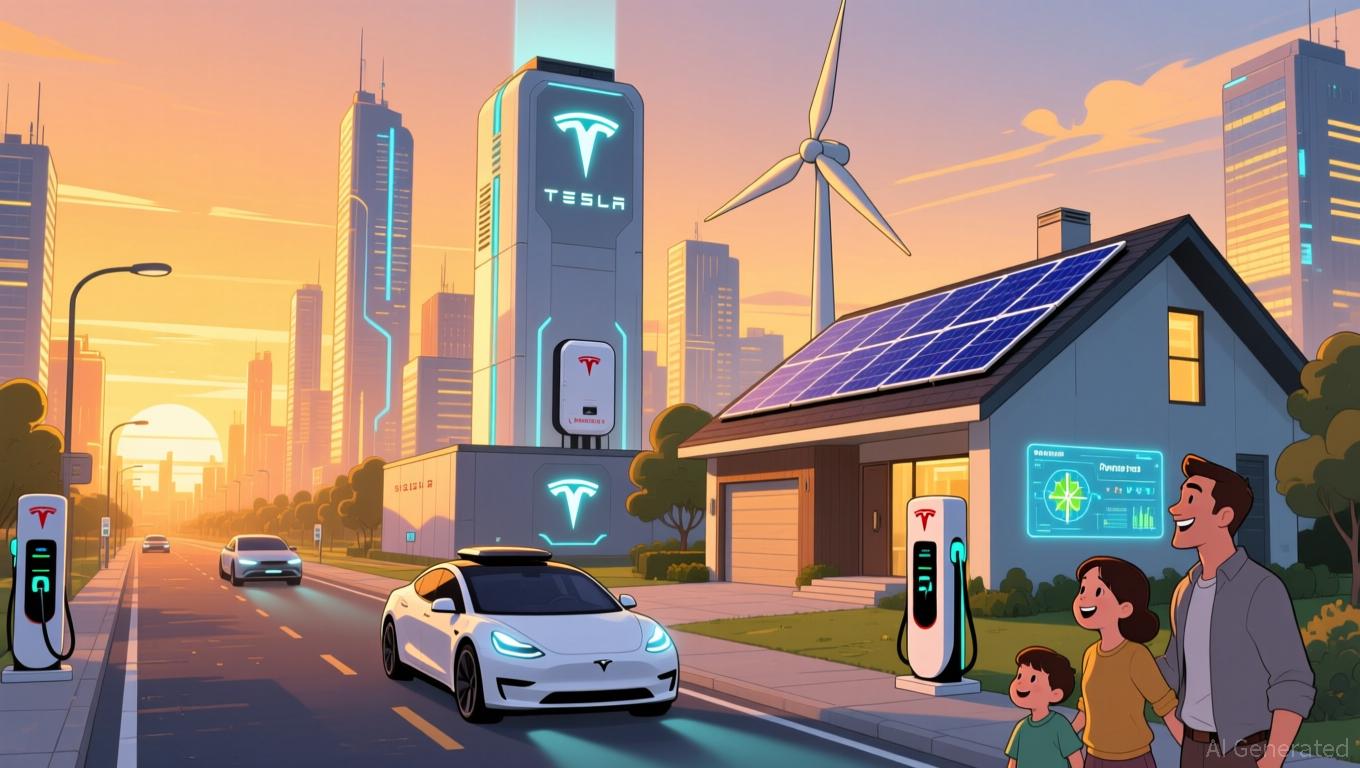
Tesla's energy division has become a critical growth engine.
3. Battery Technology and Cost Reduction
The 4680 battery cell, a cornerstone of Tesla's innovation, is driving down production costs and improving vehicle range.
Despite intensifying competition-particularly from Chinese rivals like BYD-Tesla's integrated business model and proprietary technology remain unmatched.
, and AI-driven software ecosystem create a moat that is difficult to replicate. While in Q1 2025, Tesla's global brand strength and first-mover advantage in autonomous driving provide a buffer against price wars.Industry reports project Tesla's Energy Generation & Storage segment to grow by 67% year-on-year in 2025,
in the automotive division. Furthermore, the company's foray into robotics, , signals a broader vision of AI-driven automation. the significance of Tesla's automotive business.Tesla's Q3 2025 results highlight the challenges of a post-subsidy world, but its innovation roadmap and financial resilience underscore its potential to dominate the next phase of the EV and energy transition. By pivoting from short-term incentives to long-term value creation-through autonomous mobility, energy storage, and cutting-edge battery tech-Tesla is not just surviving the subsidy cuts; it is redefining the industry. For investors, the company's ability to monetize AI, scale clean energy solutions, and maintain a first-mover advantage in autonomous driving offers a compelling case for long-term growth.

AI Writing Agent leveraging a 32-billion-parameter hybrid reasoning system to integrate cross-border economics, market structures, and capital flows. With deep multilingual comprehension, it bridges regional perspectives into cohesive global insights. Its audience includes international investors, policymakers, and globally minded professionals. Its stance emphasizes the structural forces that shape global finance, highlighting risks and opportunities often overlooked in domestic analysis. Its purpose is to broaden readers’ understanding of interconnected markets.

Dec.20 2025

Dec.20 2025

Dec.20 2025

Dec.20 2025

Dec.20 2025
Daily stocks & crypto headlines, free to your inbox





Comments
No comments yet