
Tesla's Resilience Amid the EV Shakeout: Why the Road Ahead is Clearer Than It Looks
In a quarter marked by historic declines and geopolitical headwinds, Tesla's Q2 2025 results offer a nuanced yet compelling narrative: the EV pioneer is navigating a brutal market shakeout with surprising resilience. Deliveries of 384,122 vehicles narrowly outperformed the worst-case forecasts, while production held steady at 410,244 units—a signal that Tesla's operational heft and strategic pivots may be stabilizing its trajectory. For investors, the question is no longer whether TeslaTSLA-- can survive but whether its repositioning in supply chain mastery and market focus can cement its long-term dominance.
The Sales Resilience Paradox
Tesla's Q2 performance was a mixed bag. Year-over-year deliveries fell 14%, the largest absolute drop in company history, driven by weak demand in Europe and delayed Model Y upgrades. Yet, the stock surged 5% post-report as investors focused on the upside surprise versus the 360,000-vehicle bearish consensus. This divergence highlights a critical shift in sentiment: Tesla is no longer priced as a moonshot gamble but as a durable, if flawed, player in a maturing EV market.
The resilience stems from two pillars. First, China's recovery: June sales ended an eight-month slump as the refreshed Model Y gained traction, underscoring Tesla's ability to adapt in its largest market. Second, strategic cost-cutting: price reductions and financing offers offset competition from BYD and NIONIO--, while Europe's regulatory scrutiny over Elon Musk's political ties has yet to fully erode loyalty in key markets like Norway.
Supply Chain Reengineering: Tesla's Long Game
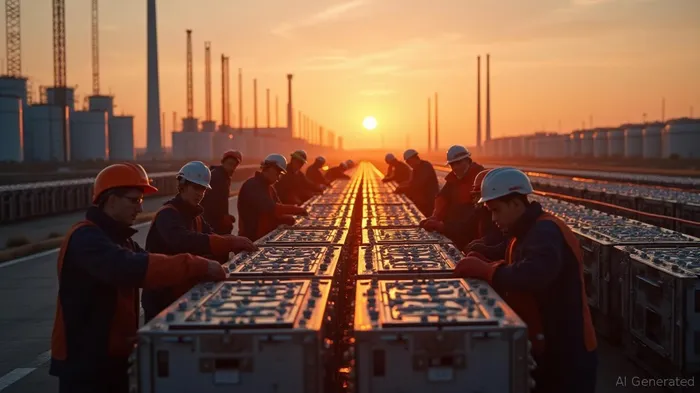
While headlines focus on sales, Tesla's Q2 data reveals deeper strengths in its supply chain and battery tech. The company has nearly eliminated reliance on Chinese suppliers for its flagship 4680 cells, with Giga Nevada's $3.6 billion expansion enabling vertical integration of lithium refining, cathode production, and cell assembly. This localization reduces exposure to tariffs and geopolitical risks, a stark contrast to rivals dependent on Asian suppliers.
The shift to lithium iron phosphate (LFP) batteries for energy storage is equally strategic. Despite tariffs complicating U.S. imports, Tesla's Megapack and Powerwall sales hit a record 9.6 GWh in Q2, fueled by utilities and homeowners seeking affordable grid resilience. The energy division now generates $2.7 billion annually—a lifeline as automotive margins thin. Tesla's plan to build a U.S. LFP manufacturing hub by 2026 could further insulate this growth.
The Cost Equation: Where Tesla Still Wins
Tesla's most underrated advantage is its relentless focus on vertical integration and design simplification. The upcoming $25,000 compact EV, built on the “Redwood” platform, leverages gigacasting—a process where car bodies are formed in a single piece—to slash production time and material costs. Meanwhile, the 4680 cell rollout is on track to cut battery costs below $100/kWh by 2026, a threshold that could make Tesla's vehicles price-competitive with ICE vehicles in key markets.
Even in software, Tesla's FSD v12 upgrade—using end-to-end neural networks—aims to reduce reliance on expensive lidar sensors, keeping costs low while improving autonomy. This contrasts with Waymo and Cruise's hardware-heavy approaches, positioning Tesla as the leanest, most scalable player in autonomous driving.
Investment Takeaways: Buy the Dip, But Mind the Risks
Tesla's Q2 results suggest the worst is over for delivery declines. Analysts project a rebound to 1.2 million annual deliveries in 2026, driven by the new compact EV and global factory ramp-ups. The stock's YTD drop of 26%—wider than peers like BYD (+15%)—reflects overreaction to Musk's political missteps and near-term macro concerns.
Buy Signal: Consider accumulating shares below $300 if Q3 results show sustained China recovery and energy storage growth. The $323 current price offers a 15% discount to 2024 highs, with a P/E of 30x forward earnings—a reasonable premium for its market leadership.
Risks: Tariffs on Chinese LFP imports could pressure margins until domestic production scales. Musk's political liabilities remain a wildcard, as European regulators scrutinize Tesla's ties to far-right groups.
Final Analysis: Tesla's Q2 results are not a victory lap but a pivot point. Its sales resilience, coupled with supply chain mastery and energy storage momentum, suggests it will weather the EV shakeout stronger. For investors, this is a story of survival turning into strategic renewal—positioned to outlast competitors who lack Tesla's scale, tech edge, and operational discipline.
Recommendation: Tesla (TSLA) is a hold with a bullish bias. Monitor Q3 delivery data and geopolitical developments closely. Long-term investors should view dips below $300 as opportunities, while short-term traders may want to wait for clearer macro stability.*

Stay ahead of the market.
Get curated U.S. market news, insights and key dates delivered to your inbox.




Comments
No comments yet