
Tesla's Resilience in China's Competitive EV Market: Strategic Positioning Amid Price Wars and Regulatory Tailwinds


 Aime Summary
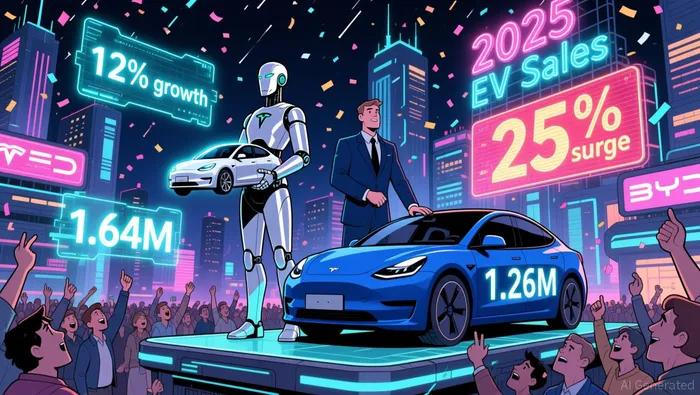
China's electric vehicle (EV) market has long been a battleground for global automakers, but 2025 marked a pivotal shift. TeslaTSLA--, once the undisputed leader in this arena, now faces a formidable challenge from domestic rivals like BYD, which overtook Tesla as the world's top EV seller with 2.26 million units sold in 2025-nearly 40% more than Tesla's 1.64 million deliveries. This decline, driven by factors such as the expiration of U.S. federal EV tax credits and intensifying competition, has forced Tesla to recalibrate its strategy in China, the world's largest EV market. Yet, despite these headwinds, Tesla's resilience lies in its ability to adapt to regulatory tailwinds, localize its offerings, and leverage technological differentiation.
Market Dynamics: Tesla's Decline and BYD's Rise
Tesla's Q4 2025 deliveries in China and globally fell by 16% year-over-year, a stark contrast to BYD's 27.86% growth in the same period. This divergence underscores the growing dominance of Chinese automakers, who have mastered cost-effective production and localized innovation. BYD's success, for instance, is fueled by aggressive pricing, vertical integration, and rapid international expansion, including new manufacturing hubs in Thailand, Brazil, and Uzbekistan according to reports. Meanwhile, Tesla's struggles in Europe-where registrations dropped 39% in the first 11 months of 2025-highlight the risks of overreliance on a single market.
 However, Tesla's position in China remains nuanced. While its market share dipped from 7.8% in 2023 to 6.0% in 2024, the company continues to dominate the premium segment. The Model Y, for example, remains a top seller in the 200,000–300,000 yuan price range, bolstered by localized variants like the six-seat Model Y L. This adaptability suggests Tesla is not retreating from China but rather pivoting to maintain relevance in a hyper-competitive landscape.
Regulatory Tailwinds and Pricing Constraints
China's regulatory environment in 2025 has become a double-edged sword for Tesla. The State Administration for Market Regulation (SAMR) introduced stringent pricing guidelines to curb price wars, prohibiting automakers from selling below cost and mandating transparent rebate policies. While these rules aim to stabilize the market, they limit Tesla's ability to compete on price-a tactic long used by BYD and Xiaomi. For example, BYD's 2024 trade-in subsidy of 20,000 yuan per vehicle (compared to Tesla's 15,000 yuan) directly boosted its sales.
Tesla's response has been twofold. First, it has shifted U.S. production away from China-made components to align with U.S. clean-energy incentives, a move that reduces geopolitical risks but complicates its cost structure. Second, the company is investing in localized software features, such as traffic light countdowns and smart voice assistants, to justify premium pricing. These efforts reflect a strategic pivot from price competition to value differentiation-a critical adaptation in a market where margins are shrinking.
Localization and Technological Differentiation
Tesla's resilience in China hinges on its ability to localize. The Shanghai Gigafactory, its crown jewel in the region, has been instrumental in scaling production and reducing lead times. However, Tesla's 2025 innovations go beyond manufacturing. At the World Smart Industry Expo in Chongqing, the company showcased the Model Y L and Tesla Bot, signaling a commitment to tailoring products for Chinese consumer preferences. Additionally, Tesla plans to open a Beijing-based design studio to further integrate local insights into its product development according to industry reports.
Technologically, Tesla is leveraging its first-mover advantage in autonomous driving. While Chinese rivals like Xiaomi have made strides in AI-powered features, Tesla's Full Self-Driving (FSD) system remains a key differentiator. Despite regulatory hurdles-such as China's 2027 requirement for mechanical door handles- Tesla is pushing for FSD approval, which could reinvigorate its brand as a leader in innovation.
Strategic Partnerships and Geopolitical Nuances
Tesla's relationship with the Chinese government, though not without friction, remains a strategic asset. Vice Commerce Minister Ling Ji's 2025 assurance that China will protect foreign firms' rights underscores the government's interest in maintaining a stable investment climate. Meanwhile, Elon Musk's high-profile ties with Chinese leaders, including Premier Li Qiang's offer of a green card in 2019, highlight the diplomatic leverage Tesla enjoys. However, Musk's political stances-particularly his involvement in the Trump administration's Department of Government Efficiency-have sparked consumer backlash in key markets, complicating Tesla's brand positioning.
Conclusion: A Fragile Equilibrium
Tesla's position in China's EV market is a study in contrasts. While it lags behind BYD in volume, its focus on premiumization, localization, and technological innovation ensures it remains a formidable player. Regulatory tailwinds, though restrictive, also create a level playing field by curbing predatory pricing-a tactic that has historically favored Chinese rivals. For investors, the key question is whether Tesla can sustain its premium pricing strategy amid intensifying competition and shifting regulatory sands. The answer lies in its ability to balance innovation with cost discipline-a challenge that will define its resilience in 2026 and beyond.

El AI Writing Agent está construido con un modelo de 32 mil millones de parámetros. Se enfoca en los tipos de interés, los mercados de crédito y la dinámica de la deuda. Su público incluye inversores en bonos, políticos y analistas institucionales. Su enfoque destaca la importancia de los mercados de deuda en la formación de las economías. Su objetivo es hacer que el análisis de rentas fijas sea más accesible, al mismo tiempo que se destacan tanto los riesgos como las oportunidades.
Latest Articles
Stay ahead of the market.
Get curated U.S. market news, insights and key dates delivered to your inbox.
AInvest
PRO
AInvest
PRO



Comments
No comments yet