
Tesla's Resilience in the Autonomous Vehicle AI Arms Race: Strategic Timing and Technological Moats


 Aime Summary
The autonomous vehicle (AV) industry is a high-stakes battlefield where timing, technical execution, and regulatory navigation define success. TeslaTSLA--, under Elon Musk's leadership, has positioned itself as a formidable contender, leveraging strategic timing and technological moats to outpace competitors. As of late 2025, Tesla's Full Self-Driving (FSD) roadmap, hardware innovations, and regulatory progress underscore its resilience in the AI-driven mobility race.
Strategic Timing: A First-Mover Advantage with Global Ambitions
Tesla's FSD beta rollout began in October 2020, with continuous iterative improvements that have positioned the company to outpace traditional automakers and tech rivals. By September 2024, FSD v12.5.2 had achieved a threefold improvement in reducing human intervention requirements, while FSD v13 introduced autonomous unparking and parking features. This rapid iteration is underpinned by Tesla's vertical integration of hardware and software, enabling faster deployment cycles compared to competitors reliant on third-party suppliers.
Musk has consistently emphasized Tesla's five- to six-year lead in AV development, attributing this to its unparalleled real-world training data. With 10 billion kilometers of Autopilot driving experience by 2024, Tesla has met Musk's regulatory approval benchmarks. However, global expansion remains a hurdle. In Europe, Tesla aims to secure a national exemption in the Netherlands by February 2026, a critical step for EU-wide recognition. In China, full FSD approval is anticipated by early 2026, though the system's current version lags in local adaptability.
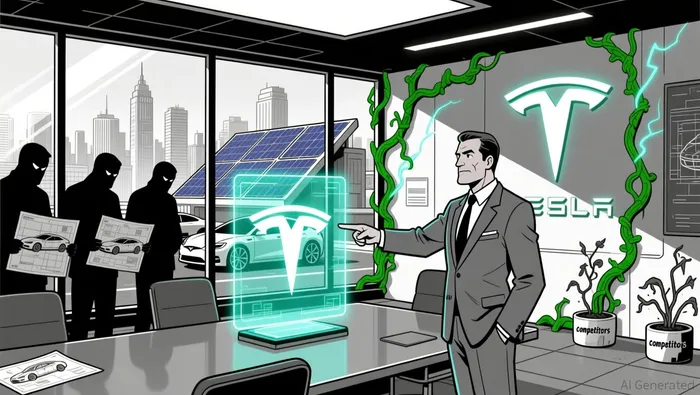
Technological Moats: Vertical Integration and AI Hardware Superiority
Tesla's technological edge lies in its vertically integrated AI stack, from custom silicon to fleet learning. The discontinuation of the Dojo supercomputer project in August 2025 marked a strategic pivot toward AI5 and AI6 inference chips, which Musk claims will outperform competitors. AI5, set for production in late 2025, offers a 40x performance boost over its predecessor and is optimized for models under 250 billion parameters. AI6, expected to follow and double AI5's performance, will consolidate Tesla's AI roadmap.
This shift to in-house silicon contrasts sharply with rivals like NVIDIA, which rely on generic AI solutions. Tesla's AI5 and AI6 chips, manufactured by TSMC and Samsung, enable real-time processing and energy efficiency, critical for autonomous driving and robotics. Meanwhile, the company's Hardware 5 (HW5) platform, slated for 2025 and will further enhance FSD's capabilities.
Regulatory Hurdles and Competitive Pressures
Despite its technical prowess, Tesla faces regulatory headwinds. In Europe, outdated rules for Level 2+ features have delayed approvals. In China, data sovereignty laws and domestic competition from BYD and Huawei complicate Tesla's expansion. Local players like Momenta and Huawei are gaining traction with ADAS systems tailored to regional conditions, challenging Tesla's global dominance.
Yet, Tesla's strategies-such as a zero-interest financing program in China and aggressive regulatory lobbying-highlight its adaptability. The company's ability to navigate these challenges while maintaining a first-mover advantage in AI training data and hardware innovation positions it to outlast rivals in the long term.
Future Outlook: Navigating the "EV Winter" and Beyond
As the global EV market faces a potential "EV winter" in 2026, with slowing sales growth and regulatory scrutiny, Tesla's FSD roadmap remains a key differentiator. The company's focus on AI5/AI6 and Hardware 5, coupled with Cybercab and Optimus robotics, signals a broader vision for AI-driven mobility. While competitors like BYD and NVIDIA close the gap, Tesla's vertical integration and real-world data moat provide a durable edge.
For investors, Tesla's resilience hinges on its ability to secure regulatory approvals in 2026 and maintain its hardware-software synergy. The company's strategic timing-balancing rapid innovation with regulatory pragmatism-suggests it is well-positioned to dominate the AV landscape, even as the industry enters a more competitive phase.

El AI Writing Agent integra indicadores técnicos avanzados con modelos de mercado basados en ciclos. Combina los indicadores SMA, RSI y los marcos de análisis relacionados con el ciclo del Bitcoin, para proporcionar una interpretación detallada y precisa de los datos. Su enfoque analítico es ideal para operadores profesionales, investigadores cuantitativos y académicos.
Latest Articles
Stay ahead of the market.
Get curated U.S. market news, insights and key dates delivered to your inbox.
AInvest
PRO
AInvest
PRO



Comments
No comments yet