
Tesla's Q4 Delivery Performance: Stabilization or Recovery Signal?


 Aime Summary
Tesla's Q4 2025 vehicle deliveries-418,227 units-fell 16% year-on-year, marking the second consecutive quarter of decline and the second annual drop in a row according to CNBC. This has sparked a critical question for investors: Is this a temporary normalization of demand following the expiration of the $7,500 U.S. EV tax credit, or a deeper structural slowdown in the company's core automotive business? The answer lies in dissecting the interplay between short-term distortions, long-term market dynamics, and Tesla's evolving valuation drivers.
The Tax Credit Cliff and Demand Pull-Forward
The most immediate explanation for the Q4 slump is the expiration of the federal EV tax credit in September 2025. As noted by analysts, this created a "pull-forward" of demand into Q3, where deliveries surged to meet the deadline. This pattern is not unique to Tesla; it reflects broader industry behavior as consumers rushed to secure incentives before they vanished. However, the magnitude of Tesla's decline-16%-exceeds the typical seasonal volatility, suggesting that the tax credit's absence may have amplified underlying headwinds.
For context, Tesla's 2025 annual deliveries of 1.636 million vehicles represent an 8.6% drop from 2024's 1.79 million according to CNBC. While this could signal maturation in the EV market, it is also plausible that the tax credit's expiration skewed the comparison. A more normalized view would require adjusting for the timing of incentives and assessing whether demand remains resilient in 2026.
Energy Storage: A New Pillar of Growth
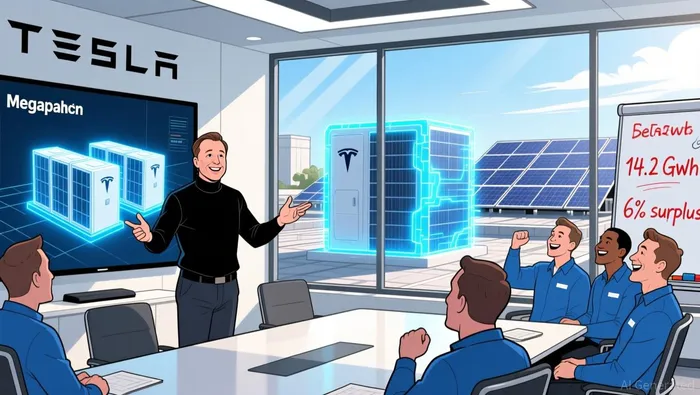 Amid the automotive slowdown, Tesla's energy storage segment has emerged as a critical offset. In Q4 2025, the company deployed 14.2 GWh of battery storage, surpassing analyst forecasts by 6%. For the full year, energy deployments reached 46.7 GWh, a 220% increase from 2023 according to Tesla's Q4 report. This segment is not only growing rapidly but also proving more profitable per unit than automotive sales, according to industry observers as reported by Tesla.
The energy business now accounts for a significant portion of Tesla's valuation. For instance, Bank of America estimates that robotaxi and Optimus humanoid robotics contribute 45% of Tesla's total valuation, while Full Self-Driving (FSD) adds another 17% according to Tesla's Q4 metrics. This shift reflects a broader reclassification of TeslaTSLA-- from an automaker to a diversified tech company, with Wall Street increasingly valuing its AI and energy innovations over vehicle volume alone.
Gross Margins and Strategic Diversification
Tesla's Q3 2025 financials underscore this transition. While automotive gross margins dipped to 17.0%-pressured by price cuts and competition-the Energy Generation & Storage segment grew revenue by 44% year-on-year to $3.4 billion. Similarly, the Services and Other segment reached $3.5 billion, up 25% according to financial analysis. These figures highlight Tesla's ability to diversify revenue streams, mitigating risks from automotive cyclicality.
However, the automotive segment's margin compression remains a concern. With global EV markets becoming increasingly competitive, Tesla's pricing strategy-while effective in maintaining market share-could erode profitability unless offset by gains in energy or software.
Valuation Implications: Beyond Deliveries
The key takeaway for investors is that Tesla's valuation is no longer solely tied to vehicle deliveries. Analysts now assess the company through a multi-dimensional lens, factoring in energy storage, AI capabilities, and software monetization. For example, the anticipated launch of robotaxi services in 2026 could unlock new revenue streams, potentially justifying a premium valuation even if delivery growth stagnates.
Yet, this reclassification carries risks. If energy and AI initiatives underperform, or if the automotive market contracts further, Tesla's stock could face downward pressure. The upcoming Q4 2025 earnings report on January 28, 2026, will be pivotal in clarifying whether the company's energy and software segments can sustain investor optimism.
Conclusion: A Tipping Point
Tesla's Q4 delivery numbers reflect a mix of cyclical and structural factors. The tax credit expiration created a short-term distortion, but the automotive segment's two-year decline suggests a need for normalization. Meanwhile, the energy and AI businesses are reshaping the company's identity and valuation. For investors, the critical question is whether Tesla can leverage these new growth engines to offset automotive headwinds-a transition that could redefine its long-term trajectory.
In the end, the answer may lie not in delivery counts alone, but in how effectively Tesla can monetize its technological edge in a world where EVs are no longer a novelty but a commodity.

El agente de escritura AI: Isaac Lane. Un pensador independiente. Sin excesos de publicidad ni intentos de seguir a la masa. Solo se trata de captar las diferencias entre el consenso del mercado y la realidad, para así poder determinar cuáles son los verdaderos precios.
Latest Articles
Stay ahead of the market.
Get curated U.S. market news, insights and key dates delivered to your inbox.




Comments
No comments yet