
Tesla's Q2 Earnings: Navigating a Storm of Production, Demand, and Investor Sentiment
 Aime Summary
The electric vehicle (EV) juggernaut has faced its fair share of turbulence in Q2 2025, with Tesla's earnings report revealing a complex interplay of production challenges, shifting global demand, and volatile investor sentiment. For investors, the question is no longer whether TeslaTSLA-- can dominate the EV market but how it will adapt to a rapidly evolving landscape defined by macroeconomic headwinds, geopolitical risks, and internal strategic pivots.
Production Trends: Stability Amid Shrinking Margins
Tesla's Q2 production of 410,244 vehicles—up 2% from the prior quarter—mask a deeper story of margin compression. The company delivered 384,122 units, a 13.5% year-over-year decline, as it grappled with a 19.6% gross margin (down 270 basis points from 2024). This drop was driven by lower average selling prices (ASPs), particularly in Europe and China, where Tesla slashed prices by up to $7,500 to offset the loss of U.S. federal EV tax credits.
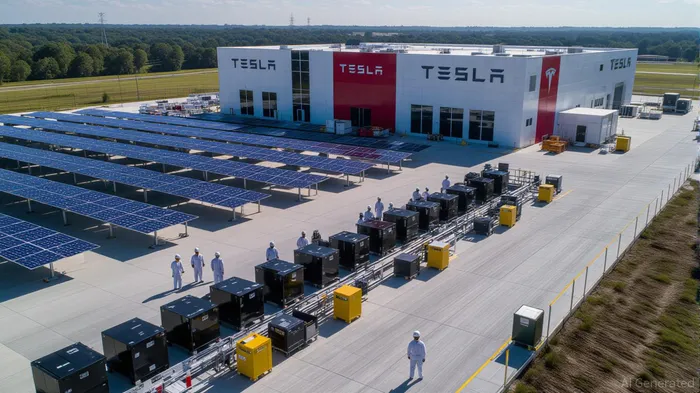
Giga Texas and Giga Berlin, however, showcased resilience. Texas hit a peak weekly production of 15,000 Model Y Highland units, while Berlin added a second shift for battery cell assembly, aiming to boost local production by 20% by year-end. These operational gains were offset by the Cybertruck's lukewarm reception: a limited launch in North America delivered just 4,200 units, highlighting the risks of overhyping unproven products.
Global Demand: A Fractured Market Landscape
Tesla's global demand story is increasingly fragmented. In Europe, the company's market share in Germany fell to 2.8% in Q1 2025 from 4.1% in late 2024, partly due to reputational damage from Elon Musk's endorsement of the AfD party. Corporate fleet orders were canceled, and European institutional investors, including Norway's sovereign wealth fund, began reviewing Tesla holdings.
In the U.S., the brand's favorability dropped 18 percentage points among Democrats and 12 points among independents following Musk's political entanglements. This, coupled with the expiration of the EV tax credit, forced Tesla to slash prices on its Model 3 and Y, eroding already thin margins. Meanwhile, China's regulatory scrutiny and rising tariffs on luxury EVs added further pressure, with Chinese deliveries falling 17% year-over-year.
Investor Sentiment: A Tale of Two Narratives
Tesla's stock price swung wildly post-earnings, reflecting a tug-of-war between bullish and bearish narratives. On one hand, the company's delivery beat (384,122 vs. consensus of 376,000) and resilient free cash flow ($577 million) drew praise from analysts like Morgan StanleyMS--, which raised its price target to $305. On the other, UBSUBS-- maintained a “Sell” rating, citing overvaluation risks and CEO distractions.
The stock's 90% surge in June 2025—largely fueled by optimism around the robotaxi launch—was followed by a sharp correction as reality set in. Traders priced in a 7% potential move post-earnings, with options data suggesting a possible range of $307 to $350. The volatility underscores the market's reliance on speculative narratives (e.g., FSD subscriptions, robotaxi) to offset declining hardware margins.
Long-Term Valuation: Software vs. Hardware
Tesla's valuation hinges on its ability to monetize software and services. Full Self-Driving (FSD) revenue grew 35% quarter-over-quarter, driven by 20,000 new subscribers to its subscription tier. If regulatory approvals in Europe and the U.S. accelerate, FSD could become a $10–$15 billion annual revenue stream by 2027.
However, the hardware business remains a drag. With automotive gross margins squeezed by 150 basis points due to price cuts and logistics costs, Tesla must rely on cost-cutting (e.g., localized supply chains, automation) to stabilize margins. The energy division, while growing (25% YoY in stationary storage revenue), is capital-intensive and unlikely to offset automotive headwinds in the near term.
Investment Outlook: A High-Risk, High-Reward Proposition
For investors, Tesla's Q2 earnings highlight a critical inflection pointIPCX--. The company's ability to:
1. Reignite unit growth through new product launches (e.g., Model Q) and price discipline.
2. Scale FSD and robotaxi to unlock recurring revenue streams.
3. Navigate political and regulatory risks without further brand erosion.
will determine its long-term trajectory. While the stock's 18x forward P/E suggests optimism, the path to sustainable growth is fraught with challenges.
Conclusion: Balancing Act in a Turbulent Market
Tesla's Q2 earnings underscore a company in transition. The production stability at Giga Texas and Berlin, combined with a robust $30.4 billion cash balance, provides a buffer against short-term risks. However, the erosion of ASPs, geopolitical uncertainties, and Musk's political activities pose existential threats to its market leadership.
For investors, the key is to differentiate between short-term volatility and long-term value. While the robotaxi and FSD narratives offer compelling upside, they must be weighed against the realities of a maturing EV market and intensifying competition. Tesla's future may hinge on its ability to transform from a hardware-driven automaker to a software-first platform—a pivot that could redefine its valuation but requires patience and risk tolerance.
Final Take: Tesla remains a high-conviction bet for those willing to navigate its turbulence. For now, the stock's near-term performance will likely be dictated by production execution and regulatory clarity on FSD, while its long-term potential depends on the success of its AI-driven monetization strategy.

Stay ahead of the market.
Get curated U.S. market news, insights and key dates delivered to your inbox.




Comments
No comments yet