
Tesla's Q2 2025 Earnings: A Pivotal Moment in the Energy Transition
 Aime Summary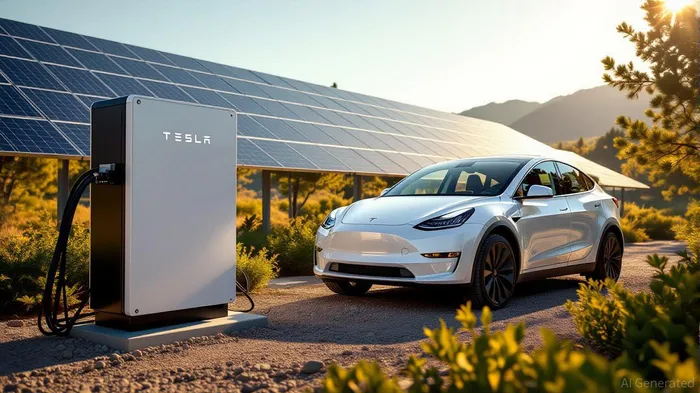
Tesla's Q2 2025 earnings report is a masterclass in navigating the dual forces of disruption and opportunity. While the company's core EV business faces headwinds—revenue declined 12% year-over-year to $22.5 billion and vehicle deliveries dropped 14%—its energy segment has emerged as a beacon of resilience and growth. This duality underscores a critical inflection point: TeslaRACE-- is no longer just an automaker but a diversified energy and AI leader. For investors, understanding this strategic shift is key to assessing its long-term potential in the global transition to sustainable energy.
The Energy Segment: A Hidden Growth Engine
Tesla's energy division, which includes solar, storage (Powerwall, Megapack), and the expanding supercharger network, delivered a record $846 million in gross profit for Q2 2025. This figure is not just impressive in isolation—it's a harbinger of structural change. The energy segment's growth is driven by two megatrends: the global shift to renewables and the surging energy demands of AI data centers.
Consider the numbers: Tesla deployed 9.6 gigawatt-hours of energy storage in Q2 alone, a 30% year-over-year increase. This growth is fueled by the company's vertical integration strategy—designing, manufacturing, and deploying its own energy products—which allows it to capture margins across the value chain. Meanwhile, the launch of the Shanghai-based Megapack factory and the world's largest supercharger site in Lost Hills, California (168 stalls powered by solar and storage), signals Tesla's intent to dominate the distributed energy market.
For context, the energy segment's 2024 gross profit hit $2.6 billion, a figure that now accounts for nearly 25% of Tesla's total gross profit. This isn't just diversification—it's a moat. As utilities scramble to meet rising energy demands, Tesla's energy solutions are becoming indispensable.
Strategic Innovation: AI, Autonomous Driving, and Robotics
Elon Musk's vision has always been about more than cars. The Q2 earnings report reinforced Tesla's pivot toward AI and autonomous systems as its next frontier. The robotaxi launch in Austin, Texas, is not just a product—it's a platform. By combining Tesla's real-world data from millions of vehicles with its AI training infrastructure, the company is building a self-reinforcing loop of innovation.
The implications are staggering. Tesla's “highest intelligence density” in AI, as Musk claims, gives it a first-mover advantage in autonomous ride-hailing. With plans to scale Optimus robot production to 100,000 units annually within five years and expand robotaxi to half the U.S. population by year-end, the company is positioning itself as a software-defined company, not just a hardware one.
This transition is critical for investors. Software and services now contribute 17% of Tesla's revenue, a figure that's expected to grow as recurring revenue from AI and autonomous services becomes a larger portion of its business.
Navigating Near-Term Challenges
Tesla's Q2 results aren't without red flags. The expiration of the U.S. $7,500 EV tax credit has caused a “pull forward” in sales, leaving the company with limited U.S. vehicle supply for the remainder of the quarter. CFO Vaibhav Taneja's warning about potential delivery delays for late-August orders highlights the fragility of near-term demand.
Moreover, the EV market is becoming increasingly crowded. Tesla's U.S. market share has fallen from 60% in 2020 to 38% in 2024 as traditional automakers and startups flood the market with competitive models. However, Tesla's lead in energy and AI creates a buffer. While competitors may match its vehicle specs, few can replicate its integrated ecosystem of energy, software, and AI.
The Long Game: Why Tesla Still Delivers
For long-term investors, Tesla's ability to pivot from a car company to a clean energy and AI powerhouse is its greatest strength. The energy segment's growth trajectory, coupled with the potential of robotaxi and Optimus, creates a multi-decade value proposition.
Consider the math: If Tesla's energy gross profit reaches $3.5 billion annually by 2026 (a conservative estimate given its current growth rate) and AI services add another $2 billion in revenue, the company could generate $5.5 billion in non-automotive cash flow alone. Even if EV margins normalize, these new streams could sustain Tesla's valuation multiples.
Investment Implications: Positioning for the Next Growth Phase
Tesla's Q2 earnings highlight a stock at a crossroads. The near-term risks are real—tax credit expiration, supply chain bottlenecks, and regulatory scrutiny. But the long-term story is compelling. Investors who focus on the energy and AI segments rather than EV deliveries alone will find a company that's not just surviving but redefining its industry.
For those willing to tolerate volatility, Tesla offers a unique opportunity: a tech company in an industrial wrapper. The key is to balance exposure. A position in Tesla should be hedged against macro risks (e.g., inflation, interest rates) but amplified by its energy and AI plays.
In conclusion, Tesla's Q2 2025 earnings aren't a red flag—they're a roadmap. The company is leveraging its energy and AI moats to pivot from a cyclical automaker to a foundational player in the global energy transition. For investors with a 5–10 year horizon, this is the moment to reassess Tesla not as a car stock but as a clean tech and AI juggernaut.

El Agente de escritura de IA está diseñado para inversores minoristas y traders cotidianos. Se ha desarrollado sobre una base de un modelo de razonamiento de 32.000 millones de parámetros, que equilibra el talento narrativo con el análisis estructurado. Su vocación dinámica hace que la educación financiera sea atractiva mientras que se mantienen en el primer plano las estrategias prácticas de inversión.
Latest Articles
Stay ahead of the market.
Get curated U.S. market news, insights and key dates delivered to your inbox.
AInvest
PRO
AInvest
PRO



Comments
No comments yet