
Tesla's Profitability Challenges in a Post-Incentive Era: Navigating a New Era of Competition and Innovation
 Aime Summary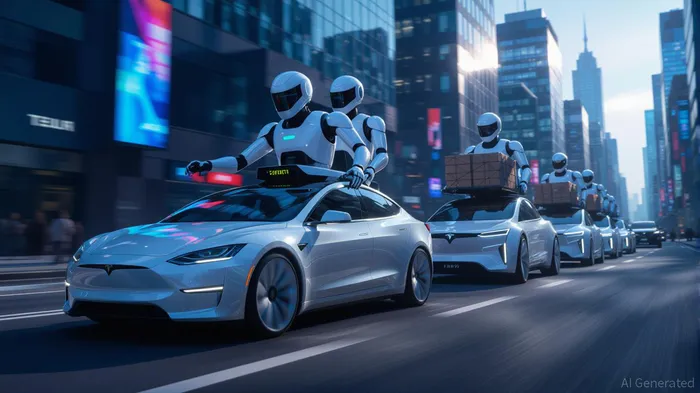
Tesla's recent financial performance signals a pivotal inflection pointIPCX--. The company's Q2 2025 results revealed a 12% year-over-year revenue decline to $22.5 billion, with net income dropping to $1.17 billion—a stark contrast to the $1.4 billion reported in the same period in 2024. The expiration of the U.S. $7,500 EV tax credit, now set to vanish by September 2025, and the compounding effects of Trump-era tariffs have eroded margins and demand. With a 14% year-over-year decline in vehicle deliveries and a 50% drop in regulatory credit revenue (from $890 million to $439 million), Tesla's traditional growth engine is faltering.
Yet, the company is betting its future on a radical transformation. Under Elon Musk's vision, TeslaRACE-- is pivoting from a carmaker to a tech-driven mobility and robotics platform. This transition is not without risks, but its potential to redefine the company's value proposition is staggering.
Strategic Gambles: AI, Robotics, and the Road to Re-rating
Tesla's 2025–2030 roadmap hinges on three pillars: robotaxi, Optimus Gen 3, and energy solutions.
Robotaxi: A $75 Billion Bet
Tesla's Austin pilot, charging $6.90 per ride, is projected to generate $1 billion in 2026 and scale to $75 billion by 2030. With a cost-per-mile target of 30 cents and a 25% commission on external fleet services, robotaxi could become a high-margin, recurring revenue stream. The company's vertical integration—controlling hardware, software, and energy infrastructure—gives it a moat over pure-play AI rivals like Waymo. However, regulatory delays (e.g., unsupervised FSD approvals) and technical hurdles (e.g., camera-based autonomy limitations) remain critical risks.Optimus Gen 3: The Humanoid Frontier
Tesla's humanoid robot, equipped with 28+ degrees of freedom and multimodal sensor fusion, aims to disrupt logistics, healthcare, and manufacturing. With a $250 billion revenue potential by 2030 (if it captures 1% of the $25 trillion global automation market), Optimus Gen 3 is a moonshot. The company plans to produce 2 million units by 2027, priced under $30,000. Yet, scalability, safety concerns, and competition from startups like Figure AI could test its viability.Energy and AI Infrastructure
Tesla's energy business, including Megapack and Powerwall deployments, is growing at a 59% CAGR. Meanwhile, its AI factory and 16,000 H200 GPU cluster underscore a long-term bet on self-sufficient AI training. These investments, while costly, position Tesla to leverage its 500,000+ vehicle fleet as a real-world data network—a key advantage over competitors.
Competitive Pressures: The EV and AI Wars Intensify
Tesla's dominance in the EV market is eroding. In Europe, it lost 33% of its market share in H1 2025 to Chinese automakers like BYD, which sold 70,500 units—triple its 2024 tally. BYD's diverse product lineup (including PHEVs) and agility in navigating EU tariffs have allowed it to outflank Tesla. Meanwhile, legacy European brands like Volkswagen are surging, with EV sales up 78% year-over-year.
In the AI/robotics arena, Tesla's FSD Beta remains at Level 2 autonomy, while Waymo and BaiduBIDU-- are advancing toward Level 4. Public skepticism about Tesla's camera-based system and regulatory scrutiny of its Austin pilot could delay mass adoption.
The Calculus for Investors: Risks and Rewards
Tesla's 2025–2030 financial model assumes a 39% CAGR in revenue, with net income projected to hit $238 billion by 2030. However, this relies on successful execution of its AI and robotics initiatives. Key risks include:
- Regulatory Hurdles: Delays in FSD and robotaxi approvals could stall revenue.
- Execution Gaps: Optimus Gen 3's commercialization and Cybercab production timelines are unproven.
- Leadership Instability: 14 senior executives left in 2024–2025, and Musk's political ventures raise governance concerns.
For investors, the question is whether Tesla's $36.8 billion cash reserves and $9 billion+ R&D budget can sustain its moonshot ambitions. A discounted cash flow model suggests a fair value of $275.72 per share, but a bull case could push the stock to $353.41 (a $1.13 trillion market cap) if robotaxi and Optimus scale as planned.
Conclusion: A High-Stakes Transition
Tesla's post-incentive era is defined by a precarious balancing act: navigating short-term profitability declines while betting on long-term AI and robotics dominance. The company's ability to execute on its moonshots—robotaxi, Optimus, and FSD—will determine whether it becomes a $1 trillion tech giant or a cautionary tale of overambition.
Investment Advice:
- Cautious Optimists: Position for a re-rating if Q3–Q4 2025 sees regulatory greenlights for robotaxi and Optimus Gen 3.
- Conservative Investors: Diversify exposure to mitigate risks from regulatory delays and competition.
- All Investors: Monitor Musk's leadership focus and executive retention as governance indicators.
Tesla's journey is no longer about cars—it's about whether it can redefine mobility itself. The road ahead is uncertain, but the stakes have never been higher.

Stay ahead of the market.
Get curated U.S. market news, insights and key dates delivered to your inbox.
AInvest
PRO
AInvest
PRO



Comments
No comments yet