
Tesla's Production Resilience: A Contrarian Opportunity in a Skeptical Market
The automotive world is abuzz with Tesla's Q2 2025 delivery report: 384,122 vehicles delivered, a 13% year-over-year decline marking the largest quarterly drop in the company's history. Yet beneath the headlines of falling deliveries lies a critical nuance: Tesla's production numbers tell a different story. While deliveries missed Wall Street's already lowered expectations by 1,278 units, the company produced 410,244 vehicles—exceeding deliveries by 26,122 units. This disconnect between output and sales volume raises a provocative question: Could Tesla's operational strength, masked by short-term demand headwinds, present a rare buying opportunity?
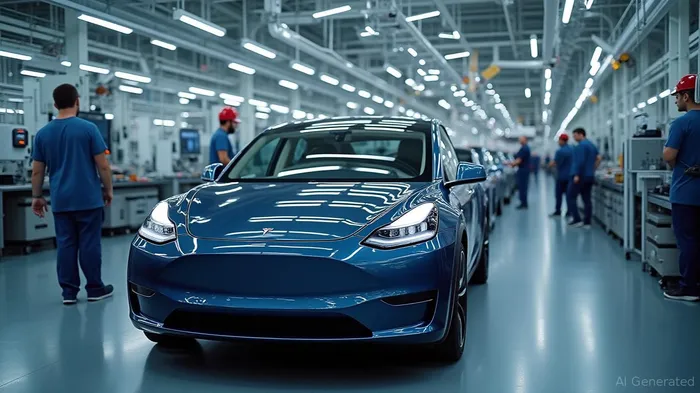
The Numbers: Deliveries vs. Production
Tesla's Q2 deliveries fell due to a confluence of factors: waning U.S. demand (-20% year-over-year), Chinese market stagnation (eight consecutive monthly declines before a June rebound), and the delayed rollout of its refreshed Model Y. Yet production of the Model Y surged to 396,835 units, accounting for 97% of total output—a testament to Tesla's ability to scale even as competitors like BYD and NIONIO-- undercut pricing. The inventory buildup (now 25,000 units) is not a sign of weakness but a strategic buffer, enabling TeslaTSLA-- to respond swiftly to demand recovery.
The market, however, has been unkind. Tesla's stock has plummeted 25% year-to-date, dragged down by Elon Musk's feud with Donald Trump and fears of subsidy cuts under the “Big Beautiful Bill.” Yet this pessimism overlooks a key truth: Tesla's production resilience is unmatched. In Q1 2025, production lagged deliveries due to Model Y retooling, but by Q2, output surged ahead—a clear sign of operational agility. Compare this to 2022, when Tesla faced supply chain bottlenecks yet still delivered 1.3 million vehicles annually. Today's inventory overhang is a repeat of that playbook: build ahead of demand, not react to it.
Why the Skepticism Misses the Mark
Analysts cite Tesla's Cybertruck woes (10,394 deliveries in Q2, down from 22,000 in Q1 2024) as a red flag. Yet the Model Y's dominance and energy storage growth (9.6 GWh deployed, a record) suggest Tesla is prioritizing its core strengths. The Cybertruck's recall issues are a temporary stumble, not a systemic failure. Meanwhile, Musk's political clashes are a near-term distraction but not existential threats. As Cathie Wood of ARK Invest noted, Tesla and Musk remain intertwined in the U.S.-China AI race—a dependency that will force compromise.
The Contrarian Case: Buying on the Dip
The market's focus on delivery declines ignores Tesla's long-term advantages:
1. Production Excellence: Tesla's Gigafactories achieved a 26% year-over-year increase in Model Y production, outpacing competitors.
2. Autonomy as a Moat: The Austin Robotaxi rollout, despite hiccups, is a proof-of-concept for Tesla's camera-based FSD system—potentially a $100 billion annual software revenue stream by 2030.
3. Energy Dominance: Energy storage deployments hit 9.6 GWh in Q2, up 2% from Q1, with Megapack demand surging in Europe and Australia.
Investors should also note Tesla's cash position: despite a $25B stock decline year-to-date, the company retains $20B in cash and equivalents—a cushion to weather short-term pain.
Catalysts on the Horizon
- July 23 Earnings Call: Management will address Model Y production ramp-up, FSD monetization, and the $25,000 affordable model. A strong update here could revalue shares.
- Texas Autonomous Rules (Sept 2025): Tesla's Robotaxi could scale rapidly under new state regulations, creating a new revenue stream.
- China Recovery: June sales in China rose 2% month-over-month—small but indicative of stabilization.
Investment Thesis
Tesla's stock now trades at 12x 2025 EV/EBITDA (vs. 20x in 2021), a valuation discount that ignores its robotics and energy growth vectors. For contrarians, this is a buying opportunity:
- Risk/Reward: A 20% rebound to $200/share (near 2023 lows) offers a 30% gain from current prices.
- Long-Term Upside: If Tesla captures 15% of the global EV market by 2030 (up from 12% today), its $500B valuation could double.
Final Verdict
Tesla's Q2 delivery shortfall is real, but it's a symptom of macro headwinds, not structural decay. The company's ability to produce 410,000 vehicles in a quarter while facing subsidy threats, political noise, and competitive pressure is a signal of operational discipline. As history shows, Tesla thrives when it overproduces and waits for demand to catch up. For investors willing to look past quarterly noise, this is a rare entry point into a tech giant with $50B in annual revenue and a moat widening in robotics and energy.

The market's panic is overdone. The contrarian's call? Buy Tesla at these levels—and hold through the storm.

Stay ahead of the market.
Get curated U.S. market news, insights and key dates delivered to your inbox.
AInvest
PRO
AInvest
PRO



Comments
No comments yet