
Tesla's Product Innovation and Market Position: A Strategic Inflection Point in EV and AI-Driven Manufacturing
 Aime Summary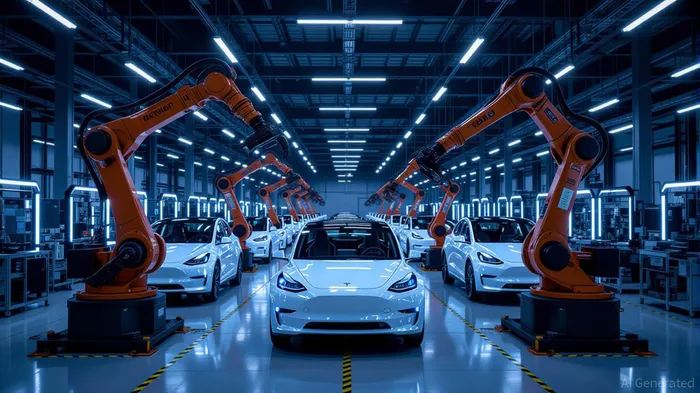
Tesla's journey from a niche electric vehicle (EV) startup to a global manufacturing juggernaut has been defined by its relentless pursuit of innovation, strategic risk-taking, and a willingness to iterate from failure. Under the leadership of engineering teams like VP Lars Moravy's, the company has transformed its R&D and production strategies, positioning itself at the forefront of the EV and AI-driven manufacturing revolution. For investors, the current inflection point—marked by Moravy's recent insights and Tesla's evolving product roadmap—presents a compelling case to reassess exposure to the company ahead of key launches like the Cybertruck and the long-anticipated “Model 2.”
R&D Momentum: From Over-Automation to Scalable Innovation
Tesla's R&D strategy has evolved significantly over the past decade. The 2018 “Alien Dreadnaught” experiment, which aimed to fully automate the Model 3 production line with over 1,000 robots, ended in a costly “Production Hell.” This failure underscored the limitations of rigid automation in a rapidly iterating industry. By 2020, TeslaTSLA-- had pivoted to a balanced human-robot model, integrating AI-driven planning tools, virtual reality simulations, and iterative software updates to optimize production. This shift allowed Tesla to achieve a 95% automation rate in its Gigafactories by 2022, with cycle times of just 40 seconds per unit—far outpacing traditional automakers.
Moravy's recent emphasis on Level 3 autonomy as a commercial threshold for Tesla's Full Self-Driving (FSD) subscription model highlights the company's focus on both technical milestones and market viability. Unlike competitors who prioritize regulatory compliance over user adoption, Tesla is engineering FSD as a revenue-generating service, leveraging its camera-only, no-LiDAR approach to reduce costs. This strategy aligns with Moravy's vision of FSD becoming an industry standard, akin to smartphones, where software differentiation drives long-term value.
Production Scalability: A Structural Edge Over Competitors
Tesla's production scalability is underpinned by its vertically integrated supply chain, AI-optimized logistics, and a culture of rapid iteration. By 2025, the company's Gigafactories in Texas and Berlin are projected to produce over 500,000 vehicles annually, with unit costs declining due to economies of scale and in-house battery production. For context, traditional automakers like BMW and ToyotaTM--, despite massive production volumes, still rely on legacy ICE-era facilities and slower, human-centric workflows. BMW's U.S. EV sales, for instance, dropped 21.2% in Q2 2025, partly due to platform limitations and tax credit constraints, while Toyota's EV output remains a fraction of its total production.
Moravy's acknowledgment of robotaxi and Optimus robot development timelines—while noting these projects are “early stage”—signals Tesla's long-term vision of a “full-stack” autonomy ecosystem. The company is leveraging revenue from its S3XY business to fund these ventures, ensuring that its AI-driven manufacturing capabilities remain ahead of the curve. This financial foundation is critical as Tesla competes with Chinese EV giants like BYD, which have cost advantages but lag in software and automation.
Strategic Timing: Inflection Points and Investor Implications
Tesla's product launches are often described as “big swings,” and the upcoming Cybertruck and Model 2 represent two such opportunities. The Cybertruck, despite delays, is expected to disrupt the EV truck segment with its stainless-steel body and FSD integration. Meanwhile, the rumored $25,000 Model 2—a compact, mass-market EV—could unlock new growth by competing directly with Chinese EVs and legacy automakers' affordable offerings.
Moravy's recent comments on robotaxi timelines, however, suggest a more measured approach. While Tesla aims to launch its ride-hailing service by June 2025, regulatory hurdles and infrastructure challenges remain. Investors should weigh these risks against the company's historical ability to adapt—such as pivoting from full automation to human-robot collaboration in 2018.
Valuation and Investment Case
Despite a 71% year-over-year decline in net profit in Q1 2025, Tesla's valuation remains anchored to its long-term potential. At $600 billion, Tesla's market cap dwards Toyota's $300 billion and BMW's $70 billion, reflecting investor confidence in its software-first model and AI-driven manufacturing edge. However, the stock's volatility—driven by production hiccups and macroeconomic headwinds—demands a balanced approach.
For investors, the key question is whether Tesla's R&D and production scalability can sustain its lead in the face of rising competition. Moravy's insights suggest the company is on track to achieve this, but execution risks remain. A diversified portfolio could include Tesla as a core holding for its innovation edge, while hedging with sector ETFs or shorter-duration EV plays.
Conclusion
Tesla's strategic timing—leveraging AI-driven manufacturing, iterative R&D, and bold product launches—positions it as a leader in the EV and autonomy economy. While challenges like robotaxi regulation and Chinese EV competition persist, Moravy's emphasis on commercial viability and scalability offers a roadmap for long-term value creation. For investors, the current inflection point—marked by key product cycles and a refined production model—warrants a reassessment of Tesla's role in a growth-oriented portfolio. The company's ability to adapt from failure, as seen in its 2018-2020 transformation, underscores its resilience and potential to redefine the automotive industry once again.

Stay ahead of the market.
Get curated U.S. market news, insights and key dates delivered to your inbox.
AInvest
PRO
AInvest
PRO



Comments
No comments yet