
The Tesla of Politics: Elon Musk's America Party and the Disruption of Democratic Process
The political arena has long been a bastion of traditional power structures, but Elon Musk's recent foray into forming the “America Party” signals a bold disruption—a tech billionaire leveraging his wealth and influence to redefine the rules of governance. This is not merely a partisan shift but a seismic experiment in political entrepreneurship, one that could reshape markets, policies, and the very fabric of democratic engagement.
The Birth of a Disruptor
Musk's decision to launch the America Party follows a sharp ideological break with former ally Donald Trump, who he now accuses of enabling a $5 trillion debt increase through a “disgusting abomination” of a tax bill. The party's stated goals—reducing government waste, cutting debt, and amplifying free speech—mirror Musk's tech ethos: lean, data-driven, and unafraid to challenge legacy systems.
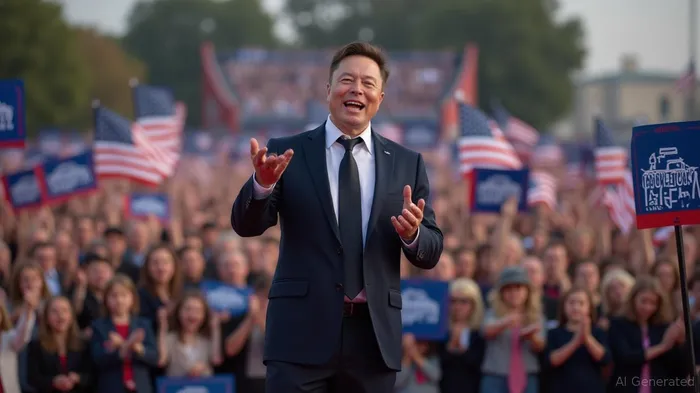
The disruptive potential here lies in Musk's ability to apply his tech playbook to politics. Just as TeslaTSLA-- disrupted automotive markets by prioritizing innovation over tradition, the America Party could upend the two-party system by framing politics as a product to be optimized. Musk's poll-driven approach—65% of 1.2 million respondents on X supported a third party—suggests a data-first strategy, akin to A/B testing public opinion.
Market Implications: Musk's Companies at the Center
The immediate focus is on how Musk's political ambitions will impact his businesses, from Tesla to SpaceX. The America Party's pro-tech, pro-natalist, and free-speech agenda could create tailwinds for industries aligned with these goals. For instance, Musk's push for AI-driven military modernization might boost defense contractors like Lockheed MartinLMT-- (LMT) or Raytheon (RTX). Meanwhile, his opposition to EV incentives that favor legacy automakers could reposition Tesla (TSLA) as a beneficiary of reduced regulatory friction.
Yet risks loom large. Trump's threats to revoke government contracts from Musk's firms—like SpaceX's Starlink or Tesla's federal EV incentives—underscore the fragility of his business ecosystem. A would reveal whether political fallout is already impacting revenue streams.
The Third-Party Paradox
Historically, third parties in the U.S. have struggled to gain traction. The Libertarian and Green Parties remain marginal, their campaigns outgunned by the financial and organizational might of Democrats and Republicans. Musk's $350 billion net worth could change this calculus, but the hurdles are vast. Securing ballot access in all 50 states alone could cost hundreds of millions—a fraction of his wealth but a distraction from core business priorities.
The party's success hinges on its ability to coalesce around a coherent platform. Musk's vague policy outline—“modernizing the military with AI” or “pro-natalist policies”—lacks the specificity needed to inspire loyalty. Without a clear vision, the America Party risks becoming a flash in the pan, akin to a tech startup that fails to scale.
Investment Takeaways: Proceed with Caution, but Keep an Eye Open
For investors, Musk's political pivot is a double-edged sword. On one hand, his influence could accelerate policies favorable to tech innovation, AI, and reduced regulation—sectors already buoyed by his ventures. A shows how Tesla's stock has thrived in part due to its perceived alignment with regulatory tailwinds.
On the other hand, the party's survival is far from certain. A reveals that Americans remain deeply skeptical of upstarts. Musk's feud with Trump also introduces geopolitical risks; a loss of Starlink's $428 million Pentagon contract, for example, would dent SpaceX's valuation.
Final Analysis
Musk's America Party is less a guaranteed political revolution and more a high-stakes experiment in leveraging tech-driven tactics to crack open a closed system. While the party's success could redefine how wealth shapes governance, its immediate market impact will be felt most acutely in sectors Musk directly influences. Investors should treat this as a bifurcated opportunity: bet on industries that align with Musk's policy leanings (AI, defense tech) while hedging against the volatility of his core businesses (Tesla, SpaceX).
In the end, Musk's gamble underscores a broader truth: in a tech-driven economy, disruption isn't confined to boardrooms—it's now being tested in the arena of democracy itself. The question isn't whether it will work, but how markets will adapt when a man who's remade cars and space travel turns his sights to politics.
Andrew Ross Sorkin is a pseudonym for this analysis. The views expressed here are hypothetical and for illustrative purposes only.

Stay ahead of the market.
Get curated U.S. market news, insights and key dates delivered to your inbox.
AInvest
PRO
AInvest
PRO



Comments
No comments yet