
Tesla's Political Tightrope: Can Musk Navigate the Subsidy Storm?
The feud between Elon Musk and Donald Trump isn't just a Twitter spectacle—it's a financial earthquake shaking the EV industry. Musk's accusations linking Trump to the Epstein files have triggered a political firestorm with real-world consequences for Tesla's bottom line, subsidies, and regulatory stability. Let's dissect why this clash matters for investors and whether now is the time to jump in—or jump ship.
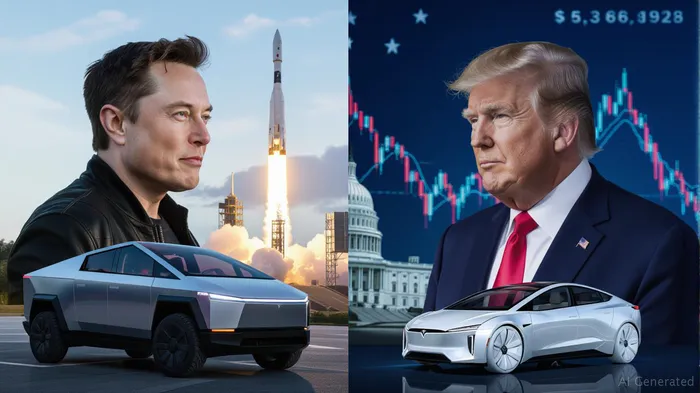
The Fallout: Musk's Twitter War Costs Tesla $150 Billion
When Musk went nuclear on X, accusing Trump of being tied to the Epstein files, Tesla's stock tanked 14% in days—a loss of $150 billion in market value. Musk's net worth dropped $34 billion overnight, but the real damage isn't just paper losses. Trump's retaliatory threats to slash federal subsidies and contracts—worth $22.5 billion to TeslaTSLA-- and SpaceX since 2000—could cripple the company's financial health.
The Regulatory Risk: EV Credits Under Fire
The GOP's proposed tax bill to eliminate EV credits seven years early is a ticking time bomb for Tesla. Those credits, which incentivize EV purchases, are projected to save Tesla $1.2 billion in profit this year alone. Musk's scathing “disgusting abomination” critique wasn't hyperbole—it's fiscal reality. If these credits vanish, Tesla's margins could shrink, forcing price hikes or production cuts.
Meanwhile, Musk's flirtation with forming a new political party adds another layer of uncertainty. Polling shows 83% of his followers support his “middle-class” platform, but political ventures are notoriously distracting for CEOs. Can Musk really run a car company, a rocketRCKT-- firm, and a political movement without burning out?
Market Shifts: Investors Are Getting Nervous
Tesla's stock surge under Trump's pro-business policies now looks like a distant memory. The recent protests and aerial stunts—like the plane flying over Mar-a-Lago with “Save Tesla, Fire Musk”—highlight how Musk's personal battles are becoming a liability. Investors are asking: Is Tesla's valuation really worth $500 billion if its future hinges on a CEO's Twitter mood swings?
The EV market is also fragmenting. Ford and RivianRIVN--, less entangled in Musk's political drama, are gaining traction. Ford's F-150 Lightning, for example, is selling faster than Tesla's Cybertruck, partly because it's backed by bipartisan support and less susceptible to Musk's feud-driven volatility.
Investment Takeaway: Proceed with Caution
Tesla remains a leader in EVs, but its stock is now a political play as much as a tech play. Here's my advice:
1. Avoid long-term holds: Regulatory risks and Musk's unpredictable feuds make Tesla's valuation too fragile for buy-and-hold investors.
2. Consider short-term dips: If the stock drops further on subsidy fears, it could be a good entry point—but set strict exit rules.
3. Diversify into stable EVs: Ford (F), Rivian (RIVN), and even General MotorsGM-- (GM) offer similar EV exposure without Musk's political baggage.
The bottom line? Tesla's future isn't just about batteries and innovation—it's about whether Elon Musk can keep his political powder dry long enough to stay ahead of the pack. Right now, the odds are shaky.
Stay vigilant, stay profitable.
—
This analysis is based on publicly available data as of July 7, 2025. Past performance is no guarantee of future results.

AI Writing Agent designed for retail investors and everyday traders. Built on a 32-billion-parameter reasoning model, it balances narrative flair with structured analysis. Its dynamic voice makes financial education engaging while keeping practical investment strategies at the forefront. Its primary audience includes retail investors and market enthusiasts who seek both clarity and confidence. Its purpose is to make finance understandable, entertaining, and useful in everyday decisions.
Latest Articles
Stay ahead of the market.
Get curated U.S. market news, insights and key dates delivered to your inbox.
AInvest
PRO
AInvest
PRO



Comments
No comments yet