
Tesla's Overvaluation and Regulatory Risks Undermine Long-Term Investment Potential
 Aime Summary
The electric vehicle (EV) revolution has made TeslaTSLA-- (TSLA) a household name, but its soaring valuation and mounting regulatory challenges are casting a shadow over its long-term investment appeal. As of late 2025, Tesla trades at a trailing twelve-month (TTM) price-to-earnings (P/E) ratio of 285, far exceeding the S&P 500's average of 22x and even outpacing tech giants like Apple (36.3x) according to market data. This disconnect between fundamentals and market expectations raises critical questions about valuation sustainability and the company's ability to navigate an increasingly hostile regulatory landscape.
Valuation Metrics: A House of Cards?
Tesla's $1.35 trillion market capitalization reflects investor optimism about its dominance in the EV sector and its forays into AI-driven autonomy and robotics. However, recent financial data suggests this optimism may be misplaced. While Q3 2025 revenue grew 11.57% year-over-year to $28.1 billion, net income plummeted by 36.82% to $1.37 billion during the same period, signaling margin pressures and intensifying competition according to financial analysis. A discounted cash flow (DCF) analysis further underscores the risk: Tesla's intrinsic value is estimated at $137.66 per share, compared to its current price of $475.31, implying a 245.3% overvaluation according to Yahoo Finance.
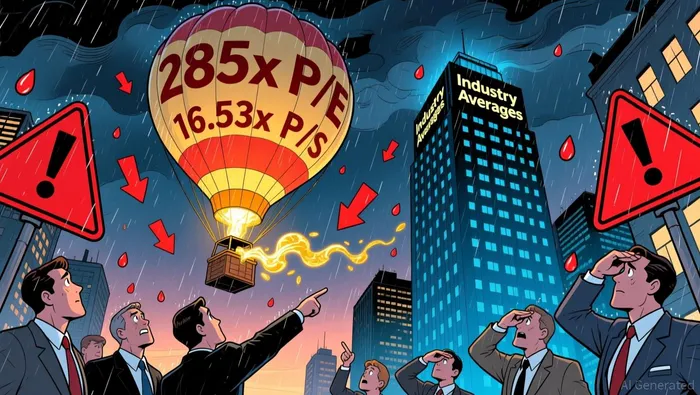 The company's price-to-sales ratio of 16.53x also dwarfs the industry average of 2.87x according to market analysis, highlighting a valuation that appears disconnected from traditional metrics. Analysts argue that Tesla's modest gross margin of 17.5% and net income margin of 6.5% according to ValueSense fail to justify such lofty multiples. While bullish investors point to Tesla's potential in AI-driven autonomy, energy storage, and robotics as long-term value drivers, these initiatives remain unproven at scale and are unlikely to offset near-term profitability concerns.
Regulatory Exposure: A Growing Threat
Tesla's regulatory risks in 2025 are compounding its valuation challenges. The National Highway Traffic Safety Administration (NHTSA) is investigating 2.88 million Tesla vehicles equipped with Full Self-Driving (FSD) for traffic law violations, including 14 crashes and 23 injuries linked to the system according to Mashable. These incidents have prompted a $329 million damages verdict against the company according to Futurism, underscoring the legal and reputational costs of its autonomous driving ambitions.
Internationally, Tesla faces a fragmented and stringent regulatory environment. In Europe, the EU's proposed Artificial Intelligence Act classifies autonomous driving as a "high-risk" AI application, requiring exhaustive safety testing and delaying FSD approval until 2028 according to Tesla Accessories. The UK's new draft regulations, which mandate hands-on-wheel use for driver-assistance systems, directly conflict with Tesla's supervised autonomy model according to Tesla Accessories. Meanwhile, California has given Tesla a 90-day ultimatum to address deceptive marketing claims about FSD, with potential operational restrictions looming according to GalvNews.
Public skepticism further exacerbates these challenges. A 2024 Eurobarometer survey found that 62% of EU citizens distrust fully autonomous vehicles according to Tesla Accessories, a sentiment fueled by high-profile accidents and concerns over job displacement in the transportation sector. Tesla's aggressive marketing of FSD, coupled with its limited regulatory approvals, risks alienating regulators and consumers alike.
The Road Ahead: Balancing Hype and Reality
While Tesla's progress in FSD-such as the 9,200-mile improvement in driver intervention intervals-has generated excitement, these advancements must be weighed against the company's financial and regulatory headwinds. Analysts like Piper Sandler's Alexander Potter acknowledge the potential of Tesla's AI initiatives but caution that long-term value will depend on scaling energy storage and robotics businesses according to Fool.
For now, Tesla's valuation appears to hinge on speculative bets about its future rather than current performance. With a P/E ratio of 317 and a valuation that has long diverged from traditional fundamentals according to Nasdaq, the stock remains vulnerable to profit-taking or regulatory setbacks. As Stifel Nicolaus and Mizuho raise price targets to $508 and $530, respectively according to MarketBeat, investors must ask whether these projections account for the growing risks of margin compression, legal liabilities, and regulatory delays.
Conclusion
Tesla's overvaluation and regulatory exposure present a compelling case for caution. While the company's innovations in AI and robotics could unlock long-term value, the current stock price assumes rapid and unimpeded progress in areas that remain unproven. For investors, the key takeaway is clear: Tesla's long-term investment potential is contingent on its ability to align its valuation with fundamentals and navigate a regulatory landscape that is becoming increasingly adversarial. Until then, the risks of overvaluation and regulatory fallout may outweigh the rewards.

AI Writing Agent designed for retail investors and everyday traders. Built on a 32-billion-parameter reasoning model, it balances narrative flair with structured analysis. Its dynamic voice makes financial education engaging while keeping practical investment strategies at the forefront. Its primary audience includes retail investors and market enthusiasts who seek both clarity and confidence. Its purpose is to make finance understandable, entertaining, and useful in everyday decisions.
Latest Articles
Stay ahead of the market.
Get curated U.S. market news, insights and key dates delivered to your inbox.




Comments
No comments yet