
Tesla's Optimus Robot Project Faces Production Delays, Threatens Annual Targets
ByAinvest
Saturday, Jul 26, 2025 1:35 am ET1min read
BTC--
Tesla's recent second quarter earnings report revealed a 19% year-to-date decline in market cap, down to $956.65 billion [1]. The company missed revenue estimates, posting $22.5 billion against $22.74 billion expected. Adjusted earnings per share came in at $0.40, shy of the expected $0.43. Vehicle deliveries declined 14% year-over-year to 384,000 units, marking the second consecutive quarter of shrinking sales. These results underscore the challenges Tesla faces amidst growing competition from Chinese rivals and product delays, such as the anticipated "Model 2" EV.
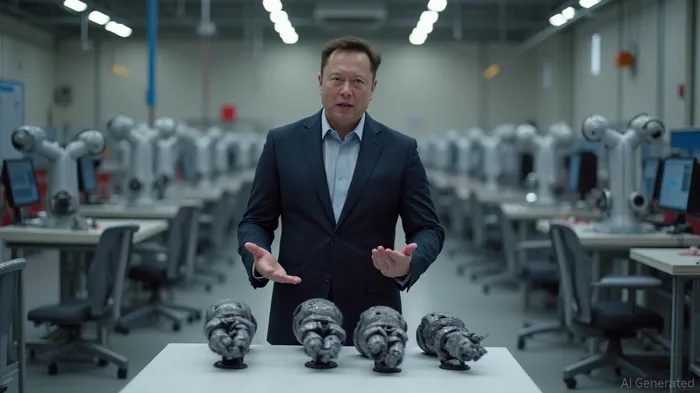
Adding to these pressures, Musk has warned of potentially difficult quarters ahead due to the expiration of US EV subsidies and increasing global market competition. The company's Optimus robot project, which aims to produce 5,000 units, is experiencing production delays. Only a few hundred units have been produced so far, primarily due to technical issues with the robotic hand technology. This delay may impact Tesla's annual targets and revenue growth.
One wildcard that could influence Tesla's trajectory is Bitcoin. Tesla bought $1.5 billion worth of Bitcoin in 2021 but has since sold most of its holdings. The company retains 9,720 BTC, valued at roughly $1.15 billion at today's prices. While Bitcoin's potential role in Tesla's growth is intriguing, it is unlikely to single-handedly drive the company to a $20 trillion valuation. Even in optimistic scenarios, Bitcoin would need to reach nearly $2 billion per coin to contribute significantly to Tesla's market cap.
In conclusion, while Elon Musk's $20 trillion vision is compelling, the current financial performance and technical challenges suggest a more nuanced path to achieving this goal. Tesla's journey will require overcoming significant hurdles, including production delays, intense competition, and the expiration of subsidies. The company's ability to execute on its long-term strategy will be crucial in determining its future trajectory.
References:
[1] https://finance.yahoo.com/news/elon-musk-floats-20-trillion-160607374.html
TSLA--
Tesla's Optimus robot project is experiencing production delays, with only a few hundred units produced, falling short of CEO Elon Musk's goal of 5,000 units. A technical issue with the robotic hand technology is the main cause of the delay, which may impact Tesla's annual targets and revenue growth. Musk has warned of potentially difficult quarters ahead due to the expiration of US EV subsidies and increasing global market competition.
Elon Musk's vision of Tesla becoming a $20 trillion company has sparked global interest, yet recent financial performance and technical challenges cast a shadow on the ambitious goal. Musk, in a recent reply on X, floated the idea that Tesla could reach this valuation with "extreme execution," but the path is fraught with obstacles.Tesla's recent second quarter earnings report revealed a 19% year-to-date decline in market cap, down to $956.65 billion [1]. The company missed revenue estimates, posting $22.5 billion against $22.74 billion expected. Adjusted earnings per share came in at $0.40, shy of the expected $0.43. Vehicle deliveries declined 14% year-over-year to 384,000 units, marking the second consecutive quarter of shrinking sales. These results underscore the challenges Tesla faces amidst growing competition from Chinese rivals and product delays, such as the anticipated "Model 2" EV.
Adding to these pressures, Musk has warned of potentially difficult quarters ahead due to the expiration of US EV subsidies and increasing global market competition. The company's Optimus robot project, which aims to produce 5,000 units, is experiencing production delays. Only a few hundred units have been produced so far, primarily due to technical issues with the robotic hand technology. This delay may impact Tesla's annual targets and revenue growth.
One wildcard that could influence Tesla's trajectory is Bitcoin. Tesla bought $1.5 billion worth of Bitcoin in 2021 but has since sold most of its holdings. The company retains 9,720 BTC, valued at roughly $1.15 billion at today's prices. While Bitcoin's potential role in Tesla's growth is intriguing, it is unlikely to single-handedly drive the company to a $20 trillion valuation. Even in optimistic scenarios, Bitcoin would need to reach nearly $2 billion per coin to contribute significantly to Tesla's market cap.
In conclusion, while Elon Musk's $20 trillion vision is compelling, the current financial performance and technical challenges suggest a more nuanced path to achieving this goal. Tesla's journey will require overcoming significant hurdles, including production delays, intense competition, and the expiration of subsidies. The company's ability to execute on its long-term strategy will be crucial in determining its future trajectory.
References:
[1] https://finance.yahoo.com/news/elon-musk-floats-20-trillion-160607374.html
Stay ahead of the market.
Get curated U.S. market news, insights and key dates delivered to your inbox.
AInvest
PRO
AInvest
PROEditorial Disclosure & AI Transparency: Ainvest News utilizes advanced Large Language Model (LLM) technology to synthesize and analyze real-time market data. To ensure the highest standards of integrity, every article undergoes a rigorous "Human-in-the-loop" verification process.
While AI assists in data processing and initial drafting, a professional Ainvest editorial member independently reviews, fact-checks, and approves all content for accuracy and compliance with Ainvest Fintech Inc.’s editorial standards. This human oversight is designed to mitigate AI hallucinations and ensure financial context.
Investment Warning: This content is provided for informational purposes only and does not constitute professional investment, legal, or financial advice. Markets involve inherent risks. Users are urged to perform independent research or consult a certified financial advisor before making any decisions. Ainvest Fintech Inc. disclaims all liability for actions taken based on this information. Found an error?Report an Issue


ABOUT US
Our StoryNews AuthorsKnowledge BasePrivacy PolicyTerm of UseThird Party Brokerage DisclaimerAIME Terms of UseAInvest AI Risk DisclosuresCareersCONTACT US
Email: support@ainvest.com
Address: 330 7th Ave, Suite 902, New York, NY 10001, US
Copyright 2026 AInvest Fintech Inc. All rights reserved.


Comments
No comments yet