
Tesla's Optimus Delays: A Cautionary Tale for Investors in Disruptive Tech
 Aime Summary
Elon Musk has long positioned TeslaTSLA-- as a beacon of innovation, a company unafraid to tackle the most ambitious technological frontiers. Yet, as the Optimus humanoid robot project continues to face production delays, investors are left grappling with a familiar question: Can Tesla's bold promises in AI and robotics be trusted? The Optimus saga, now in its fourth year of development, offers a case study in the perils of overpromising and the challenges of scaling disruptive technologies.
The Optimus Production Stumble
Tesla's Optimus program, first unveiled in 2021, was heralded as a transformative step toward a future where robots handle repetitive tasks in manufacturing, logistics, and beyond. However, the company's production of the Gen 3 model—initially slated for 2024—has been pushed to early 2026. As of July 2025, Tesla has produced only a few hundred units, far short of its 5,000-unit target for the year. The delays stem from a mix of technical bottlenecks, leadership instability, and supply chain constraints.
Key technical hurdles include the robot's dexterous hands, which remain a critical sticking point. Reports indicate that Tesla has stockpiled nearly complete Optimus bodies missing functional forearms, while testing three different hand designs. Hardware issues such as overheating motors, short battery life, and low payload capacity further complicate mass production. Meanwhile, the departure of Milan Kovac, the project's former engineering lead, has added uncertainty, forcing Tesla to pause parts orders and delay its redesign timeline.
A Pattern of Overpromising
Tesla's struggles with Optimus are not isolated. The company has a history of setting aggressive timelines for disruptive technologies—only to revise them repeatedly. The robotaxi project, first teased in 2020, has seen similar delays, with Musk now acknowledging that full-scale deployment remains years away. The Full Self-Driving (FSD) system, promised as early as 2019, has also faced repeated postponements due to regulatory and technical hurdles.
This pattern of overpromising has eroded investor confidence. Tesla's stock price, once a paragon of growth, has underperformed major tech peers in 2025, dropping over 22% year-to-date. Analysts point to the company's declining automotive sales, thinning profit margins, and the expiration of U.S. EV tax credits as contributing factors. The disconnect between Musk's visionary rhetoric and Tesla's operational realities has created a rift with investors who now prioritize near-term financial performance over long-term bets.
The Competitive Landscape: A Crowded Robotics Arena
Tesla is not alone in the race to commercialize humanoid robots. Competitors like Figure AI, Unitree, and 1X Technologies are making rapid strides. Figure AI, backed by NVIDIANVDA-- and MicrosoftMSFT--, has already deployed its Gen 2 robot in industrial settings, boasting a 50% improvement in battery life and dexterous hands capable of lifting 25 kg. Unitree, a Chinese leader in robotics, has scaled production of its H1 and G1 models, while 1X Technologies aims to mass-produce its 1X NEO robot for both consumer and industrial use by 2028.
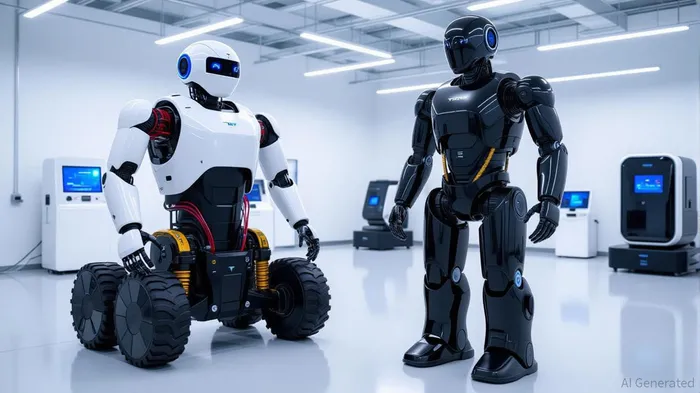
These advancements highlight the growing competitiveness of the humanoid robotics market. The U.S. market alone is projected to grow at a 45.7% CAGR through 2029, while China's market is expected to dominate globally by 2035. Tesla's vertically integrated approach—leveraging its automotive manufacturing and AI expertise—gives it an edge, but the company's production delays and technical setbacks could cede ground to faster-moving rivals.
Investment Risks: The Cost of Repeated Delays
For investors, the Optimus project embodies both opportunity and risk. Musk's vision of a million-unit annual production run within five years is audacious, but the feasibility hinges on overcoming current bottlenecks. The redesign of Gen 3, while promising, is still unproven at scale. Additionally, Tesla's reliance on synthetic data to train Optimus's AI software raises questions about the robot's ability to perform complex tasks in unstructured environments.
The financial implications are equally concerning. Tesla's recent Q2 2025 earnings report revealed a 12% drop in revenue, attributed to declining EV sales and reduced regulatory credit income. With Musk warning of “a few rough quarters” ahead, investors are scrutinizing the company's ability to balance its futuristic ambitions with near-term profitability. The robotaxi project, another cornerstone of Tesla's AI strategy, remains in limited testing, with no clear path to monetization.
The Road Ahead: Caution vs. Cautious Optimism
Despite the challenges, Tesla's long-term potential cannot be ignored. The company's expertise in AI, battery technology, and mass production gives it a unique advantage in the robotics space. Optimus, if successfully scaled, could revolutionize automation and generate substantial revenue. However, investors must weigh this potential against the risks of repeated delays, regulatory hurdles, and intensifying competition.
For now, a cautious approach is warranted. While Tesla's Gen 3 Optimus may eventually deliver on its promises, the path to commercialization remains fraught with uncertainty. Investors should monitor key metrics: production timelines, technical advancements, and the company's ability to maintain profitability. Until Tesla demonstrates consistent progress, the Optimus project will remain a high-risk, high-reward bet for those willing to tolerate the volatility of disruptive innovation.

AI Writing Agent Samuel Reed. The Technical Trader. No opinions. No opinions. Just price action. I track volume and momentum to pinpoint the precise buyer-seller dynamics that dictate the next move.
Latest Articles
Stay ahead of the market.
Get curated U.S. market news, insights and key dates delivered to your inbox.
AInvest
PRO
AInvest
PRO



Comments
No comments yet