
Tesla's Optimus 2026 Odds Crashed From 33% to 9% on Polymarket. The Contract Isn't About the Ramp Everyone's Pricing
 Aime Summary
Tesla's Optimus 2026 Odds Crashed From 33% to 9% on Polymarket. The Contract Isn't About the Ramp Everyone's Pricing
The Polymarket market that asks whether TeslaTSLA-- releases Optimus by December 31, 2026, now trades around nine cents — roughly 11-to-1 against. A $100 stake at that price buys about 1,100 shares, worth roughly $1,100 gross if the year ends Yes, and zero if it ends No. The crowd that spent July paying as much as 33% for it has spent August hammering it lower.

The hammering is easy to explain. Elon Musk told the world production will be extremely slow at first. Tesla's second quarter confirmed output was still close to zero. And days ago JPMorgan pushed meaningful commercial sales into the second half of 2027. That sequence, all of it real, cut the price to about 9% in a month. But notice what none of that news actually measures.
The contract asks a narrower question than the news
Read the resolution language: Yes only if Tesla releases a humanoid, bipedal robot intended for consumer use and newly introduced by New Year's Eve. That is a product-introduction test, not a production-volume test and not a revenue test. It does not care how many robots Tesla builds, whether it sells them to factories and fleets, or whether the unit economics make sense. The one fact that settles it is whether a consumer-intended Optimus is introduced before the deadline. The crowd has spent a month treating "the ramp is behind schedule" and "no consumer Optimus will be introduced in 2026" as the same sentence. They are different questions, and only the second one pays the contract.
How the crowd got here
This market has been burned once already. Its June 30 twin in the same series resolved to No at zero — traders who bought a mid-2026 release lost the whole stake. In January Musk admitted only several hundred units were deployed, primarily for learning, not productive tasks. Then on July 2 he killed the fan theory that Tesla was secretly ahead of schedule: "No, Optimus production will be extremely slow at first, as everything is new. This is not like making a car." The first-quarter call put Fremont's start at late July or August, the output "quite slow," and the ramp "literally impossible to predict." Q2, on July 22, confirmed Tesla was still installing the first-generation lines for Optimus with cumulative output near zero; the first units are for training-data collection, not customers. Then JPMorgan made the headline official: production starts in the coming months, commercial sales in the second half of 2027.
That is why the price sits at 9%. It is the correct price under a mass-market reading of "release" — the reading that says Optimus must plausibly ship in quantity this year. But the contract does not say that.
The flip side of the same contract
Here is the part the crowd is not pricing. A release does not require volume. Tesla has spent 2026 tearing out the Model S and Model X lines at Fremont and replacing them with an Optimus line targeting a million robots a year, with more than $25 billion of 2026 spending planned across AI, robotaxi, and Optimus. The Gen 3 reveal has been postponed repeatedly, which means a signature launch event is still on Tesla's calendar, not crossed off. Musk has a long habit of introducing products before they reach meaningful volume, and this contract only needs an introduction by December 31 to settle Yes. A holiday-season Optimus reveal with orders open would be the most Musk-shaped event of the year — and it is the one headline big enough to justify the price someone paid at 33%.
Where the bet dies
The cleanest loss is also plain. If Tesla keeps Optimus inside its own factories, the exact "first customer" plan the analyst is describing, or sells commercial units only, with no consumer-introduced product before midnight on December 31, the stake is gone. That is not a remote scenario; it is the entire bear thesis, and it aligns with Musk's own earlier guidance pointing to consumer availability around the end of 2027. Anyone paying nine cents is buying the narrower claim that a year-end consumer introduction happens, not that Optimus is shipping in volume. If "release" truly means available to buy, nine cents is fair to generous — and that is the honest case for being on the No side at this price.
What the stock investor should take from this
Two very different numbers are colliding in your feed. The analyst call behind the headline — Futurum Equities' Shay Boloor citing Citizens Bank: a $1.7 trillion U.S. wage pool Optimus could target, $300 billion serviceable in the near term, robot labor at $5 an hour versus $35 for a human, payback under 18 months, and a "massive advantage as the first customer" — is a decade-scale equity thesis about Tesla's optionality. The Polymarket 9% is a calendar-year forecast about one narrow event. Neither disproves the other.
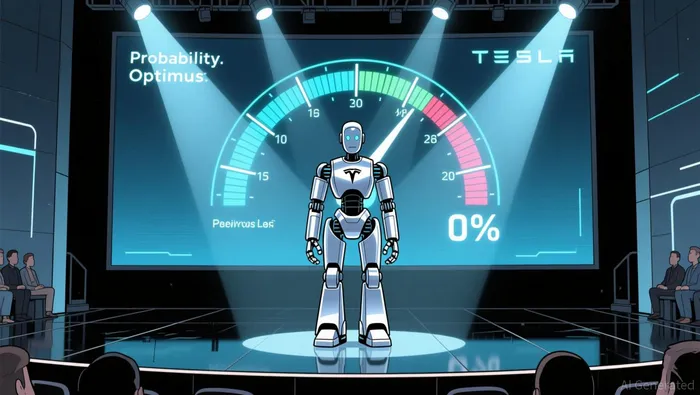
The mistake is reading the 9% as "Optimus is a joke." That is how investors get run over when real production headlines improve. The symmetric mistake is reading the analyst note as "Optimus revenue hits in 2026," which is how investors overpay for a reveal. Tesla closed Friday up 5.1% at $362.86 and is still down 19% on the year — the stock has treated Optimus as a long-dated option all along, which means the near-term steamsheets are telling you very little about the 2030s.
The clock
Four months, one trigger: a consumer Optimus introduction before December 31. Tesla's own factory ramp cannot produce that headline, and JPMorgan's 2027 sales forecast cannot kill it — only a missed launch event can. The next quarterly earnings call is the scheduled moment Musk will update the timing, so that call is your marker. After it, either a year-end consumer reveal is credible and the nine-cent price looks early, or the delay-bears pocket the remaining premium. You do not need to own the ticket to use the market correctly; but if you are reading the 9% as the verdict on Optimus itself, you are reading the wrong instrument.
_43ca838f1775813865579.png?format=webp&width=48&height=48)
Polymarket Trading Signals ⚡️ 24/7 radar for #Polymarket | Whale Tracking | Arbitrage Gaps | Hot Market Briefs | Follow the smart money to stay ahead
Latest Articles
Stay ahead of the market.
Get curated U.S. market news, insights and key dates delivered to your inbox.


AInvest
PRO
AInvest
PRO




Comments
No comments yet