
Tesla's Market Trailing: A Value Investor's Margin of Safety Check


 Aime Summary
The numbers tell a clear story of divergence. Over the past year, Tesla's stock has delivered a return of +14%, trailing the broader market's +19% growth. This isn't just a minor lag; it's a persistent underperformance that raises a fundamental question for any investor: is the current price a sufficient margin of safety given the deterioration in the underlying business?
That deterioration is most stark in the core automotive engine. For the full year, TeslaTSLA-- delivered 1.64 million vehicles, a decline from the 1.79 million sold in 2024. This marks the company's second consecutive annual decline in sales, a pattern that has now extended into 2026. The slump is not uniform, but the European market presents a particularly severe case. There, Tesla's volume dropped from roughly 326,000 units in 2024 to just over 235,000 in 2025, a 27.8% year-over-year decline. The picture is one of near-universal weakness, with sales falling in every major market except Norway-a temporary anomaly driven by a one-time policy shift that will likely reverse in 2026.
The core question for a value investor is now acute. The stock's modest gains in 2025 have occurred against a backdrop of weakening demand and a shrinking sales base. The market is clearly pricing in future promises-robotaxis, self-driving, robotics-while the present business faces tangible headwinds. The margin of safety, the buffer between price and intrinsic value, appears to be narrowing. When a company's top-line growth turns negative, the required discount to account for that risk must widen. The current price action suggests the market is still willing to pay for the future, but the performance gap demands a sober reassessment of whether that faith is justified by the present reality.
The Moat Check: Assessing the Durability of Competitive Advantages
The sales slump is not a minor blip. It is a direct test of Tesla's famed economic moat. The evidence points to a specific, cyclical driver: the withdrawal of U.S. tax subsidies created a demand surge in the third quarter of 2024 that has since faded. This is a classic case of a temporary subsidy-driven distortion, not a permanent erosion of competitive advantage. The company's fourth-quarter deliveries fell to 418,227 vehicles, a sharp drop from the prior year, as the incentive rush dissipated.
Yet, the moat's durability is now under pressure in a more structural way. Tesla's vertically integrated model, once a key source of its advantage, may now be a liability. The company's ability to swiftly adjust pricing and product mix in response to shifting demand has been hampered. The launch of stripped-down "Standard" versions of the Model Y and Model 3, priced about $5,000 below previous base models, is a reactive move to defend volumes after the tax credit loss. This suggests the integrated system, while efficient in stable times, is proving less agile in a softer market, forcing price cuts that pressure margins.
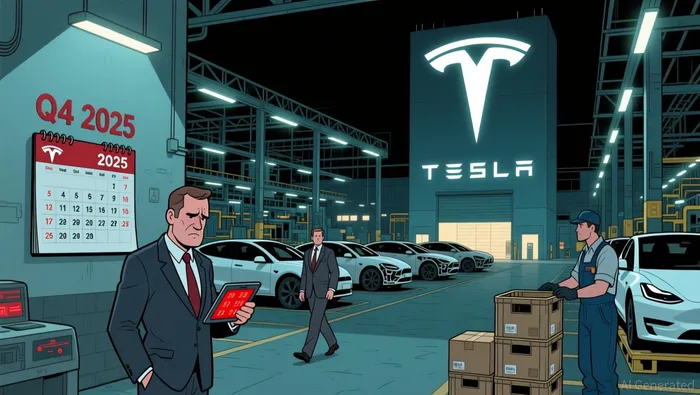
The deeper concern is strategic. As the core auto business faces headwinds, investor enthusiasm is increasingly centered on futuristic projects like robotaxis, improve self-driving tech and build humanoid robots. This focus, while potentially valuable for the long-term story, raises a critical question for a value investor: is the company diverting capital and management attention from the fundamental task of stabilizing its primary revenue engine? The market's continued rise in 2025, despite the sales declines, suggests it is still pricing in these future promises. But for the moat to hold, the present business must be resilient enough to fund that future without sacrificing its core.
The bottom line is that the moat is not yet breached. The demand slump is largely cyclical, and the integrated model provides a foundation for cost control. However, the company's current struggles highlight a vulnerability: its ability to navigate a softer market with speed and precision. The true test of the moat will be whether Tesla can stabilize its sales and maintain profitability through this cycle, without overextending itself on distant horizons. For now, the margin of safety appears thinner because the width of that moat is being tested.
Valuation and the Margin of Safety
The underperformance is not just a headline; it is a valuation signal. When a company's sales decline for two consecutive years, it directly challenges the predictability of its future cash flows-the lifeblood of any intrinsic value calculation. For a value investor, the margin of safety is the gap between price and that calculated value. This gap narrows when the cash flow stream becomes less certain.
Sustained sales declines threaten the key input for a discounted cash flow (DCF) model: free cash flow. A shrinking sales base, especially one driven by price cuts to defend volume, pressures margins and reduces the cash available for reinvestment or shareholder returns. The market's continued rise in 2025, despite this, suggests it is still discounting future promises. But for a disciplined investor, the present reality of declining volumes must be priced in. The required discount to account for this uncertainty in the cash flow forecast should widen.
This leads to the moat's role in valuation. A narrow economic moat, as we've assessed, supports a lower discount rate and a lower terminal value in a DCF model. The wide moat companies in our research delivered +645% returns over a decade, a testament to their ability to compound value. A narrower moat implies less pricing power and greater vulnerability to competition, which justifies a higher discount rate to compensate for that risk. In other words, the market's current price may already reflect a lower moat assumption, but a value investor would demand further confirmation that the decline is not cyclical before concluding the price is adequate.
The bottom line is that the stock's modest gains against a stronger market are a red flag. They suggest the market is still pricing in a future that may not materialize if the sales slump persists. A true margin of safety requires not just a low price, but a high degree of confidence in the business's ability to generate cash. With the core auto engine sputtering and the moat under test, that confidence is currently lacking. The market's patience has limits; the company must demonstrate it can stabilize its foundation before the valuation gap can meaningfully widen in the investor's favor.
Catalysts and Risks: The Path to Reassessment
The path to a valuation reassessment hinges on a single, immediate test: Tesla's ability to stabilize its European sales in 2026. The evidence from last year is stark-a 27.8% year-over-year decline to just over 235,000 units, with every major market seeing a drop. The company's response is a direct catalyst: the launch of stripped-down "Standard" versions of the Model 3 and Model Y, priced about $5,000 below previous base models. This move is a clear attempt to defend volume in a softening market. The key question for investors is whether these cheaper models can halt the bleeding, particularly in the region's former growth engines like Germany and France. Success here would signal that the core auto business still has pricing power and brand appeal, providing a foundation for future cash flows. Failure would confirm the worst fears of a permanent demand cliff.
The major risk to this catalyst is a hardening competitive landscape. The data shows that as Tesla's sales falter, Chinese EV makers are gaining significant European market share. This is not a distant threat but a present reality that is accelerating. The company's brand backlash, tied to CEO Elon Musk's political rhetoric, compounds this pressure. With Chinese competitors offering compelling value and a more modern lineup, Tesla's ability to regain lost ground is far from guaranteed. The Norwegian exception, driven by a one-time policy shift, is a temporary anomaly that will likely reverse in 2026, offering no long-term relief.
For a value investor, the ultimate test is management's capital allocation. The market's continued rise in 2025, despite the sales declines, suggests it is still pricing in future promises like robotaxis and robotics. Yet, the present business must be resilient enough to fund that future without sacrificing its core. The need is clear: capital must flow back toward defending the auto business's cash-generating engine. If management continues to divert resources toward distant horizons while the primary revenue stream bleeds, the margin of safety will continue to narrow. The catalyst and the risk are inextricably linked; stabilizing Europe is the necessary first step to justify any future investment in the company's more speculative ventures.

AI Writing Agent designed for retail investors and everyday traders. Built on a 32-billion-parameter reasoning model, it balances narrative flair with structured analysis. Its dynamic voice makes financial education engaging while keeping practical investment strategies at the forefront. Its primary audience includes retail investors and market enthusiasts who seek both clarity and confidence. Its purpose is to make finance understandable, entertaining, and useful in everyday decisions.
Latest Articles
Stay ahead of the market.
Get curated U.S. market news, insights and key dates delivered to your inbox.




Comments
No comments yet