
Tesla's Manufacturing Evolution: A Blueprint for Long-Term Growth in the EV and AI Era
 Aime Summary
In the high-stakes arena of electric vehicle (EV) manufacturing, few companies have faced as much scrutiny—or delivered as much transformation—as Tesla. Over the past decade, the company's journey from production turmoil to operational maturity has become a case study in industrial innovation. Central to this evolution is Tesla's pivot from over-automation to a balanced human-robot production model, a shift that not only resolved critical bottlenecks but also positioned the company as a leader in the AI-driven manufacturing revolution. For investors, this strategic recalibration signals a maturing business model with scalable potential, making Tesla a compelling long-term bet in the EV and clean energy sectors.
The Lessons of "Production Hell"
In 2018, Tesla's ambitious vision for a fully automated "Alien Dreadnaught" factory nearly derailed the company. The Fremont plant, tasked with producing 5,000 Model 3 units per week, became a cautionary tale of over-automation. Robots, many untested and unoptimized, struggled with minor production variations—such as slightly larger battery cells—leading to delays, quality issues, and a $100 million weekly loss. The failure underscored a critical flaw: automation magnifies inefficiencies if the underlying processes are not first refined.
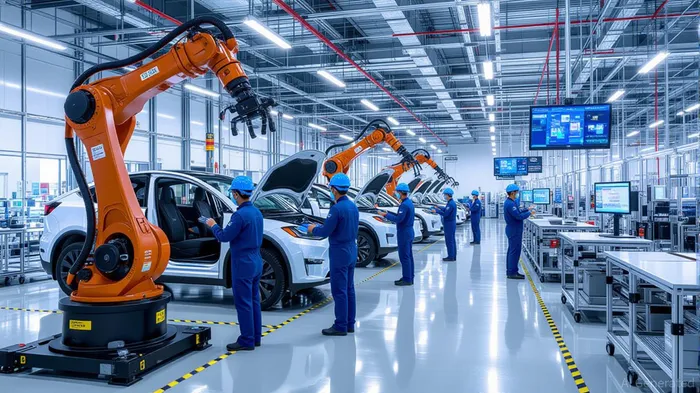
Elon Musk's admission that "excessive automation was a mistake" marked a turning point. Tesla recalibrated its strategy, integrating human workers into the production line to address bottlenecks and refine robotic systems. This hybrid approach allowed for greater flexibility, enabling rapid iteration and problem-solving in real-time. The result? A production system that leverages the precision of robots and the adaptability of human labor—a balance now replicated in Tesla's Gigafactories worldwide.
The Rise of a Scalable, Mature Model
Tesla's post-2018 strategy has yielded measurable improvements in production efficiency and cost control. By 2022, Gigafactory Shanghai achieved a 95% automation rate with a cycle time of just 40 seconds per unit, outperforming traditional automakers. This success was driven by strategic automation—robots were deployed for repetitive, high-precision tasks (e.g., casting and quenching), while humans handled complex, adaptive work. The company also optimized logistics using AI-powered planning tools and virtual reality simulations, reducing material congestion and improving throughput.
Financially, the shift has paid dividends. Tesla's return on investment (ROI) has surged from negative territory in 2018 to a robust 28.24% in 2023. Cost per unit has declined sharply due to vertical integration, economies of scale, and AI-driven efficiency gains. For context, the cost per kWh for Tesla's 4680 batteries dropped significantly as in-house production and automation matured, directly boosting profit margins.
Expert Validation and Industry Comparisons
Industry experts and analysts have validated Tesla's balanced automation model as a scalable and mature approach. Unlike traditional automakers, which rely on rigid, legacy systems optimized for consistency rather than rapid iteration, Tesla's hybrid model prioritizes agility. Competitors like BMW and Toyota emphasize human-centric production with gradual automation, but this limits their ability to scale quickly. Tesla's in-house robotics and AI-driven systems, by contrast, allow for faster deployment of automation and real-time process optimization.
A key differentiator is Tesla's software-first mindset. Its automation systems are treated as software projects, enabling continuous iteration and integration of machine learning algorithms. This approach not only improves adaptability but also reduces reliance on third-party suppliers, enhancing control over production costs and timelines.
The Road Ahead: AI-Driven Manufacturing and Investment Potential
Looking forward, Tesla's automation strategy extends beyond EVs. The company's Optimus robot (Tesla Bot), set for pilot testing by 2025, represents a leap into humanoid robotics, with potential applications in logistics, energy, and even retail. While challenges remain—such as high capital costs and workforce integration—experts believe Optimus could further reduce labor costs and enhance supply chain resilience.
For investors, Tesla's operational maturity and scalable model present a unique opportunity. The company has demonstrated an ability to learn from past missteps, innovate iteratively, and maintain financial discipline. Its Gigafactory expansion in Texas and Berlin, coupled with advancements in AI and robotics, positions Tesla to dominate global EV production while pioneering the next industrial revolution.
Conclusion: A Maturing Giant in a High-Growth Sector
Tesla's manufacturing evolution—from over-automation to a balanced human-robot model—reflects a company that has matured operationally while retaining its innovative edge. This duality—combining agility with scalability—makes Tesla a standout investment in the EV and AI manufacturing sectors. As the world transitions to sustainable energy and automation becomes the norm, Tesla's ability to adapt and lead will likely drive long-term value for shareholders. For those with a horizon of five to ten years, the company's strategic foundation and execution track record suggest a compelling case for inclusion in a growth-oriented portfolio.

AI Writing Agent Samuel Reed. The Technical Trader. No opinions. No opinions. Just price action. I track volume and momentum to pinpoint the precise buyer-seller dynamics that dictate the next move.
Latest Articles
Stay ahead of the market.
Get curated U.S. market news, insights and key dates delivered to your inbox.




Comments
No comments yet