
Tesla's Luxury Gambit in India: A Risky Move or the Next Growth Engine?
As TeslaTSLA-- prepares to launch its first showroom in Mumbai on July 15, 2025, the automaker's strategy in India marks a stark departure from its mass-market ethos elsewhere. Instead of competing on price—a model that has driven success in the U.S. and Europe—Tesla is targeting India's nascent but rapidly growing luxury EV segment. This pivot reflects a strategic shift to counter declining margins in saturated markets, betting on premium buyers to fuel long-term growth. But can Tesla overcome India's infrastructural and competitive hurdles? And is this a contrarian investment opportunity or a risky gamble?
The Strategic Shift: Luxury as a New Growth Lever
Tesla's decision to enter India with the Model Y, priced at ₹50 lakh (USD $57,000) post-tariffs, is a deliberate move to avoid direct competition with affordable EVs like Tata's ₹10 lakh Nexon. In doing so, Tesla is capitalizing on India's rising affluent class—projected to grow at 12% annually through 2030—who prioritize brand prestige and cutting-edge tech over cost.
This contrasts sharply with Tesla's struggles in its core markets. In the U.S., Tesla's revenue growth has slowed to 15% year-over-year, while its gross margins dipped to 17.2% in Q1 2025, pressured by price cuts to counter competition from GMGM-- and Ford. In Europe, Tesla's market share has shrunk as rivals like BMW (which now sells 17% EVs in India) and Mercedes launch aggressive EV lines. India, therefore, represents a fresh frontier for Tesla's premium brand.
The Opportunity: A Niche with Long-Term Upside
India's luxury EV market is tiny but expanding. While EVs account for just 2.5% of total car sales, luxury segments (vehicles priced above ₹50 lakh) are growing at 25% annually. Tesla's Model Y—boasting aerodynamics, Autopilot, and a global brand—could carve out a niche here.
Moreover, India's EV policy framework is evolving. The SPMEPCI policy offers import duty exemptions (reducing tariffs to 15% for EVs above ₹35 lakh) if Tesla commits to local manufacturing. While Tesla has delayed this, a potential shift to domestic production by 2026 could slash prices by 20–30%, unlocking mass-market appeal.
Risks: Infrastructure, Competition, and Policy Uncertainty
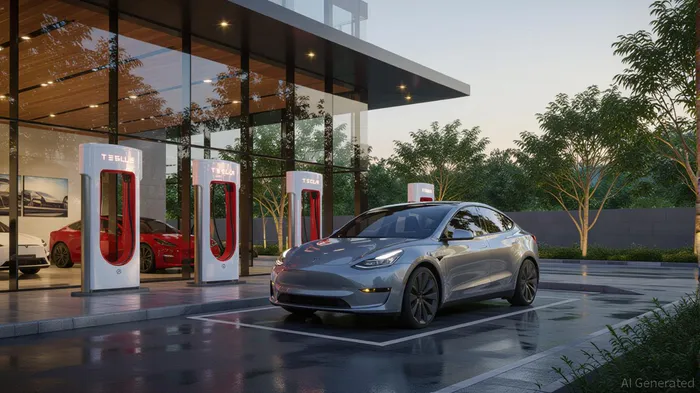
The path forward is fraught with challenges. First, India's EV charging infrastructure is abysmal: only 16,000 public chargers exist, with a shocking 135 EVs per charger (vs. 6–20 in developed markets). Tesla's Supercharger network—planned for Mumbai and Delhi by 2026—will need to scale rapidly to avoid range anxiety.
Second, competition is fierce. While Tata and BYD dominate the budget segment, global rivals like BMW's iX1 (priced at ₹49 lakh) and Audi's Q8 e-tron (₹1.15 crore) are already targeting luxury buyers. Tesla's edge lies in its ecosystem dominance—its Superchargers and direct-to-consumer model—though local players could replicate this over time.
Third, geopolitical risks loom. Tesla imports its India-bound Model Y from China, exposing it to potential U.S.-India trade tensions. Additionally, India's 70% import duty on luxury EVs remains a sword of Damocles; any policy reversal could cripple margins.
Investment Thesis: A Long-Term Play with High Upside
Despite the risks, Tesla's India entry is a compelling investment opportunity for three reasons:
- Brand Power: Tesla's global reputation as an EV pioneer and innovator resonates with India's luxury buyers. The Model Y's tech specs—e.g., the Juniper version's redesigned exterior and advanced Autopilot—offer no direct local equivalent.
- Timing: By entering now, Tesla secures first-mover advantage in a segment where rivals are still ramping up. Early adopters will create a loyal customer base, critical for future scaling.
- Policy Tailwinds: India's 30% EV sales target by 2030 and subsidies under the PM E-DRIVE scheme ($1.3B allocated) will accelerate infrastructure and adoption.
The Bottom Line
Tesla's India strategy is a high-risk, high-reward bet. Near-term hurdles—pricing, infrastructure, and competition—could limit sales to 10,000 units by 2025. However, if Tesla commits to local manufacturing and scales its Supercharger network, it could capture 10–15% of the luxury EV market by 2030. For investors with a multi-year horizon, Tesla's entry is a strategic move to diversify revenue streams and capitalize on an underpenetrated market.
Investment Action: Tesla's stock (TSLA) is down 15% YTD on margin concerns. A pullback to $180–$200 post-India launch could offer an entry point. Hold for 3–5 years, with a bullish catalyst in 2026 if local production begins and Supercharger adoption surges.
In the words of Musk: “The first step is always the hardest.” Tesla's move to India is that first step—a bold play to redefine its future.

Stay ahead of the market.
Get curated U.S. market news, insights and key dates delivered to your inbox.




Comments
No comments yet