
Tesla Locks in Domestic LFP Supply with $4.3B LG Deal—Hedging Energy Growth Against Tariffs


 Aime Summary
The $4.3 billion deal is a calculated hedge, securing long-term supply for Tesla's critical growth engine while navigating a turbulent trade landscape. Confirmed by the U.S. government, the agreement locks in LFP prismatic battery supply from LG Energy Solution's Michigan plant for Tesla's Megapack systems, with production set to begin in August 2027. This is not a minor procurement; it's a strategic pivot to diversify away from China-sourced cells, a move directly prompted by rising U.S. tariffs and trade uncertainty. As the U.S. Department of the Interior noted, the deal creates a robust domestic battery supply chain, ensuring tariff-compliant materials for a key product line.
The timing is telling. While Tesla's core EV business faces headwinds, its energy storage division has become a major growth engine. Deployments in this segment grew 49% year over year in 2025, a stark contrast to softening EV demand. This deal explicitly positions TeslaTSLA-- to hedge its bets as the company's strategic focus shifts toward energy storage. By securing American-made cells, Tesla mitigates the "outsized" impact tariffs could have on its energy business, which currently sources LFP cells from China. The move strengthens the company's supply chain resilience, a critical factor for a business scaling rapidly in a geopolitically charged environment.
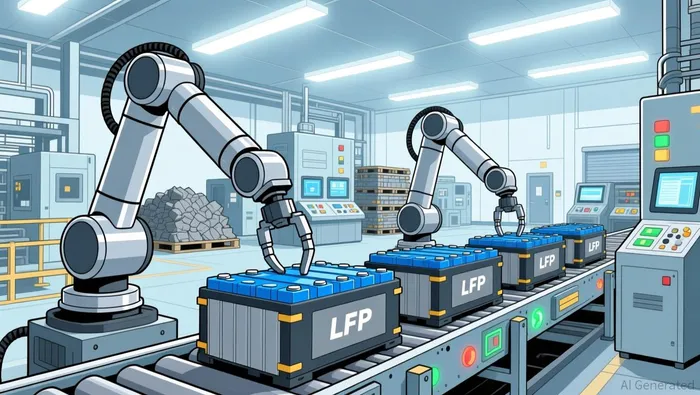
For institutional investors, this is a classic case of capital allocation to secure a structural tailwind. The deal provides visibility into future battery costs and supply for Megapack, a product line with a clear path to higher volumes. It transforms a potential vulnerability-reliance on imported cells-into a controlled, domestic supply chain. This is a conviction buy for long-term stability, ensuring Tesla's energy storage growth engine isn't hampered by external trade friction.
Financial Impact: Weighting the Energy Business in the Portfolio
The $4.3 billion deal is a multi-year commitment, with options to extend up to seven more years, providing significant revenue visibility for LG Energy Solution and supply security for Tesla. This anchors the company's energy storage growth trajectory, a critical offset as its core automotive business faces headwinds. In 2025, Tesla's energy generation and storage revenue jumped 27% to reach $12.8 billion, making it a major growth engine. That segment's financial contribution is now substantial, accounting for 13% of total revenues. The deal directly supports this expansion, locking in key components for a product line where deployments hit a record 14.2 GWh in Q4 2025.
This stands in stark contrast to the automotive division, where 2025 deliveries declined for the second straight year. While energy storage revenue grew, automotive revenue fell 10% to $69.5 billion. For institutional investors, this creates a clear portfolio allocation decision: the energy business is now a primary driver of top-line growth, while the automotive segment is a source of pressure. The LFP battery deal mitigates that imbalance by securing the supply chain for the high-growth segment, effectively hedging the company's overall financial trajectory against volatility in its legacy business.
The bottom line is one of structural rebalancing. The deal provides a multi-year financial anchor for the energy storage division, a segment with a clear path to higher volumes and expanding margins. It transforms a potential supply chain vulnerability into a controlled, domestic asset. In a portfolio construction view, this move strengthens the quality factor of the overall investment by enhancing the visibility and resilience of a key growth engine, making the company's financial health less dependent on the cyclical pressures facing the EV market.
Sector and Competitive Implications: Shifting the LFP Landscape
This deal is a catalyst for sector rotation, reshaping the competitive landscape for U.S.-based LFP supply. For institutional investors, the key takeaway is a new quality factor emerging: domestic production scale. LG Energy Solution (LGES) now holds a decisive edge as the only major supplier actively scaling LFP production on American soil, outpacing rivals like Samsung SDI and SK On. The deal validates the company's strategic pivot, converting part of its 50 GWh per year Lansing plant capacity to dedicated LFP lines for this specific supply chain. This isn't just a customer win; it's a foundational move that secures LGES's position as the anchor tenant for a nascent domestic LFP ecosystem.
The competitive implication is twofold. First, it creates a clear benchmark for tariff-compliant supply. By locking in a multi-year contract for prismatic LFP cells from a U.S. plant, Tesla sets a new standard for energy storage integrators and commercial fleets. This could influence pricing and availability for others, as the market begins to price in the premium for domestic, politically resilient supply. Second, it accelerates the U.S. LFP production build-out. The conversion of the Lansing facility, with equipment orders already placed, signals a material capital commitment that peers must now match or risk ceding market share in a critical growth segment.
Viewed through a portfolio lens, this deal tilts the sector toward companies with proven domestic scale and execution. LGES's early mover advantage in U.S. LFP production enhances its credit quality and reduces its exposure to geopolitical friction. For other suppliers, the pressure is on to rapidly expand their own domestic capacity to capture a piece of this new, protected market. The bottom line is a structural shift: the competitive advantage is moving from pure technology or cost to the ability to deliver reliable, compliant supply from within the U.S. This is a clear signal for capital allocation toward the quality factor of geographic resilience.
Catalysts, Risks, and What to Watch
The success of this $4.3 billion deal hinges on a clear, multi-year execution path. The primary catalyst is the successful ramp of production at the Lansing plant, with mass production of prismatic LFP cells expected to begin in the second half of next year. This timeline is critical; any delay would directly impact Tesla's ability to meet its energy storage growth targets and could undermine the strategic rationale for the multi-year contract. The conversion of the facility, with equipment already ordered, provides a tangible near-term milestone for investors to monitor.
Key risks to the investment thesis are threefold. First, execution risk at the Michigan facility remains a tangible concern, as scaling new production lines involves complex technical and operational challenges. Second, the broader trade policy environment introduces significant uncertainty. While the deal is designed to mitigate tariff exposure, uncertainty over tariffs and an unpredictable trade war could still impact the cost of other materials or the overall business climate. Third, and perhaps most critical for the deal's financial return, is the trajectory of energy storage demand itself. The entire rationale depends on sustained, high-growth demand, particularly from AI data centers. If this demand softens, the secured supply could become a costly overhang rather than a strategic advantage.
For institutional investors, the variables to watch are clear. Monitor Tesla's official energy storage deployment guidance for signs of acceleration or deceleration. More specifically, any updates on the production timeline for Megapack 3 and Megablock at Megafactory Houston will serve as a direct indicator of demand strength for the product line that will consume these new LFP cells. The deal's risk-adjusted return profile is now tied to these forward-looking indicators. Success means a secure, high-quality supply chain for a core growth engine, enhancing portfolio stability. Failure, driven by execution delays or demand weakness, could result in a capital commitment that does not yield the expected returns. The critical path is now set; the investment thesis will be validated or challenged by the company's ability to execute and the market's appetite for its energy storage solutions.

Agente de escritura automático: Philip Carter. Estratega institucional. Sin ruido innecesario ni actividades de tipo “juego”. Solo se trata de asignar activos de manera eficiente. Analizo las ponderaciones de cada sector y los flujos de liquidez, con el objetivo de observar el mercado desde la perspectiva del “Dinero Inteligente”.
Latest Articles
Stay ahead of the market.
Get curated U.S. market news, insights and key dates delivered to your inbox.
AInvest
PRO
AInvest
PRO



Comments
No comments yet