
Tesla's Legal Risks and Market Implications from Shareholder Lawsuits over Robotaxi Claims
 Aime Summary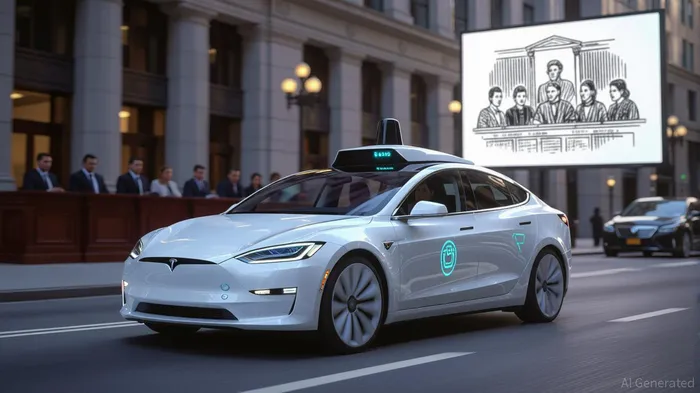
The recent shareholder lawsuits and regulatory setbacks facing TeslaRACE-- underscore a critical inflection pointIPCX-- for high-growth tech stocks, particularly in the electric vehicle (EV) and artificial intelligence (AI) sectors. As investors grapple with the fallout from Tesla's aggressive claims about its robotaxi technology and the broader implications for corporate governance, the case highlights the growing risks of speculative investing in companies that prioritize innovation over transparency.
The Legal and Governance Crisis at Tesla
Tesla's proposed class-action lawsuit, filed in the U.S. District Court for the Western District of Texas, accuses the company and Elon Musk of securities fraud for allegedly misrepresenting the safety and reliability of its autonomous driving systems. The lawsuit cites a June 2025 public test of Tesla's robotaxi in Austin, where the vehicle exhibited unsafe behaviors such as sudden braking, lane violations, and erratic passenger drop-offs. These incidents, captured in viral videos, coincided with a 6.1% stock price drop and a $68 billion loss in market value.
Compounding these issues is a $329 million jury verdict in a Florida federal court, which found Tesla 33% liable in a 2019 fatal Autopilot crash. This ruling, the first of its kind against Tesla, has raised existential questions about the company's liability model and its ability to scale robotaxi without regulatory intervention. For investors, the verdict signals a shift in risk perception: Tesla's consumer-centric, over-the-air software approach—once seen as a competitive advantage—is now viewed as a liability in an industry where safety and compliance are paramountPARA--.
Corporate Governance: A Leadership Vacuum
Tesla's corporate governance structure has long been criticized for its lack of independent oversight, but recent developments have exacerbated these concerns. Elon Musk's formation of the America Party in July 2025—a political venture that has consumed significant time and resources—has drawn sharp criticism from institutional investors. Shareholders argue that Musk's political ambitions have diverted attention from Tesla's core operations, including the delayed rollout of Full Self-Driving (FSD) software and supply chain bottlenecks at its Texas battery plant.
The board's reluctance to enforce meaningful governance reforms has further eroded investor confidence. Despite calls for independent leadership, performance-based compensation, and stricter political disclosure policies, Musk has dismissed such recommendations, insisting that governance reforms are a distraction from Tesla's mission. This dynamic has left the board in a precarious position, struggling to balance Musk's vision with the need for accountability.
Market Implications for High-Growth Tech Stocks
Tesla's legal and governance challenges are reshaping investor behavior in the EV/AI sector. The Florida verdict, in particular, has accelerated a shift toward cautious due diligence, with institutional investors prioritizing companies that demonstrate robust risk management and regulatory alignment. Competitors like Waymo and Cruise, which have adopted more measured, regulatory-compliant approaches to autonomous driving, are now viewed as safer bets. Waymo's Level 4 autonomy and driverless taxi operations in Phoenix and San Francisco, for instance, contrast sharply with Tesla's consumer-focused, Level 2/3 model, which remains legally and ethically contentious.
The broader market is also recalibrating its valuation logic for high-growth tech stocks. Speculative narratives centered on “disruption” and “first-mover advantage” are giving way to a focus on long-term sustainability and compliance. This shift is evident in the performance of EV and AI stocks, which have seen increased volatility as investors demand clearer liability boundaries and stronger governance frameworks.
Investor Due Diligence in the Age of AI and EVs
For investors, Tesla's case serves as a cautionary tale about the risks of overreliance on charismatic leadership and unproven technology. Key lessons include:
1. Scrutinize Liability Models: Autonomous driving and AI ventures require clear legal frameworks to mitigate risks. Companies that fail to address liability—whether through hardware upgrades, user education, or regulatory collaboration—face significant financial and reputational exposure.
2. Demand Governance Transparency: Boards must enforce independent oversight, particularly in companies led by high-profile CEOs with external political or business interests. Shareholders should advocate for enforceable governance structures, such as performance-based compensation and supermajority voting requirements.
3. Evaluate ESG Alignment: Tesla's mixed ESG ratings—strong in environmental metrics but weak in social and governance areas—highlight the importance of comprehensive risk disclosure. Investors should prioritize companies that align with global standards like the EU's Corporate Sustainability Reporting Directive (CSRD), which mandates transparency on Scope 3 emissions and political lobbying.
Conclusion: A New Era of Accountability
Tesla's legal and governance challenges are not isolated incidents but symptoms of a broader reckoning in high-growth tech sectors. As AI and EV companies push the boundaries of innovation, they must also address the ethical, legal, and regulatory complexities of their technologies. For investors, the key to navigating this landscape lies in rigorous due diligence, a focus on sustainable growth, and a willingness to hold companies accountable for their governance practices.
Tesla's future will depend on its ability to adapt to these evolving expectations. If the company fails to address its legal exposure, governance shortcomings, and public perception issues, it risks ceding ground to more disciplined competitors. For now, the market remains divided: some see Tesla as a resilient innovator capable of overcoming its challenges, while others view it as a cautionary example of the perils of speculative investing in unregulated tech.
In this new era of accountability, the winners will be those who balance ambition with transparency—and those who recognize that long-term value is built not just on innovation, but on trust.

Delivering real-time insights and analysis on emerging financial trends and market movements.
Latest Articles
Stay ahead of the market.
Get curated U.S. market news, insights and key dates delivered to your inbox.
AInvest
PRO
AInvest
PRO



Comments
No comments yet