
Tesla Launches First Diner as Brand Strategy Pivot Amid 18.3% Sales Decline
 Aime Summary
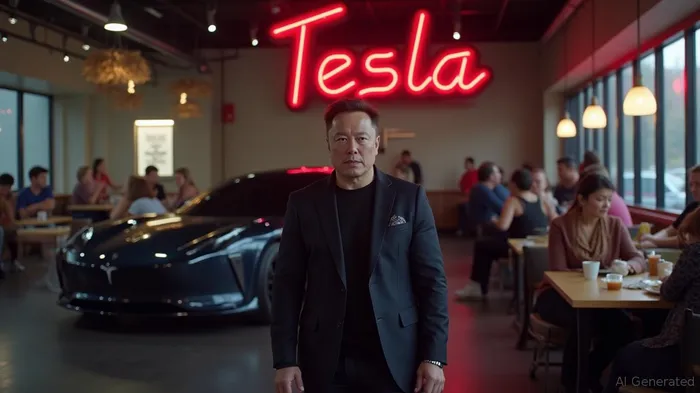
Tesla Inc. has unveiled its first TeslaRACE-- Diner in Los Angeles, marking a strategic pivot in its branding strategy as the electric vehicle (EV) maker navigates challenges in the automotive market. The retro-futuristic restaurant, located along Historic Route 66, features 80 Tesla charging stations, movie screens, and Optimus robots serving popcorn, alongside a menu of classic diner fare such as $4 tallow-fried french fries and $13 hot dogs. The concept, described by CEO Elon Musk as an “island of good food, good vibes & entertainment,” aims to expand globally and to Supercharger locations [1].
The diner’s launch coincides with a broader effort to reinvigorate Tesla’s brand following a series of setbacks. Wedbush Securities analyst Dan Ives highlighted the move as a critical step in Musk’s vision to create an “all-encompassing brand” spanning vehicles, homes, and now hospitality [1]. “It’s all about brand,” Ives told Fortune, emphasizing that Tesla’s strategy hinges on “laying out an ecosystem that eventually goes from the car to the house to a restaurant to other areas of AI.” The diner, with its nostalgic aesthetic and integration of Tesla’s technology, aligns with this ambition while leveraging the company’s cult-like customer base [1].
The restaurant’s debut has generated buzz, albeit with long wait times for food. Early social media reviews praised the experience, including a tuna melt served in a cardboard Cybertruck box and the novelty of Optimus robots. However, the diner’s success is intertwined with Tesla’s broader commercial struggles. In California, the company’s sales have declined for seven consecutive quarters, with year-to-date vehicle registrations down 18.3% in the state [1]. Meanwhile, Musk’s recent robotaxi pilot in Austin has faced scrutiny over safety concerns and limited scalability, raising questions about the timeline for profitability in robotics [1].
Ives framed the diner as part of Musk’s “wartime CEO” approach, a shift from the CEO’s earlier entanglements with U.S. politics, including his role in Donald Trump’s DOGE initiative. This political involvement had sparked protests and investor skepticism, with Tesla’s market value plummeting by $127 billion in March [1]. Ives argued that the diner’s focus on brand-building could help contain the reputational damage while redirecting Musk’s attention to core business priorities.
The analyst also suggested structural changes for Tesla’s board to reinforce Musk’s focus, including performance-linked incentives tied to growth metrics and a committee to monitor the CEO’s political activities [1]. These measures aim to ensure Tesla remains on track to capitalize on its autonomous driving and robotics innovations, which Ives described as “the most important stages of its growth cycle.”
Tesla’s foray into hospitality reflects a broader trend of brands leveraging nostalgia-driven concepts to foster customer loyalty. As competitors like Cheez-It launch retro dining experiences, Musk’s vision for the diner underscores his determination to position Tesla as a lifestyle brand. The company, which avoids traditional advertising, relies on viral moments and product integration to attract attention—a strategy now extended to its menu and charging infrastructure [1].
Source: [1] [Elon Musk’s Tesla Diner is a next step in the beleaguered EV-maker’s plan to create an ‘all-encompassing brand,’ analyst Dan Ives says] [https://fortune.com/2025/07/23/elon-musk-tesla-diner-brand-recovery-wedbush-dan-ives/]

Stay ahead of the market.
Get curated U.S. market news, insights and key dates delivered to your inbox.
AInvest
PRO
AInvest
PRO



Comments
No comments yet