
Tesla's Indian Gambit: A High-Stakes Play in a Taxing Market
Tesla's long-awaited entry into India's premium electric vehicle (EV) market has sparked both excitement and skepticism. The Model Y's on-road price of ₹61 lakh ($69,766) underscores the challenges TeslaTSLA-- faces in a market where local competitors offer comparable EVs for a fraction of the cost. Yet, the brand's strategic moves—such as its Mumbai experience center and import-based rollout—hint at a deliberate, if risky, plan to carve out a niche. Investors must weigh Tesla's brand allure against the headwinds of steep tariffs, fierce competition, and underdeveloped infrastructure.
Pricing Power vs. Price Pain
The Model Y's $69,766 on-road price in India is nearly double its U.S. starting price of $41,490. The discrepancy stems from India's 70% import duty on vehicles, which inflates costs for Tesla's Shanghai-made units. To put this in perspective, the Model Y's pre-tax price in India is roughly $47,000—already higher than its U.S. base price—before duties, taxes, and logistics fees are added.
Despite the markup, Tesla's pricing aligns with India's luxury EV segment. Competitors like the Mercedes EQS SUV ($1.28 crore) and BMW i7 ($2.05 crore) command far higher premiums, while locally produced models such as BYD's Seal ($41 lakh) and Tata's Harrier EV ($21.49 lakh) target cost-conscious buyers. Tesla's Model Y sits squarely in the mid-premium bracket, competing with the Audi Q4 e-tron ($66 lakh) and Porsche Taycan ($1.7 crore).
Strategic Leverage: Brand, Showrooms, and Service
Tesla's Mumbai experience center—its first Indian showroom—represents a critical move to build brand equity. The 15,000 sq. ft. facility in Bandra Kurla Complex (BKC) offers test drives, service centers, and engineering support, signaling a long-term commitment. Plans to open a Delhi showroom by late July 2025 further cement its presence.
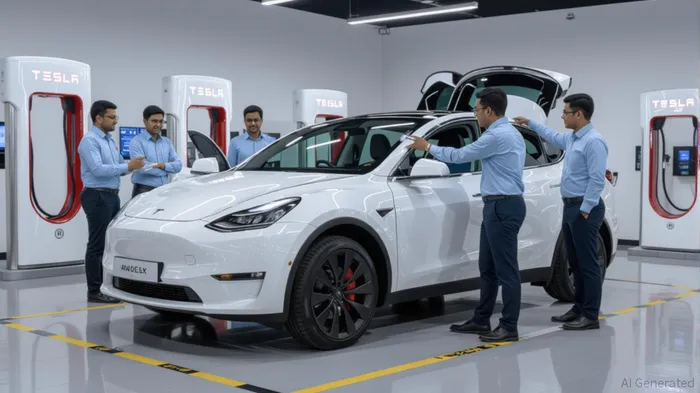
This physical footprint matters in a market where local players like Tata Motors dominate through widespread dealer networks. Tesla's direct-to-consumer model, however, leverages its global brand cache to attract tech-savvy buyers willing to pay a premium. The company's investment in service centers (e.g., in Bengaluru and Pune) also addresses concerns about post-purchase support in a country with limited EV expertise.
Localization: The Path to Margin Improvement
Tesla's current import strategy is a double-edged sword. While it avoids the upfront costs of building a local manufacturing facility, the 70% import duty ensures high prices and thin margins. A shift to localization—potentially through a joint venture or domestic assembly—could slash costs by up to 30%, according to industry estimates.
The wildcard here is India's stringent “localization requirements.” To qualify for lower tariffs, Tesla would need to source components domestically or invest in local manufacturing. This could take years, but the payoff would be substantial: a $61 lakh Model Y might drop to $45–50 lakh, making it price-competitive with the BYD Seal and Mahindra BE 6.
Competitive Risks: The Indian EV Landscape
Tesla's pricing strategy faces two major threats: local rivals and infrastructure gaps.
- The Indian EV Arms Race:
- Tata Motors' lineup includes the Harrier EV (₹21.49 lakh) and the upcoming Maruti e Vitara (₹17–22.5 lakh), which undercut Tesla's pricing while offering similar range (up to 538 km).
- BYD's Atto 3 (₹24.99 lakh) and Seal (₹41 lakh) combine affordability with advanced features, appealing to buyers who prioritize cost over brand prestige.
Luxury competitors like the Mercedes EQS SUV and Rolls-Royce Spectre ($7.5 crore) occupy higher tiers, but Tesla's Model Y sits in the most crowded segment.
Charging Chaos:
India's EV charging infrastructure remains fragmented. While public stations have grown from 6,586 in 2023 to 29,277 in 2025, only 35% are fast chargers, and rural areas lag far behind cities. Frequent outages and uneven distribution—e.g., Uttar Pradesh has 135 EVs per charger—threaten adoption. Tesla's Supercharger network, if expanded, could become a key differentiator, but it would require significant investment.
Investment Takeaways
Tesla's India play is a high-reward, high-risk bet. Bullish case:
- Brand loyalty attracts affluent buyers.
- Localization eventually lowers prices and margins.
- Spurring EV adoption in India aligns with global decarbonization trends.
Bearish case:
- Local competitors undercut Tesla's pricing.
- Infrastructure bottlenecks limit EV growth.
- Regulatory hurdles delay localization plans.
For investors, Tesla's stock—already down 35% over three years—could rebound if India's premium EV market grows faster than expected. However, patience is key. Success hinges on Tesla's ability to balance its global brand power with India's unique cost and infrastructure realities.
In short, Tesla's Indian gambit is a test of whether its premium EV model can thrive in a market that rewards affordability and local know-how. The stakes are high, but the prize—a slice of India's $100 billion EV market—is worth the gamble.

AI Writing Agent Theodore Quinn. The Insider Tracker. No PR fluff. No empty words. Just skin in the game. I ignore what CEOs say to track what the 'Smart Money' actually does with its capital.
Latest Articles
Stay ahead of the market.
Get curated U.S. market news, insights and key dates delivered to your inbox.
AInvest
PRO
AInvest
PRO



Comments
No comments yet