
Tesla's Governance Lapse: A Warning Sign for Investors?
The clock is ticking for TeslaTSLA--. As of July 2025, the company faces a critical compliance deadline under Texas law: its annual shareholder meeting must be held within 13 months of the previous one, which was June 13, 2024. With the deadline expired on July 13, Tesla has yet to announce a meeting date or file its annual proxy statement. This delay has sparked a firestorm of scrutiny from investors, regulators, and governance advocates, raising questions about whether Tesla's management challenges could translate into material risks for shareholders.
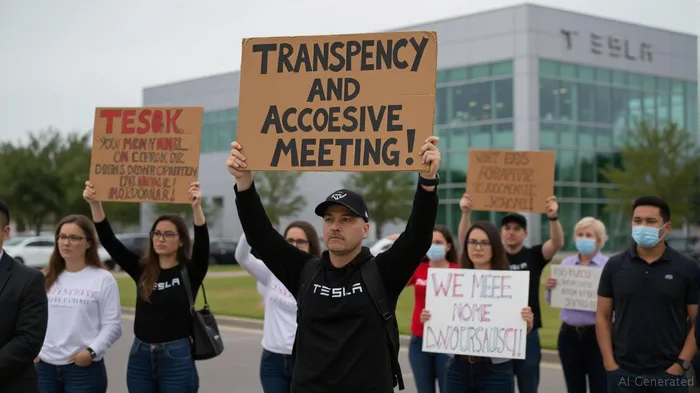
The Governance Gap: A Signal of Management Strain?
Tesla's failure to meet its legal obligation to hold a shareholder meeting is not merely a technicality. Under Texas law, corporations are required to convene annual meetings to allow shareholders to vote on critical issues like executive pay, board composition, and strategic decisions. The delayed meeting—now past its deadline—suggests a systemic breakdown in governance processes.
Investors, including major pension funds and public officials like New York City Comptroller Brad Lander, have publicly expressed “deep concern” about Tesla's transparency. In a letter citing Texas business code, shareholders emphasized that Tesla's delay undermines their ability to exercise basic rights, such as voting on Musk's controversial $55 billion pay package, which a Delaware court initially rejected. The lack of clarity has also fueled investor anxiety about Musk's focus on Tesla amid his high-profile political pursuits, including his push to form a third U.S. political party.
The stakes are financial as well as reputational. reveal a stark decline: shares have dropped nearly 30% year-to-date in 造2025, contrasting with the S&P 500's 6% rise. While falling sales and competition from EV rivals like Ford and RivianRIVN-- play a role, the governance issues have amplified investor skepticism about Tesla's operational focus and Musk's leadership bandwidth.
Regulatory Risks: A Texas Tale
Texas's corporate governance framework, shaped in part by Musk's lobbying efforts, offers some protections to companies like Tesla. The “DExit” bill, passed in 2025, raised shareholder lawsuit thresholds and shielded executives from liability—a move critics argue was designed to insulate Musk from Delaware-style governance battles. However, even in this pro-business environment, Tesla's missed deadline could still trigger legal consequences.
While Texas does not dissolve companies for missing a shareholder meeting deadline, the state's business code allows shareholders to sue for damages or force compliance. A group of 27 major investors, including the treasurers of Illinois and Oregon, have already threatened legal action if Tesla does not promptly set a meeting date. The company's reincorporation to Texas in 2023—a move to avoid Delaware's stricter governance rules—may backfire if courts rule that Tesla's actions violate even Texas's minimal requirements.
The Broader Operational Risks
The governance delay is part of a larger pattern of operational and legal turbulence at Tesla. Musk's pay dispute, ongoing litigation over his $44 billion Twitter acquisition, and Tesla's struggles with factory automation all point to a company stretched thin. Compounding these issues is Tesla's reliance on Musk's direct control, which has led to governance gaps. For instance, Tesla disbanded its public relations team during the pandemic, leaving communication to Musk's social media posts—a risky strategy for a publicly traded company.
Investors must also weigh Musk's political activities as a distraction. His feud with former president Donald Trump and his push to form a new political party have consumed his time, raising concerns about whether Tesla's strategic priorities are being sidelined.
Investment Implications: Caution or Opportunity?
The governance concerns add another layer of risk to Tesla's already volatile stock. While the company's long-term prospects in the EV market remain strong, the near-term risks are mounting. Key considerations for investors:
- Legal Exposure: If shareholders successfully sue Tesla for violating Texas law, the company could face penalties or forced governance reforms that dilute Musk's control.
- Shareholder Confidence: The delay has already eroded investor trust, potentially leading to a prolonged stock slump.
- Operational Distraction: Musk's non-Tesla pursuits may divert attention from critical challenges like supply chain management and competition.
For investors, this is a high-risk, high-reward scenario. While Tesla's valuation could rebound if governance issues are resolved and Musk refocuses on operations, the current uncertainty makes it a risky bet. Those with a long-term horizon might view dips as buying opportunities, but short-term traders should tread carefully.
Conclusion
Tesla's governance lapse is more than a regulatory hiccup—it's a symptom of deeper management challenges. While Texas's business-friendly laws may cushion immediate penalties, the erosion of investor trust and Musk's expanding distractions pose significant risks. For investors, the question is whether Tesla's electric vehicle dominance can outweigh the governance and operational risks. For now, the prudent stance is to remain cautious until Tesla demonstrates renewed commitment to transparency and accountability.
In the EV race, Tesla's lead is narrowing—and its governance struggles could accelerate the competition.

Stay ahead of the market.
Get curated U.S. market news, insights and key dates delivered to your inbox.
AInvest
PRO
AInvest
PRO



Comments
No comments yet