
Tesla Eyes $2.9B In Chinese Solar Equipment: Targeted Chinese Solar Stocks Suddenly Surge
 Aime Summary
Update2 (March 20, 2026): According to sources cited by Cailianshe, Elon Musk’s SpaceX team has successfully procured equipment from a leading Chinese Heterojunction (HJT) equipment manufacturer, with shipments anticipated as early as the first week of May. The export of these semiconductor-like products is currently undergoing the mandatory regulatory filing and approval processes in China. Notably, Musk’s broader solar procurement strategy is reportedly bifurcated into two distinct streams: the "S-chain" (SpaceX) for extraterrestrial applications and the "T-chain" (Tesla) for terrestrial deployment. Sources further indicate that while the S-chain order is preparing for shipment, T-chain contracts involving multiple TOPCon equipment manufacturers remain in the active negotiation phase.
Update (March 20, 2026): Rumors surrounding Tesla's aggressive procurement of Chinese solar assets have been substantiated. Following market speculation on March 20 that the TeslaTSLA-- team plans to purchase a substantial volume of Chinese solar manufacturing equipment from several publicly traded companies, a representative from one of the implicated solar enterprises officially confirmed the news to Beijing News Shell Finance , revealing that the impending contract is at the gigawatt (GW) scale.
On Thursday, March 19, 2026, an exclusive Reuters report revealed that Tesla is currently looking to purchase an estimated $2.9 billion worth of solar panel and cell manufacturing equipment from a consortium of Chinese suppliers. The targeted machinery, valued at approximately 20 billion yuan, is slated to be shipped to Texas before this autumn. Following the release of this information, shares of the implicated Chinese solar equipment manufacturers experienced immediate and violent upside volatility in the market. This development represents a highly positive fundamental catalyst for Tesla's long-term margin expansion; securing low-cost, industry-leading manufacturing hardware is the only mathematically viable strategy to fulfill CEO Elon Musk's mandate of deploying 100 gigawatts of solar capacity in the United States. The subsequent analysis will examine the operational mechanics of this proposed transaction and the underlying economic realities forcing the world's most valuable automaker to source its energy infrastructure from China.
Anatomy of the Cross-Border Transaction
The specifics of the prospective deal highlight a complex logistical and regulatory operation. According to sources familiar with the matter, Suzhou Maxwell Technologies, which operates as the world's largest producer of screen-printing equipment for solar cells, is a leading candidate to supply the critical production lines. Other potential suppliers engaged in these advanced talks include Shenzhen S.C New Energy Technology and Laplace Renewable Energy Technology.
A crucial operational hurdle remains, as portions of the screen-printing production lines will explicitly require export approval from Chinese regulators. Suzhou Maxwell has already been seeking this necessary export approval from China's commerce ministry. The exact volume of machinery requiring this approval and the associated timeline remain unclarified. This procurement push follows a secret tour conducted by Elon Musk’s team last month, where they actively inspected top-tier Chinese photovoltaic enterprises, scrutinizing production lines for equipment, silicon wafers, and battery modules. At the time of the report, Tesla, China's commerce ministry, Suzhou Maxwell, Shenzhen S.C New Energy, and Laplace Renewable Energy did not respond to requests for comment.
The Necessity of Chinese Solar Manufacturing Capacity
To comprehend the strategic logic behind this massive capital expenditure, one must analyze the intersection of advanced technology, unprecedented scale, and global trade dynamics. China currently controls approximately 90% of the global solar supply chain, from polysilicon to highly specialized manufacturing equipment. The targeted companies represent the absolute technological ceiling in next-generation cell production. Suzhou Maxwell leads globally in Heterojunction (HJT) equipment, capable of producing perovskite-silicon tandem cells with conversion efficiencies exceeding 32%. Shenzhen S.C New Energy dominates the TOPCon equipment market, while Laplace provides cutting-edge thermal machinery. To deploy 100 GW-level high-efficiency cell capacity rapidly, suppliers with true global turnkey delivery capabilities for advanced routes like HJT and TOPCon are found almost exclusively in China.
Furthermore, Tesla is constrained by an aggressive timeline. Musk aims to deploy 100 GW of solar manufacturing on American soil before the end of 2028. With Chinese suppliers instructed to deliver equipment to Texas by this autumn, Tesla expects to complete the full cycle—from installation to mass production—within three years. The United States currently lacks any supplier capable of executing a single-step delivery of this magnitude. Conversely, Chinese equipment manufacturers have successfully constructed dozens of gigawatt-level facilities recently. Given Musk’s compressed three-year window, purchasing mature, ready-to-deploy Chinese manufacturing lines is practically the only realistic option.
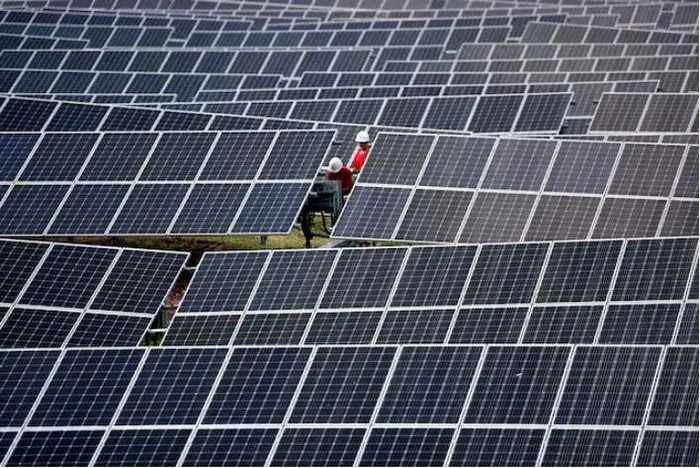
Finally, this procurement exploits a fascinating industrial policy paradox within the US trade framework. While Washington heavily protects the domestic market with steep tariffs on completed Chinese solar panels, manufacturing machinery was officially excluded from tariffs by the Biden administration in 2024—an exemption extended by the Trump administration. By importing these production lines, Tesla can manufacture "Made in USA" modules, effectively bypassing component tariffs while capturing local subsidies. Ultimately, this maneuver highlights Tesla's quiet shift toward comprehensive energy and compute infrastructure. Amidst a maturing EV market, Musk is utilizing this acquired manufacturing capacity to directly power the surging electricity demands of AI data centers and SpaceX's satellite networks.
Market Reaction: China A-Share Equipment Makers Soar
The financial markets reacted aggressively to the realization that Chinese hardware is required to fuel US energy infrastructure expansion. Investors immediately recognized that an order of this magnitude from Tesla would serve as a massive boost for Chinese producers of solar manufacturing equipment, many of whom have struggled with weak demand due to domestic oversupply. The price action was swift across the Shenzhen and Shanghai exchanges.
According to Ainvest analysis, the volume profile indicates heavy institutional accumulation across the targeted tickers as the news propagated through the market. The specific equity performances are as follows:
- Suzhou Maxwell Technologies (300751.SZ): As the primary candidate for the screen-printing machinery, the stock experienced a short-term violent surge of approximately 9%. At the time of publication, the equity maintained a gain of 7.51%, with the share price reported at 269.4 yuan.
- Shenzhen S.C New Energy Technology (300724.SZ): Identified as a secondary potential supplier, the stock recorded a rapid increase of roughly 8%. The price action stabilized slightly, showing a 7.37% increase to a price of 126.7 yuan at the time of writing.
- Laplace Renewable Energy Technology (688726.SH): Also named as a potential supplier in the advanced talks, Laplace witnessed the most aggressive percentage gain, surging approximately 14% in a condensed timeframe. The stock was trading up 12.3% at 67.6 yuan at publication.
Conclusion
Tesla's reported $2.9 billion pursuit of Chinese solar manufacturing equipment underscores a fundamental market reality: the physical expansion of next-generation energy infrastructure currently relies on the scale and cost-efficiency concentrated within China. By utilizing tariff exemptions on manufacturing machinery, Tesla aims to bypass elevated domestic component costs to achieve its 100 GW deployment target. However, market participants must acknowledge the inherent risks. The transaction remains subject to the approval of Chinese regulators, and shifting geopolitical frameworks or sudden alterations in tariff exemptions could severely impact the execution of these cross-border procurements. Investors chasing the current rally in Chinese solar equipment equities should carefully monitor export authorization developments in the coming months.

Tianhao Xu is currently a financial content editor, focusing on fintech and market analysis. Previously, he worked as a full-time forex trader for several years, specializing in global currency trading and risk management. He holds a master’s degree in Financial Analysis.
Latest Articles
Stay ahead of the market.
Get curated U.S. market news, insights and key dates delivered to your inbox.
AInvest
PRO
AInvest
PRO



Comments
No comments yet