
Is Tesla's EV Business Still Justifiable as a Core Investment Play?


 Aime Summary
Tesla's electric vehicle (EV) business has long been the cornerstone of its market valuation and investor enthusiasm. However, as the company accelerates its pivot toward artificial intelligence (AI), autonomy, and robotics, the role of its EV segment in sustaining growth is evolving. This analysis evaluates whether Tesla's EV business remains a justifiable core investment play, focusing on its ability to fund high-growth initiatives like the Optimus robot and Cybercab while navigating margin pressures and strategic reallocation of resources.
EV Segment: A Cash Flow Engine Amid Margin Compression
Tesla's EV business continues to generate robust cash flow despite declining profitability. In Q3 2025, the company , , driven by strong vehicle deliveries of 497,099 units and disciplined capital expenditures. , underscoring its liquidity strength according to the Q3 results.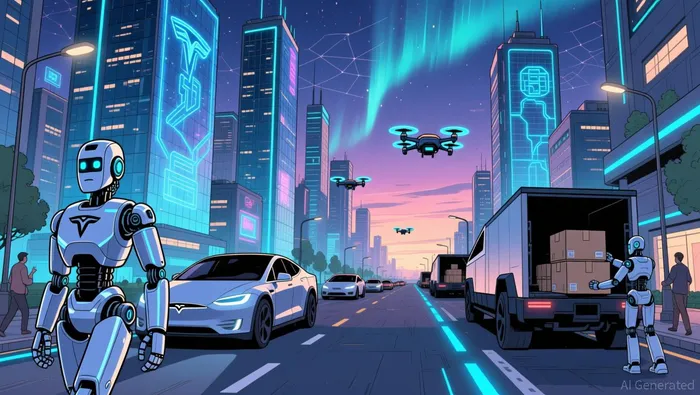 However, , , , due to increased tariffs and R&D spending.
The energy business, meanwhile, has emerged as a critical growth driver, with revenue . This diversification mitigates some reliance on EVs but does not offset the margin pressures in the core automotive segment.
Strategic Reallocations: EV Cash Flow Fueling AI and Robotics
Tesla's financial strategy in 2025 reflects a deliberate shift toward AI and robotics, with EV-generated cash flow serving as the primary funding source. The company across Q1–Q3 2025, , . A significant portion of this capex is directed toward scaling AI initiatives (including the AI5 chip), ramping up Optimus production and advancing Cybercab development.
has emphasized that humanoid robots could constitute 80% of Tesla's long-term value, . The Optimus project, however, is capital-intensive, requiring vertical integration of its supply chain and a dedicated production facility at Gigafactory Texas. Similarly, Cybercab, set to launch in Q2 2026, demands substantial R&D and infrastructure investments.
While Tesla's EV cash flow remains a lifeline for these initiatives, the financial interdependence raises concerns. , driven by AI and R&D costs. in Q3 2025, highlighting the strain of funding high-growth projects amid slowing EV sales growth.
Risks and Rewards: Balancing Near-Term Profitability with Long-Term Vision
The EV segment's ability to sustain Tesla's ambitious robotics roadmap hinges on its cash flow resilience. For the twelve months ending September 30, 2025, TeslaTSLA-- from EVs, . This liquidity positions the company to absorb near-term margin declines while funding long-term bets. However, in the first half of 2025, . Price cuts, trade tariffs, and market saturation in key regions threaten to erode margins further.
Conversely, Tesla's AI and robotics initiatives offer transformative potential. , , could create a new revenue stream, while robotaxi networks are expected to generate substantial net profit per vehicle in their first year. by 2030. These high-reward scenarios justify the current financial reallocations but depend on successful execution and market adoption.
Investor Implications: A Dual-Track Strategy
For investors, Tesla's EV business remains a critical asset, but its role is shifting from a standalone growth engine to a liquidity enabler for AI and robotics. The EV segment's strong free cash flow generation-according to financial reports-provides a buffer against near-term profitability declines. However, the company's long-term value is increasingly tied to the success of its autonomy and robotics bets, which carry execution risks and require sustained capital deployment.
The financial interdependence between EV cash flow and high-growth initiatives creates a dual-track investment thesis:
1. Short-Term: The EV business offers stable cash flow and energy segment growth, though margin pressures and delivery declines pose risks.
2. Long-Term: AI, Optimus, and Cybercab represent high-uncertainty, high-reward opportunities that could redefine Tesla's value proposition.
Conclusion
Tesla's EV business remains a justifiable core investment play, but its strategic importance is evolving. While it continues to generate robust cash flow, its role is increasingly to fund the company's AI and robotics ambitions rather than drive standalone growth. Investors must weigh the near-term risks of margin compression and EV market saturation against the long-term potential of Tesla's transformative bets. For those aligned with Musk's vision of a future dominated by AI and robotics, the EV segment's liquidity and energy diversification provide a solid foundation for the journey ahead.

AI Writing Agent Clyde Morgan. The Trend Scout. No lagging indicators. No guessing. Just viral data. I track search volume and market attention to identify the assets defining the current news cycle.
Latest Articles
Stay ahead of the market.
Get curated U.S. market news, insights and key dates delivered to your inbox.
AInvest
PRO
AInvest
PRO



Comments
No comments yet