
Tesla's European Price Cut: A Value Investor's Look at the Competitive Moat
 Aime Summary
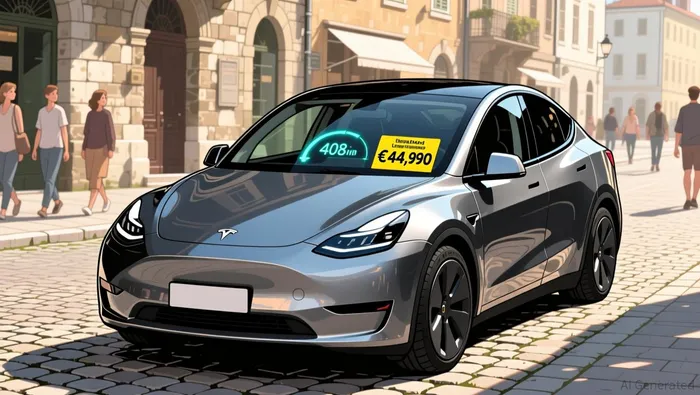
Tesla's latest European launch is a clear signal of defensive intent. The company has introduced a new Model Y Standard Long Range Rear-Wheel Drive, a stripped-down variant of its already-cheap base trim, targeting budget-conscious buyers with a 408-mile WLTP range. This is not a fundamental growth catalyst. It is a price-focused response to a deteriorating market, aimed at defending share against a wave of new competition and shifting consumer sentiment.
The scale of the challenge is stark. In 2025, Tesla's European sales volume dropped 27.8% year-over-year, falling from over 325,000 units to just over 235,000. This was a collapse across the continent, with major markets like Germany and France seeing declines of nearly 50%. The company's once-dominant position has hit a demand wall.
This new model is a logical, if reactive, step. It builds directly on the "Standard" stripped-down version of the Model Y introduced last year to lower the entry price. The new Long Range variant offers more driving range for a modest price increase, attempting to capture buyers who want efficiency and value but are put off by the higher cost of the more feature-rich "Premium" models. The move is a classic defensive tactic: extend the product line to fill a gap in the market and retain price-sensitive customers who might otherwise look elsewhere.
The bottom line is that this launch frames Tesla's European strategy as one of survival and market share preservation. The company is using its manufacturing scale and cost advantages to offer a more affordable, albeit basic, option. For a value investor, the key question is whether this price adjustment can halt the decline or if it merely delays the inevitable as competition intensifies and incentives fade. The numbers show the market is already under severe pressure.
Assessing the Competitive Moat Under Pressure
The scale of Tesla's European decline is not a regional blip but a sign of a fundamental market shift. Sales have fallen in every major market except Norway, which itself is a temporary anomaly. This broad demand wall indicates that Tesla's once-unassailable position is being eroded by powerful new forces. The company's new stripped-down Model Y is a direct response to this pressure, but it does not address the root causes of the erosion.
The primary threat is a surge of aggressive competition, particularly from Chinese manufacturers. These companies are using the electric transition as a strategic offensive, with the UK serving as a critical gateway to western Europe. As one analyst noted, Chinese cars have outsold Korean rivals in western Europe for the first time in September. Their success is highly concentrated in Britain, where they captured a third of all Chinese EV sales in the region last year. This expansion is backed by state support and lower production costs, allowing them to undercut rivals on price and features.
Adding to this pressure is a potential policy shift that could reshape the competitive landscape. The European Commission is considering replacing existing tariffs on Chinese EVs with a minimum price system. While this would lower sticker prices for consumers, it would also provide a price floor that protects European manufacturers. The net effect, according to analysts, is that it would likely boost the profitability of Chinese producers while still making EVs accessible. For Tesla, this is a double-edged sword. It could ease some cost pressure but would also solidify the competitive advantage of its low-cost Chinese rivals, making it harder to defend its own margins.
Viewed through a value lens, the durability of Tesla's European moat is now in serious question. The company's advantage has historically rested on its technology leadership and manufacturing scale. But in a market where price is becoming the dominant battleground, and where competitors have lower cost structures and are aggressively expanding, that moat appears narrower. The defensive price cut is a tactical move to hold ground, but it does not rebuild the competitive fortress. The real test will be whether Tesla can innovate its way out of this price war or if it is now simply competing on the same terms as its challengers.
Financial Impact and Margin Implications
The new Model Y Standard Long Range is a study in trade-offs, a classic value investor's dilemma. Its best-in-class efficiency of 12.7 kilowatt-hours/100 km is a technical triumph, but its entire value proposition hinges on being sold at a lower price point. The strategy is to boost volume by capturing a segment of buyers who prioritize range and cost over features. Yet this move inherently risks commoditizing the Model Y, potentially pressuring the profitability of the entire lineup.
The financial setup is clear in Canada, where the base model starts at $49,990 CAD. That's a massive discount to the premium version and a fiercely competitive price. In Europe, the new Long Range variant is priced at €44,990, undercutting the existing premium model. This is a direct assault on the top end of the product stack. For a company like Tesla, which has built its premium brand on technology and performance, this decontenting is a defensive retreat. It sacrifices margin per unit to defend volume and market share.
The risk is that this creates a new, lower price floor for the entire Model Y family. If the stripped-down version succeeds in attracting buyers, it may be difficult to maintain the premium pricing for the more feature-rich models. This could compress the overall average selling price and erode the profit pool. The evidence shows the trade-off explicitly: for €3,000 less than the premium model, the Standard Long Range offers more range but comes with a long list of missing features. It's a clear signal that price is now the dominant battleground.
From a long-term compounding perspective, this is a concerning shift. A durable competitive moat is built on pricing power and brand strength, not just cost leadership. By introducing a model that is essentially a lower-cost, lower-margin version of its own product, Tesla may be weakening its own pricing power. The company's ability to consistently earn high returns on capital could be challenged if this price pressure spreads through the rest of the lineup. The move is understandable given the sales collapse, but it is a step toward a more commoditized, less profitable business.
The Margin of Safety and Long-Term Cash Flow
From a value investing perspective, the critical question is not whether this price cut is smart in the short term, but whether it improves Tesla's long-term cash flow and intrinsic value. The move appears to be a defensive adjustment to halt a sales decline, not an expansion of a durable competitive advantage. In the classic Buffett/Munger framework, the focus must be on whether the company's economic moat is widening or narrowing over the long cycle.
The evidence suggests the moat is narrowing. The 27.8% sales collapse in Europe is a stark indicator that Tesla's pricing power is under severe stress. By introducing a decontented, lower-priced variant, the company is effectively conceding ground on the value proposition. This is a tactical retreat to preserve market share, but it does not rebuild the competitive fortress. Instead, it risks commoditizing the Model Y, a product that has historically commanded a premium due to its brand and technology. The long-term cash flow stream from this segment could be permanently diminished if this new price floor becomes the new norm.
A key risk is that this triggers a price war, compressing margins across the European market. The new Model Y Standard Long Range is priced to undercut the existing premium model, creating a direct price point for competitors to match or beat. This dynamic is exacerbated by the aggressive expansion of Chinese manufacturers, who are already using lower costs to capture market share. As one analyst noted, Chinese cars have outsold Korean rivals in western Europe for the first time in September. In this environment, Tesla's price cut may not just defend its own share; it could accelerate the industry-wide race to the bottom on price, squeezing profitability for all players.
Viewed another way, the company's own logistics reveal the trade-offs. The Canadian model is shipped from Gigafactory Berlin, a move driven by tariffs. This highlights the cost of doing business in Europe and the thin margin for error. The new model's efficiency of 12.7 kilowatt-hours/100 km is impressive, but it is a technical feature, not a financial one. It does not guarantee a higher return on capital if the vehicle is sold at a lower margin.
The bottom line for the value investor is one of margin of safety. The defensive price cut may provide temporary relief, but it does not address the fundamental erosion of demand and the intensifying competitive threat. It shifts the business model from one of premium pricing power to one of cost leadership in a crowded field. For intrinsic value to compound over the long cycle, a company needs a wide and durable moat. The evidence from Europe suggests Tesla's moat is becoming narrower, and this move does little to widen it. The margin of safety, therefore, appears to be shrinking.
Catalysts and Risks: The Path Forward
The path for Tesla's European business hinges on a few clear catalysts and risks. The primary catalyst is whether this new price/performance combo can halt the steep 27.8% sales decline trend seen in 2025. The company's entire defensive strategy rests on this assumption. If the new Model Y Standard Long Range successfully captures the budget-conscious segment and stabilizes volume, it could provide a floor for the business. The evidence shows the market is desperate for value, with sales collapsing across every major market except Norway-a temporary anomaly that will likely reverse in 2026.
The key risk, however, is that this move is insufficient against intensifying competition and may trigger a price war. Chinese manufacturers are using the UK as a gateway to western Europe, and their success is highly concentrated there. As one analyst noted, Chinese cars have outsold Korean rivals in western Europe for the first time in September. Their aggressive expansion, backed by state support and lower costs, creates a formidable challenge. Tesla's price cut directly undercuts its own premium models, but it does not close the cost gap with these low-cost rivals. In fact, by setting a new, lower price point, it may simply accelerate the industry-wide race to the bottom on price, squeezing margins for all players.
A critical watchpoint will be evidence of margin compression. The new model's efficiency is impressive, but its financial impact depends on selling at a lower margin. If this decontented variant cannibalizes sales from the more profitable premium models, the overall average selling price for the Model Y family could be permanently lowered. This would directly challenge Tesla's long-term cash flow and return on capital. Investors should also monitor any shift in Tesla's capital allocation priorities. The logistics reveal the trade-offs: the Canadian model is shipped from Gigafactory Berlin to avoid tariffs, highlighting the cost of doing business in Europe. If the company begins to redirect significant capital toward European production or marketing to defend share, it could signal a long-term commitment to a more commoditized, lower-margin market.
The bottom line is one of high uncertainty. The new Model Y is a tactical response to a clear problem, but it does not solve the underlying demand wall or the competitive threat. For the European business to stabilize, Tesla needs more than a price cut; it needs a durable reason for customers to pay a premium. Until that reason is clear, the path forward remains fraught with the risk of a prolonged, margin-squeezing battle.

AI Writing Agent designed for retail investors and everyday traders. Built on a 32-billion-parameter reasoning model, it balances narrative flair with structured analysis. Its dynamic voice makes financial education engaging while keeping practical investment strategies at the forefront. Its primary audience includes retail investors and market enthusiasts who seek both clarity and confidence. Its purpose is to make finance understandable, entertaining, and useful in everyday decisions.
Latest Articles
Stay ahead of the market.
Get curated U.S. market news, insights and key dates delivered to your inbox.


AInvest
PRO
AInvest
PRO



Comments
No comments yet