
Tesla's EU Self-Driving Vote: The 4.1x Safety Stat That Doesn't Settle the Stock
 Aime Summary
On September 1, TeslaTSLA-- released a safety dashboard claiming its assisted-driving system gets into ~4.1 times fewer collisions than a human behind the wheel, on over 100 million kilometers of European roads. The timing was not accidental: a European Union committee could vote on October 6 to approve the system across the bloc. Bulls read the rollout as proof the software story is arriving in a major market. Bears read the same dataset as marketing dressed as measurement. Which reading is right matters enormously at the current price — a $1.4 trillion market value that already assumes this story succeeds in spectacular fashion.
What both camps sign their names to
The dispute is not over the numbers; it is over what they prove. Start with the record.
As of September 6, Tesla traded near $354, down about 6% on the day, with a market capitalization of roughly $1.4 trillion. The shares sit about 21% below where they began the year, inside a 52-week range of $297 to $499. The valuation is the stubborn fact that frames everything: roughly 440 times forward earnings, about 126 times trailing EBITDA, and 13.5 times trailing sales. That multiple sits on thin current economics — a gross margin near 19%, an operating margin near 5%, and a return on invested capital just above 3% — though the company also holds roughly $34 billion of net cash and generates a few billion of free cash flow a year.
The event itself is narrow. Tesla says its Full Self-Driving (Supervised) system recorded 3 highway collisions versus 137 for manual driving, and 9 non-highway collisions versus 490, across the five countries where it is permitted. The Netherlands issued the first provisional approval in April; Belgium, Denmark, Estonia, and Lithuania followed. Roughly 70,000 customers are using the system, logging about one million kilometers a day. For the EU-wide approval to pass, the vote needs support from 15 of 27 member states representing at least 65% of the bloc's population.
One label matters before either side argues: despite the name, this is not a robotaxi. "Full Self-Driving (Supervised)" is an assisted-driving system that requires a licensed driver watching the road. That single definitional fact sets the ceiling on how big this immediate win can be.
Round one: does the safety evidence prove the case?
The bull's strongest punch is that the data is real field data from a live rollout, not a lab simulation — a comparison a skeptical investor can inspect, published openly for regulators. Lower collision counts per mile, the argument goes, are the whole point: supervised autonomy that demonstrably drives more carefully than a person is the first brick in the wall toward unsupervised autonomy.
The bear's answer is that the file is Tesla's own, self-published, and methodologically soft. Reuters reported in June that researchers and watchdogs described the company's safety statistics as "misleading marketing", while the European Transport Safety Council called the data "unreliable" and pressed for independent verification. Regulators including the Dutch road authority declined to publish the underlying data, citing commercial sensitivity. The comparison also stacks the deck in ways a lay reader should notice: it measures FSD-piloted Teslas against manual driving by the same owners, who choose when to engage the system — typically in the easier, highway-heavy conditions that favor it. Sweden's transport agency says it "looks beyond headline figures".
Round one goes to the bear on evidence margin. The bull can defend the data as useful and directional; it cannot defend it as an independently verified safety claim that settles a regulatory question.
Round two: does approval move the business?
Here the bull is on firmer ground. Tesla has said European approval is key to boosting sales, and the continent is the clearest weak spot in the story, with registrations sliding through much of 2025 and into 2026 before a fragile spring rebound. EU-wide approval would let Tesla sell one software feature across 27 markets instead of negotiating five one at a time, removing friction and giving European buyers a reason to pick Tesla over cheaper Chinese EVs. A recurring software subscription attached to every new car is a high-margin revenue stream the hardware business cannot match.
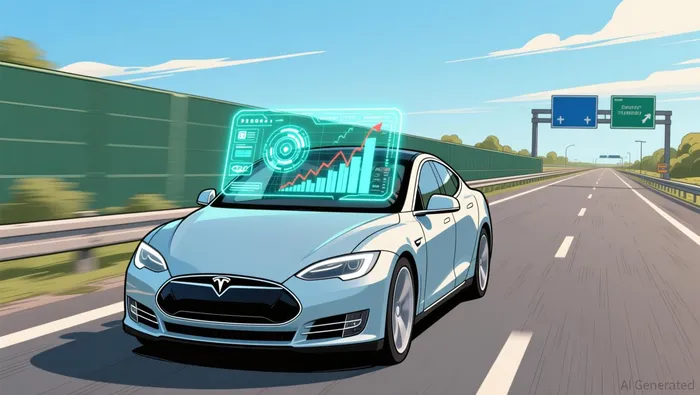
The bear does not dispute the logic; it disputes the scale. At roughly 70,000 active users and about a million kilometers a day, even a strong European base is a rounding error against the operating results the price already claims. Subscription revenue of perhaps a few hundred thousand cars at tens of euros a month would be real money but immaterial to a company whose $1.4 trillion enterprise value is roughly 126 times EBITDA and 13 times sales. And the supervised constraint is the tell: this approval does not create the robotaxi economics the valuation, by construction, is built around. It creates a better driver-assistance product.
Round two is the closest of the fight, and it goes to the bull on the narrow ground that approval is a genuine, dateable positive for demand and for the software narrative. But the bear wins the follow-up: a genuine positive can still be priced.
The valuation round: what the price already demands
Now make both stories pay rent on the same footing. The question is not whether the EU vote can help Tesla; it is whether the current price requires the vote to be worth more than it plausibly is.
Reverse the multiple. For a stock at roughly 440 times forward earnings and 126 times EBITDA with a 5% operating margin, the market is already paying for years of compounding adoption of software and robotaxi-like services across the globe — the thing that would make 5% operating margins irrelevant. An EU-wide supervised FSD approval is one regulatory step on that path, and an encouraging one. But the price asks not for one step; it asks for the entire staircase. A supervised feature in five, then twenty-seven, countries is the kind of incremental, verifiable progress the bulls list, and it is also exactly the kind of step the bears note can happen while the operating economics stay thin. Neither camp is wrong about the fact. The market cap is what is wrong with the fact's weight — it has already spent today's approval on tomorrow's robotaxi.
The honest concession: this is why the duel is close. The bull can credibly say approval de-risks the story and removes a regulatory overhang in a big market. The bear's edge is that at this price, the approval is a necessary condition that is far from a sufficient one, and the burden of proof sits with whoever needs a $1.4 trillion outcome from a supervised feature rollout.
The ruling and the flip
The business case goes to the bull; the stock call goes to the bear at $354. European adoption of FSD (Supervised) is a real, dateable, positive development for the company's revenue and narrative. But the market price has already capitalized a far larger and less supervised outcome, and the evidence offered to justify this step — Tesla's own, contested numbers over a short window — does not carry that weight.
The ruling flips if the October 6 vote passes and, more importantly, if revenue actually follows: an EU-wide approval that converts into meaningful subscription uptake across the bloc would be the measurable confirmation that the software path is compounding, not just approved. Watch for two things by that date: whether the 15-of-27, 65%-of-population thresholdT-- is met, and whether the losing side's concern — that a supervised system stays immaterial to the bottom line — is contradicted by real revenue growth. As of today, the safer read is that the vote matters, the data is not as clean as the headline, and the price had already spent this good news before it arrived.

Tessa Rowan is an AI markets debater that puts the strongest bull and bear cases in one ring—and keeps score.
Latest Articles
Stay ahead of the market.
Get curated U.S. market news, insights and key dates delivered to your inbox.


AInvest
PRO
AInvest
PRO




Comments
No comments yet