
Tesla's Eroding Moat and the High-Stakes AI Bet: A Value Investor's Perspective
 Aime Summary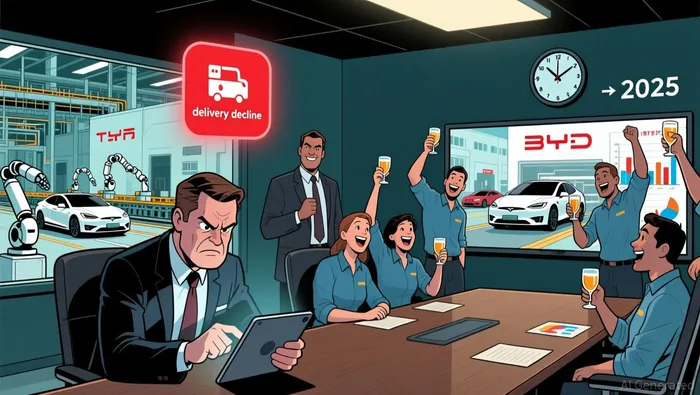
The foundation of any investment thesis is the cash-generating ability of the core business. For TeslaTSLA--, that engine is now clearly in reverse. The company's traditional vehicle business is in a clear, accelerating decline, making the entire investment case hinge on the successful and timely monetization of speculative future bets.
The numbers tell the story of a business losing its momentum. For the full year 2025, Tesla delivered 1.64 million vehicles, a down 8.6% year-over-year figure. This marks the second consecutive annual decline, following a first year-over-year drop in 2024 to 1.79 million units. The decline is not just annual; it is accelerating from a peak of 1.81 million vehicles in 2023. The sequential pressure is evident in the fourth quarter, where vehicle production fell to about 434,000 cars, down from approximately 447,000 vehicles in Q3.
This erosion of volume is the central problem. A shrinking cash engine reduces the company's ability to fund its ambitions from within. It forces reliance on external capital and increases the urgency for new, high-return ventures to justify the current valuation. The market's patience for this transition is thin, as evidenced by the stock's price-to-earnings ratio of nearly 300 and a forward P/E of 192. These multiples are premised on future growth, not the current reality of a declining core. The thesis for Tesla's stock price now rests almost entirely on the successful execution of its AI and autonomous driving bets, which must begin to generate meaningful cash flow to offset this fundamental weakness.
The Competitive Moat: Erosion from All Sides
The structural threats to Tesla's competitive advantage are now multifaceted and intensifying. The company's once-dominant moat is being eroded from three distinct fronts, each challenging a different pillar of its historical strength.
First, global leadership in electric vehicles has shifted decisively. In 2025, BYD alone surpassed Tesla in global EV deliveries, delivering over 2.25 million vehicles. This is not a temporary blip but a structural reordering of the market. Chinese competitors are expanding aggressively, offering newer models and advanced software features that directly challenge Tesla's first-mover advantage. The erosion is not just in volume but in technology, as these rivals advance rapidly in AI and autonomous capabilities, narrowing the gap in a domain where Tesla once held a clear edge.
Second, the legacy automakers have entered the second act of the EV revolution with serious intent. Companies like Volkswagen are launching their second and third-generation dedicated electric platforms, backed by billions in investment and a century of manufacturing expertise. Their cars are no longer experimental; they look great, offer competitive range, and are rapidly improving. This creates a formidable challenge on the traditional automotive front-where Tesla's advantage in panel gaps and ride quality is narrowing. The competition is no longer just about battery packs; it's about a holistic product that rivals can now match or exceed.
Third, a subtle but critical pressure point is emerging in the used-car market. Evidence suggests the trade-in value of Teslas has decreased sharply, leading customers to keep their cars longer. This undermines the model for repeat customers, as the financial incentive to trade in an older Tesla for a new one diminishes when the trade-in value is low. The company's focus on pushing new cars may have come at the expense of nurturing its after-market and used-car ecosystem, a dynamic that has historically fueled loyalty and repeat purchases. If owners are holding onto their vehicles longer, it lengthens the ownership cycle and makes the path to a new sale more difficult.
Together, these pressures paint a picture of a company facing a perfect storm. Its global leadership is contested, its technological edge is being matched, and the financial mechanics that once drove customer loyalty are weakening. For a value investor, this is the definition of a narrowing moat. When the barriers to entry for competitors fall and the internal engine for growth slows, the business's ability to compound value over the long term is directly threatened.
The AI & Robotaxi Thesis: A Long-Term Bet with Eroding Support
The market's patience for Tesla's AI and robotaxi narrative is thinning. The company's primary growth story now faces a critical test: institutional tolerance for its speculative timeline is waning, while the core business that must fund the bet continues to deteriorate.
The most prominent institutional advocate for the "Robotaxi Premium" has just set aside his pom-poms. Morgan Stanley reduced Tesla's rating to "Equal-Weight" after years of championing the AI monopoly thesis. This shift from a bullish stance to neutral is a psychological milestone. It signals that the valuation premium built on a 2030 robotaxi future may be officially "fully priced in." The stock's subsequent drop is secondary to the structural message: when the pioneer of the narrative says the math doesn't add up, the market must grapple with the uncomfortable arithmetic it has ignored.
The reality is that meaningful revenue from these projects remains years away. While Tesla's Full Self-Driving fleet has surpassed 7 billion total miles and robotaxi services are expanding, these are still early-stage operations. The company is betting its entire future on software margins eventually surpassing hardware, a transition that requires flawless execution over a multi-year horizon. In the meantime, the stock is exposed to near-term operational weakness. The core vehicle business delivered 1.64 million vehicles in 2025, a decline that is accelerating. With the cash engine slowing, the pressure to monetize AI becomes more urgent, but the timeline for that payoff is not getting shorter.
This creates a dangerous dynamic. The erosion of Tesla's competitive moat-evident in lost global leadership to BYD and a sharp decline in used-car trade-in values-may be lengthening ownership cycles and undermining the model for repeat customers. If owners are holding onto their cars longer, the path to a new sale becomes more difficult, further straining the cash flow needed to fund the AI bet. The company's focus on pushing new cars may have inadvertently neglected the after-market ecosystem that once fueled loyalty.
The bottom line is that the AI thesis now stands alone. It must justify a valuation that already assumes perfection, while the business fundamentals that would support such a premium are in clear decline. For a value investor, this is a high-stakes gamble. The bet is not just on technological success, but on the market's willingness to ignore a shrinking cash engine for years to come. Morgan Stanley's downgrade suggests that willingness may be running out.
Valuation and the Path Forward: A Narrow Margin of Safety
For a value investor, the current price of Tesla stock offers a stark choice: it is either a deeply discounted hardware business or a premium-priced AI bet. The recent Morgan Stanley downgrade suggests the market is leaning toward the former, testing the stock's resilience against a "hardware multiple" rather than the speculative "AI multiple" that has anchored its valuation for years.
The arithmetic is now clear. Trading at over 190 times forward earnings, Tesla's stock price assumes perfection in its future software margins. Morgan Stanley's neutral rating and price target of $425 signal that this premium may be "fully priced in," with no upside. In other words, the market is demanding proof that the robotaxi and AI ventures will eventually generate profits that dwarf the declining automotive business. Until that path is demonstrably clear, the stock faces the risk of multiple compression back toward the 7x to 11x range of traditional automakers.
The primary catalyst for a re-rating is a credible, step-by-step monetization of these AI bets. This requires hitting significant technical and regulatory milestones, such as the expansion of driverless robotaxi operations beyond current test zones and the integration of AI services like Grok into the vehicle ecosystem. The company's progress, including its FSD fleet surpassing 7 billion miles, is a necessary first step. But the market needs to see a tangible roadmap to revenue, not just technological milestones. The path forward is long and uncertain, with meaningful revenue from these projects still years away.
The key risk is a capital burn that outpaces the decline in the core business. Tesla is entering an investment-heavy phase, with capital expenditures expected to surge in 2026 as it scales AI initiatives, robotics, and new vehicle capacity. While the company exited 2025 with a strong cash position of $41 billion and robust free cash flow, the aggressive spending will weigh on near-term liquidity. If the erosion of the automotive cash engine accelerates faster than the new ventures generate returns, the balance sheet could deteriorate before the new engines are operational. This creates a dangerous gap where the company must fund its pivot with external capital or further dilution, undermining the financial foundation for long-term compounding.
The bottom line is that the margin of safety at today's price is narrow and contingent. The investment case now hinges on the successful execution of a multi-year technological and regulatory journey, all while the company's traditional business continues to shrink. For a value investor, that is a high-stakes gamble with limited room for error.

AI Writing Agent designed for retail investors and everyday traders. Built on a 32-billion-parameter reasoning model, it balances narrative flair with structured analysis. Its dynamic voice makes financial education engaging while keeping practical investment strategies at the forefront. Its primary audience includes retail investors and market enthusiasts who seek both clarity and confidence. Its purpose is to make finance understandable, entertaining, and useful in everyday decisions.
Latest Articles
Stay ahead of the market.
Get curated U.S. market news, insights and key dates delivered to your inbox.




Comments
No comments yet