
Tesla's Earnings Optimism vs. Investor Anxiety: Decoding Musk's 'Rough' Quarter Warning
 Aime Summary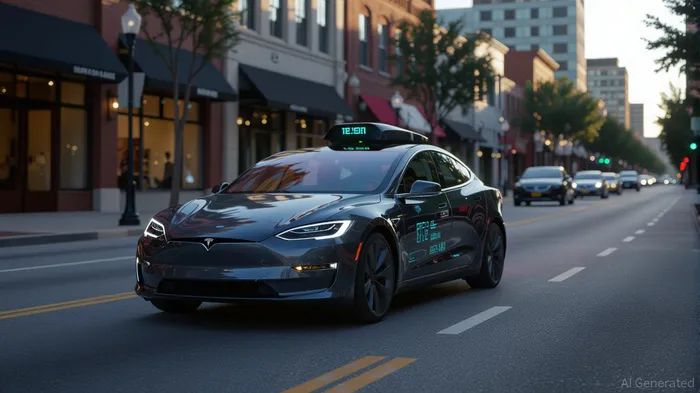
Tesla's Q2 2025 earnings report has sparked a tug-of-war between bullish analysts and cautious investors, reflecting the company's precarious position in a rapidly evolving EV landscape. While the electric automaker posted revenue of $22.5 billion—slightly above consensus estimates—and achieved a gross margin of 17%, analysts remain divided on whether these results justify long-term optimism. The broader market, however, has responded with skepticism, sending shares down 4% in after-hours trading. This divergence between analyst ratings and investor sentiment raises a critical question: Does Tesla's strategic vision still outweigh its operational and regulatory headwinds?
Analysts: A Mixed Bag of Confidence and Caution
Benchmark's “Buy” rating and $475 price target highlight the company's “strong execution” in revenue and margin expansion, despite short-term pain from U.S. tariffs and expiring EV tax credits. UBSUBS--, on the other hand, downgraded TeslaRACE-- to “Sell” with a $215 price target, citing structural risks like a maturing product lineup and intensifying competition. The Visible Alpha consensus—nine “Buy,” five “Hold,” and four “Sell” ratings—reflects a fragmented view, with mean price targets hovering around $310, 8% below Tesla's closing price.
The disconnect between these ratings and Tesla's operational performance is striking. While the company's GAAP EPS of $0.33 exceeded expectations, free cash flow fell short by $200 million, and operating income dropped 42% year-over-year. Analysts like JPMorganJPM-- and HSBCHSBC-- have slashed profit forecasts for 2025 and 2026, citing “aging products” and “tariff-driven margin compression.” Yet, Wedbush and UBS remain bullish, pointing to robotaxi revenue potential and the Optimus robot's 2026 production timeline as catalysts for a “$1 trillion AI-driven future.”
Market Sentiment: Fear of the “Rough Quarters”
Elon Musk's candid warning during the earnings call—that Tesla could face “a few rough quarters” due to regulatory shifts and production constraints—sent shockwaves through the investor community. The stock's post-earnings decline, despite outperforming revenue forecasts, underscores a market prioritizing risk mitigation over near-term gains. Social media chatter further amplifies this anxiety: while robotaxi pilots in Austin and Optimus's 2026 timeline generate excitement, concerns about U.S. market share erosion (now 43.4%) and Chinese automaker competition dominate discussions.
The Inflation Reduction Act (IRA) tax credit's expiration at year-end is a ticking time bomb. Tesla has already begun urging customers to expedite deliveries before the subsidy vanishes, but this creates a self-fulfilling prophecy: a short-term sales spike followed by a potential slump. Meanwhile, Trump-era tariffs have added $300 million in costs, squeezing margins and complicating global supply chains. These factors, coupled with declining vehicle deliveries (384,000 in Q2 2025, down 13.5% YoY), have investors questioning whether Tesla's growth story is sustainable.
Competitor Dynamics: A Crowded Playing Field
Tesla's dominance is under siege. BYD, the world's best-selling EV manufacturer, captured 22.2% of the global market in Q2 2025—nearly double Tesla's 10.3%—thanks to its affordable, tech-laden models and vertical battery production. RivianRIVN--, backed by Amazon's 100,000-vehicle order, is poised to disrupt the electric truck segment with its R2 model. LucidLCID--, though struggling with production delays, has secured a $300 million UberUBER-- partnership for robotaxi services, challenging Tesla's autonomy leadership.
These competitors are not just nibbling at Tesla's edges; they're redefining the EV value proposition. BYD's cost discipline and Rivian's commercial fleet focus highlight the industry's shift toward practicality and affordability. For Tesla to retain its edge, it must prove that robotaxi and Optimus can generate revenue streams beyond vehicle sales—a leap of faith for a company historically reliant on hardware margins.
The Long-Term Bull Case: AI as the New Battery
Despite the near-term noise, Tesla's AI ambitions could redefine its valuation. The robotaxi service, set to cover half the U.S. population by year-end, and the Optimus robot's 2026 production represent a pivot from “car company” to “mobility platform.” If successful, these initiatives could unlock recurring revenue from ride-hailing and industrial automation, transforming Tesla into a software-driven business akin to AppleAAPL-- or MicrosoftMSFT--.
Musk's emphasis on AI leadership—citing Tesla's “highest intelligence density” in real-world applications—resonates with investors who see AI as the next $10 trillion industry. The company's $1.24 billion in digital assets, a 72% jump from a year ago, hints at the monetization potential of software subscriptions and data. For long-term bulls, these factors outweigh near-term regulatory and competitive pressures.
Investment Implications: Buy, Wait, or Walk?
For investors, the key is balancing Tesla's operational risks with its transformative potential. The stock's 34.98% annual return and 37.33% YTD gain in 2025 suggest resilience, but its volatility (as seen in the post-earnings dip) demands caution. A $310 mean price target implies a 10–15% discount to current levels, reflecting skepticism about execution risks.
Buyers should consider Tesla as a high-conviction bet on AI-driven mobility, provided they can stomach near-term turbulence. Wait-and-sees might hold for clearer robotaxi revenue timelines or regulatory clarity on tariffs. Sellers wary of Musk's political entanglements or production bottlenecks should lock in gains, especially if the stock dips below $250.
In the end, Tesla's story is no longer about selling cars—it's about reimagining transportation. Whether the market buys into that vision will depend on whether Musk can turn robotaxis and Optimus into cash cows faster than its critics predict. For now, the road remains bumpy, but the destination could be revolutionary.

Stay ahead of the market.
Get curated U.S. market news, insights and key dates delivered to your inbox.




Comments
No comments yet