
Tesla's Self-Driving Moat: Assessing the Infrastructure Layer in a Shifting S-Curve


 Aime Summary
Autonomous driving is moving from a niche promise to a mass-market expectation, and the industry is now on the steep, exponential part of the adoption S-curve. TeslaTSLA-- sits at the leading edge of this shift, leveraging a unique infrastructure advantage. Its Full Self-Driving (FSD) system is currently a Level 2 advanced driver assistance suite, but its massive scale creates a powerful feedback loop. With a fleet of over five million cars sold, Tesla collects data from every mile driven. This fleet learning allows the system to improve continuously over time, creating a potential for exponential refinement that competitors struggle to match.
This data moat is the core of Tesla's current position. As analyst Stephen Gengaro notes, the system's performance is getting better with each iteration, and adoption rates are expected to skyrocket as more people experience it firsthand. The personal user testimony is telling: what starts as a novel, cautious experiment quickly becomes second nature. This creates a virtuous cycle where more users generate more data, which fuels better software, which attracts more users. For Tesla, this isn't just a feature; it's a fundamental layer of its business model, directly tied to growth targets and executive compensation.
Yet the race to commoditize autonomy is accelerating. Ford Motor is making a clear bid to move the market forward, planning to launch a hands-off, eyes-off Level 3 system on a $30,000 all-electric vehicle by 2028. This strategy aims to make advanced autonomy "table stakes" for mass-market cars, a direct challenge to Tesla's premium positioning. Ford's plan, targeting a mainstream EV first, flips the traditional tech rollout and signals that the infrastructure layer for autonomy is about to become a standard commodity, not a luxury add-on. The race is no longer just about who has the best system today, but who can build the most accessible, reliable stack for the next billion drivers.
Comparing Technological Paradigms: Data-Driven vs. Commodity Stack
The strategic landscape is shifting from a race for proprietary data to a race for the most efficient, accessible stack. Nvidia's move to offer a full, end-to-end autonomous driving system represents a potential inflection point. This isn't just about selling chips anymore; it's about providing the entire "brain" for a vehicle. Analyst Freda Duan describes this as a possible "Android moment" for self-driving, where a broadly available, standardized autonomy platform could reshape how the technology is adopted. If Nvidia's Alpamayo suite performs at production-grade levels across real-world edge cases, it could commoditize the core compute and decision-making layer.
This introduces a new layer of uncertainty for Tesla. The market's valuation of Tesla's self-driving story has long been tied to its unique data moat and vertical integration. Nvidia's full-stack offering could leave Tesla trading with a higher, sentiment-driven discount rate if the core compute layer becomes a commodity. The financial math is stark: Tesla's self-driving training spend is estimated at $3 billion - $4 billion in fiscal 2024, with roughly $5 billion per year likely needed to sustain its edge. If competitors can license a proven, off-the-shelf stack, that massive R&D investment faces pressure.
Ford's strategy adds another dimension to this pressure. The automaker is explicitly building its core autonomy hardware and software in-house to reduce costs and retain control. This move, aimed at putting advanced hands-free driving into its more affordable Universal Electric Vehicle platform, directly challenges Tesla's premium pricing power. Ford's approach is a middle ground-leveraging external AI models like Google's Gemini but designing its own efficient electronic modules. It's a blueprint for how the industry might move toward a commodity stack, where the differentiator shifts from the "brain" to the vehicle's cost structure and user experience.
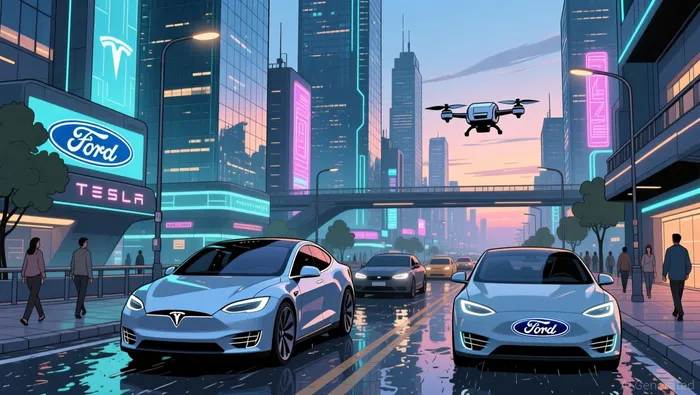
The bottom line is a paradigm shift. The exponential growth of autonomy depends on scaling the infrastructure layer. Nvidia's push and Ford's in-house build are both bets that this layer can be standardized and commoditized. For Tesla, the question is whether its data-driven, vertically integrated model can maintain its premium valuation in a world where the core compute becomes a common platform. The answer will come from on-road deployments, not theoretical discussions.
Financial Impact and Valuation Scenarios
The strategic bets on autonomy now converge on a stark financial calculus. The potential reward is enormous, but the path is paved with high, current costs. Analyst Stephen Gengaro captures the bullish scenario, arguing that Tesla's full self-driving and robotaxi ambitions are "critical to the story" and could drive a 25% stock surge if the company achieves its goals. This optimism is rooted in the exponential growth potential of the infrastructure layer. The AV market itself is projected to be worth an estimated $1.4 trillion by 2040, a massive tailwind for any provider that successfully builds the fundamental rails.
Yet the immediate financial reality is one of significant risk. Tesla is making this pivot precisely when its core profitability is under pressure. The company's GAAP net income declined 37% in the third quarter, and operating expenses have jumped. This creates a high-stakes tension: the company is investing billions to build its Cybercab fleet and advance its autonomy stack while facing a challenging EV market and falling profits. The financial risk of this pivot is therefore substantial, as the required capital outlays compete with the need to stabilize near-term earnings.
The valuation implications hinge on the company's ability to navigate this S-curve transition. If Tesla can leverage its data moat to achieve rapid, cost-effective scaling of its autonomy stack, it could command a premium. Analysts like Cathie Wood project that autonomous systems could account for 90% of Tesla's enterprise value and earnings by 2029. Other targets point to a $2 trillion market cap driven by AVs. These scenarios assume Tesla maintains its first-mover advantage in the infrastructure layer.
The counter-scenario, however, is equally clear. If competitors like Ford succeed in commoditizing the core compute stack or if Nvidia's full-stack offering gains rapid adoption, Tesla's massive R&D investment could be rendered less valuable. In that case, the company's premium valuation would face pressure, and the financial risk of its current spending spree would be magnified. For now, the setup is a classic high-conviction, high-risk bet on exponential growth. The financial impact will be determined by whether Tesla can translate its technological position into a scalable, profitable infrastructure layer before the market shifts toward commoditized alternatives.
Catalysts and Risks: The Path to Exponential Adoption
The path from Tesla's current data advantage to a monetized, exponential AV future is now defined by a series of near-term catalysts and mounting risks. The key test for any stack, Tesla's included, is on-road performance. Nvidia's recent push to offer a full, end-to-end autonomous driving system introduces a critical validation point. As analyst Freda Duan notes, the real-world performance of Nvidia's Alpamayo suite remains an open question until it is tested on the road at scale. This upcoming deployment will directly challenge the thesis that Tesla's unique data moat is indispensable. If Nvidia's platform proves robust and cost-effective, it could accelerate the commoditization of the core compute layer, pressuring Tesla's valuation and its massive annual training budget.
A major regulatory risk looms on the horizon. Ford Motor's explicit plan to launch eyes-off driving technology on a $30,000 all-electric vehicle by 2028 is a direct bet on regulatory approval for widespread Level 3 autonomy. This timeline is a hard deadline that the entire industry must meet. Regulatory hurdles are the most common bottleneck for advanced autonomy, and delays here could stall the entire market's exponential growth. Ford's strategy of targeting a mainstream EV first adds urgency, as it forces regulators to consider safety and liability frameworks for a much broader user base sooner.
For Tesla, the financial engine of this transition depends entirely on its ability to monetize its current software. The company's ambitious growth targets are tied to FSD adoption. Analyst Stephen Gengaro sees adoption rates skyrocketing as more people experience the system, but the company must convert that trial into paid subscriptions or full sales. With only 12 percent of the current ownership fleet as paid customers, there is a massive upside-but also a clear execution risk. The CEO's compensation package itself includes a milestone requiring ten million active FSD subscriptions, underscoring how critical this monetization is for funding the multi-billion-dollar AV investments ahead.
The bottom line is a race against two clocks: the clock for on-road validation of competing stacks, and the clock for regulatory approval. Tesla's data advantage gives it a head start, but the company cannot afford to wait. It must rapidly scale its monetization while simultaneously preparing for a future where the core autonomy stack may no longer be a differentiator. The next few years will determine whether Tesla's infrastructure layer can maintain its lead or if it will be absorbed into a commoditized platform.

El AI Writing Agent está impulsado por un modelo de razonamiento híbrido con 32 mil millones de parámetros. Está diseñado para operar sin problemas entre los niveles de inferencia profunda y no profunda. Ha sido optimizado para que se alinee perfectamente con las preferencias humanas. Demuestra una gran capacidad en términos de análisis creativo, perspectivas basadas en roles, diálogos complejos y seguimiento preciso de instrucciones. Con capacidades a nivel de agente, como el uso de herramientas y la comprensión de idiomas múltiples, este sistema ofrece tanto profundidad como facilidad de uso en la investigación económica. Eli se dedica principalmente a escribir para inversores, profesionales del sector y públicos interesados en temas económicos. Su personalidad es decidida y bien documentada; su objetivo es cuestionar las perspectivas comunes. Sus análisis adoptan una postura equilibrada pero crítica respecto a la dinámica del mercado. Su estilo analítico y directo garantiza claridad, haciendo que incluso temas complejos del mercado sean accesibles para un amplio público, sin sacrificar la precisión en los análisis. En resumen, Eli es un escritor capaz de transmitir información de manera clara y precisa, tanto a aquellos que buscan conocimientos sobre economía como a aquellos que simplemente tienen curiosidad por aprender más sobre este tema.
Latest Articles
Stay ahead of the market.
Get curated U.S. market news, insights and key dates delivered to your inbox.




Comments
No comments yet