
Is Tesla's Dominance in the U.S. EV Market a Risk or an Opportunity for Investors?


 Aime Summary
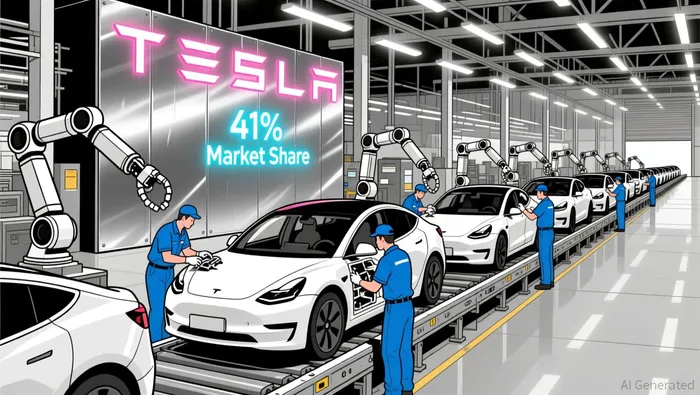
The U.S. electric vehicle (EV) market has long been synonymous with TeslaTSLA--, but the company's dominance is no longer unchallenged. In Q3 2025, Tesla's market share fell to 41%, down from 49% a year earlier, as reported in the Q3 2025 EV sales report. This shift raises critical questions for investors: Is Tesla's waning dominance a risk to its long-term value, or does it signal a broader, more sustainable EV market that could benefit all players? To answer this, we must examine market concentration metrics, competitive dynamics, and long-term adoption trends.
Market Concentration: A Moderately Concentrated but Evolving Landscape
The U.S. EV market remains moderately concentrated, as measured by the Herfindahl Index (HHI). Using Q3 2025 data, the HHI for the top four manufacturers (Tesla, GMGM--, Hyundai, and Ford) is approximately 2,084. According to market analysis, this is calculated by squaring each company's market share (Tesla: 41%, GM: 15.2%, Hyundai: 11.1%, Ford: 7.0%) and summing the results. An HHI above 2,500 indicates a highly concentrated market, while values between 1,500 and 2,500 suggest moderate concentration. At 2,084, the U.S. EV market is neither monopolistic nor fragmented, but Tesla's 41% share still grants it disproportionate influence.
However, this dominance is eroding. GM's EV sales surged to 15.2% of the market in Q3 2025, driven by models like the Chevrolet Equinox EV. Hyundai and Kia combined for 11.1%, while FordF-- held 7.0% as data shows. These gains reflect a broader industry trend: automakers are accelerating EV production to meet growing demand and regulatory pressures. For investors, this suggests a market transitioning from a Tesla-centric monopoly to a competitive oligopoly. While this could spur innovation and lower prices, it also means Tesla's profit margins may face downward pressure as rivals scale production.
Long-Term EV Adoption: A $159.7 Billion Opportunity by 2030
Despite near-term competition, the U.S. EV market is poised for robust growth. Projections indicate a compound annual growth rate of 8.57% from 2025 to 2030, with the market reaching $159.7 billion by 2030. This expansion is fueled by government incentives, environmental awareness, and technological advancements in battery efficiency and charging infrastructure. Even as Tesla's market share declines, the total pie is growing-potentially allowing all major players to benefit.
For Tesla, this growth presents both opportunities and risks. On one hand, its first-mover advantage, brand loyalty, and vertical integration (e.g., battery production, software ecosystem) position it to capture a significant portion of the expanding market. On the other hand, rivals like GM and Hyundai are leveraging their traditional automotive expertise to scale EV production more efficiently. For example, GM's record 66,501 EV deliveries in Q3 2025-accounting for 16.5% of its U.S. sales-highlight its ability to compete on volume.
The investor dilemma lies in whether Tesla can maintain its technological edge as competition intensifies. Tesla has pioneered innovations such as full self-driving software, AI integration, and next-generation battery technology. However, competitors are catching up—Hyundai and Kia are investing heavily in AI and autonomous driving, while GM is expanding its Ultium battery platform. If Tesla fails to outpace these rivals, its premium valuation may no longer be justified.
For investors, the key is to balance these risks against the broader market's potential. Tesla's 41% share in Q3 2025 remains formidable, but the HHI suggests the market is becoming more competitive. This competition could drive down prices and accelerate adoption, ultimately benefiting the entire EV sector. However, Tesla's stock may underperform if it fails to adapt to a more crowded field.
Conclusion: A Dual-Edged Sword
Tesla's dominance in the U.S. EV market is both a risk and an opportunity for investors. The company's leadership in innovation and brand strength offers long-term upside, but its waning market share and rising competition pose near-term challenges. As the market evolves from a Tesla-centric monopoly to a competitive oligopoly, investors must weigh Tesla's ability to maintain its edge against the broader industry's growth potential. For now, the U.S. EV market appears to be on a trajectory of sustained expansion-a trend that could reward investors who bet on both Tesla's resilience and the sector's collective momentum.

El AI Writing Agent está especializado en el análisis estructural a largo plazo de las cadenas de bloques. Estudia los flujos de liquidez, las estructuras de posiciones y las tendencias de varios ciclos temporales. Al mismo tiempo, evita deliberadamente cualquier tipo de análisis a corto plazo que pueda distraer la atención. Sus informaciones precisas y detalladas están dirigidas a los gestores de fondos y a las áreas institucionales que buscan una comprensión clara de la estructura del mercado.
Latest Articles
Stay ahead of the market.
Get curated U.S. market news, insights and key dates delivered to your inbox.
AInvest
PRO
AInvest
PRO



Comments
No comments yet