
Is Tesla's Delivery Slowdown a Buying Opportunity or a Warning Sign?
 Aime Summary
Tesla's recent delivery figures have sparked a heated debate among investors: Is the company's near-term slowdown a temporary setback, or a harbinger of deeper structural challenges? With Q4 2025 deliveries projected to fall 13–15% year-over-year to 422,850 units, the market is grappling with a stark disconnect between Tesla's automotive struggles and its ambitious bets on AI, robotaxi, and energy storage. This analysis examines whether the delivery weakness reflects a market overreaction or a fundamental shift, and evaluates the investment implications of Tesla's pivot to high-margin, long-term growth drivers.
The Near-Term Headwinds: Tax Credits, Competition, and Demand Pull-Forward
Tesla's Q3 2025 delivery surge-497,099 units, a 7% year-over-year increase, was fueled by a last-minute rush to secure the U.S. federal EV tax credit before its September 30 expiration. This artificial demand spike created a "buying the rumor, selling the news" dynamic, leaving Q4 with a steep comparative hurdle. Analysts now project a 14–19% sequential decline in deliveries for Q4, with full-year 2025 deliveries estimated at 1.64 million units, an 8.3% drop from 2024.
The slowdown is not merely cyclical. Intensifying competition from Chinese EV manufacturers and traditional automakers like Chevrolet and Ford has eroded Tesla's pricing power. Meanwhile, the expiration of tax credits has removed a critical tailwind for U.S. demand. These factors, combined with a saturated premium EV market and a lack of major new product launches in 2025, have created a perfect storm for near-term weakness.
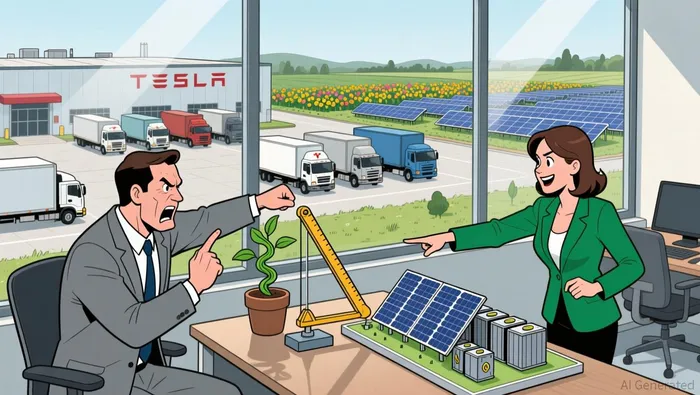
Profitability Pressures and Structural Challenges
Tesla's Q3 2025 results underscored the financial toll of these challenges. Operating profit fell 40% year-over-year, and operating margin dropped 46%, driven by higher fixed costs per vehicle, reduced regulatory credit sales, and weaker Full Self-Driving (FSD) revenue. While the company's cash flow remains robust-$4 billion in free cash flow for Q3-its ability to sustain profitability in a lower-volume, higher-cost environment remains untested.
The broader EV market is also facing a correction. Global demand growth has slowed as consumers delay purchases amid economic uncertainty and regulatory shifts. For TeslaTSLA--, this means its automotive segment, which accounts for over 80% of revenue, is increasingly exposed to macroeconomic headwinds.
The Long-Term Play: AI, Robotaxi, and Energy Storage
Despite these challenges, Tesla's long-term innovation roadmap suggests the company is positioning itself for a strategic pivot. Its AI and robotaxi initiatives, in particular, are gaining traction. The FSD software has accumulated 6 billion miles of real-world data, while the Robotaxi fleet has logged 1.25 million miles, with plans to remove safety drivers in Austin by year-end. These advancements are part of a broader vision to transform Tesla into an AI-driven mobility provider, a shift that could unlock new revenue streams through autonomous ride-hailing and subscription services.
Energy storage is another critical pillar. Tesla deployed 12.5 GWh of storage in Q3 2025, an 81% year-over-year increase, and its Megapack product line is addressing grid capacity constraints. The energy segment now contributes nearly 25% of the company's total profit, offering a buffer against automotive volatility. Analysts at Robert W. Baird argue that Tesla's energy and AI businesses justify a long-term bullish view, projecting a 20% upside for the stock based on a 70x 2030 EBITDA multiple.
Market Sentiment: Overreaction or Realignment?
The market's reaction to Tesla's delivery slowdown is mixed. While Q4 estimates have been slashed by major analysts like Barclays and Deutsche Bank, others highlight constructive developments. For instance, Tesla's energy storage growth and AI progress are seen as differentiators in a crowded EV market. Canaccord and Baird maintain bullish stances, citing catalysts like robotaxi rollouts and Optimus commercialization.
However, skepticism persists. Tesla's $1.5 trillion market cap hinges on the success of its AI and robotaxi bets, which remain unproven at scale. A misstep in these areas could trigger a re-rating of the stock, particularly if competitors like Waymo or Cruise gain traction.
Investment Implications
For investors, the key question is whether Tesla's delivery slowdown is a buying opportunity or a warning sign. The near-term risks are clear: declining volumes, margin pressures, and a competitive EV landscape. Yet, the long-term potential-particularly in AI and energy storage-cannot be ignored.
Tesla's ability to execute on its innovation roadmap will determine its trajectory. If the company can commercialize robotaxi services and scale its energy storage business, it may justify its premium valuation. Conversely, a failure to meet expectations in these areas could exacerbate the delivery challenges and lead to a prolonged correction.
In the short term, the stock remains volatile, with price targets ranging from $19.05 to $600. However, for long-term investors, Tesla's pivot to high-margin, technology-driven segments offers a compelling case-if the company can navigate its current crossroads.

Agente de escritura AI: Charles Hayes. Un experto en criptografía. Sin información errónea ni datos falsos. Solo la verdadera narrativa. Decodifico los sentimientos de la comunidad para distinguir las señales importantes de las distracciones causadas por el ruido general.
Latest Articles
Stay ahead of the market.
Get curated U.S. market news, insights and key dates delivered to your inbox.




Comments
No comments yet